
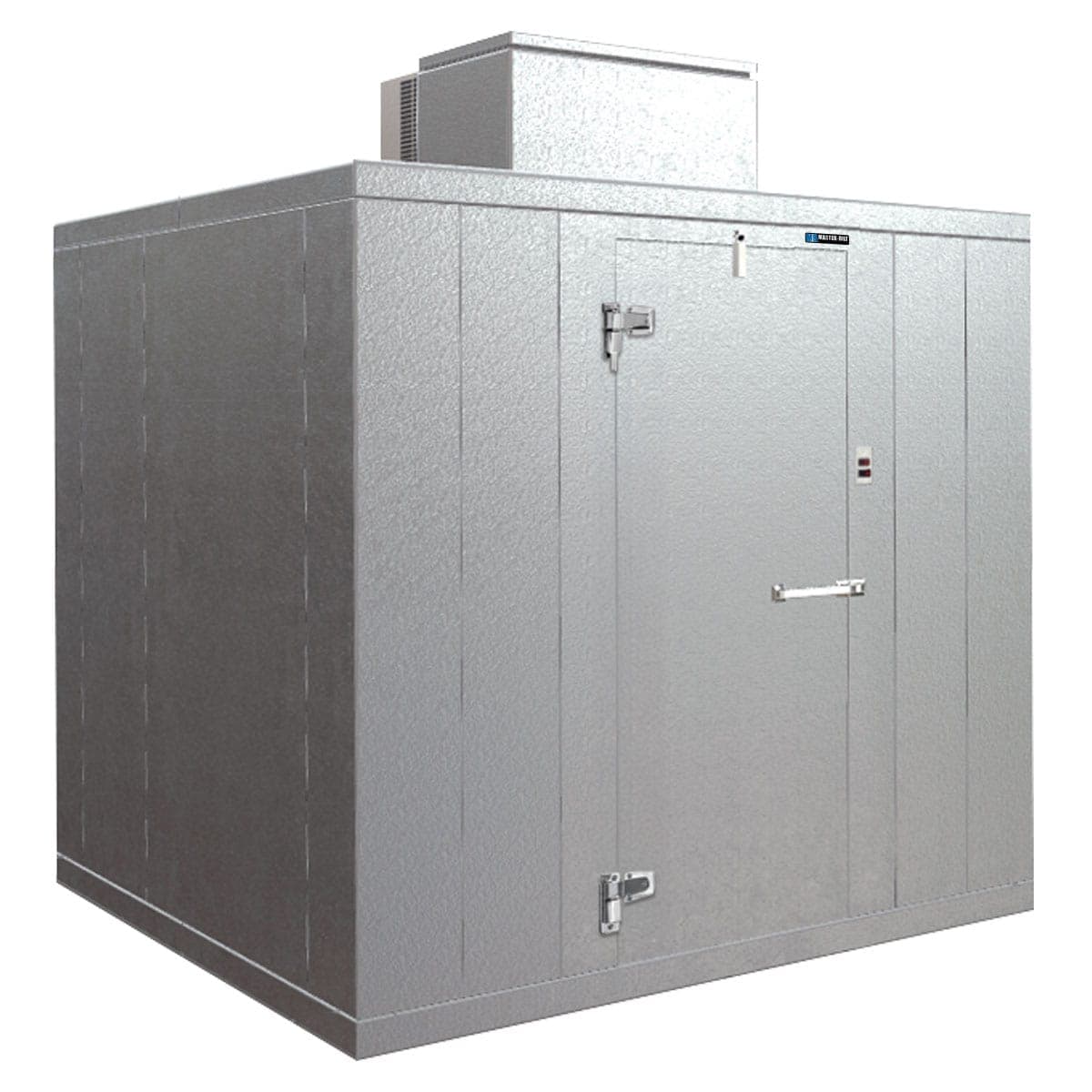
A walk-in is built to order from insulated panels, so you choose its size, panel thickness, floor, doors and refrigeration rather than picking a model. Decide the type and the footprint first, then where the refrigeration unit sits, and get it priced from a drawing.
Key takeaways
- Choose the type first: a cooler holds food at about 2 to 4 °C, a freezer at −18 °C or colder, and a combo puts both behind one entry door.
- Size it from what you hold between deliveries at your busiest, then add aisle space: shelving takes 18 to 24 inches down each wall.
- A freezer always needs an insulated floor. A cooler on a level concrete slab at ground level can often go without one.
- Self-contained refrigeration is simpler to install; a remote unit puts the heat and noise outside and suits larger boxes.
- Panels sold in Canada must meet federal minimum insulation values: about R-25 for cooler walls, R-32 for freezer walls and R-28 for freezer floors.
Cooler, freezer or combo
A walk-in cooler holds chilled food at about 2 to 4 °C: produce, dairy, meat, prepared food and drinks. A walk-in freezer holds frozen food at −18 °C or colder. The two are built the same way, from insulated panels that lock together, but a freezer has thicker insulation, an insulated floor, a heated door frame and a refrigeration system with a defrost cycle sized for the lower temperature.
A combo is one box divided by an insulated partition, with a cooler room and a freezer room. The usual layout puts the freezer behind the cooler, so the freezer door opens into chilled air instead of into the kitchen. That keeps frost off the freezer coil and saves one outside door. Each room has its own refrigeration system.
If you are replacing two or three reach-in refrigerators with one room, start with a cooler. If your menu leans on frozen product, or you buy frozen in bulk, a combo usually costs less than two separate boxes and takes less floor space.
How to size a walk-in
Size the box from your deliveries, not from your seat count. Work out how much chilled and frozen product you hold on the day before a delivery in your busiest week, then lay that out on shelves. A kitchen that receives produce and dairy three times a week needs far less room than one that receives a single weekly truck.
Then add the space people need. Wire shelving is usually 18 or 24 inches deep, and an aisle wants about 36 inches between shelves so a person can turn with a case in their arms. That is why a box 6 feet wide works with shelving on both walls and a box 4 feet wide works with shelving on one. Pallet storage needs a wider door and an aisle the pallet jack can turn in.
Height matters as much as footprint. Common box heights run from about 7 feet 6 inches to 8 feet 6 inches and higher; check your ceiling, then leave room above the box for a top-mounted refrigeration unit if you choose one, and for air to move around it. Measure the route in as well. Panels arrive flat and are assembled in place, so a walk-in can go where a one-piece cabinet could not, but the panels still have to turn the corners.
A walk-in does not have to be a rectangle. An L-shaped or U-shaped box can wrap a column or use a corner that would otherwise be wasted, and the panels are cut to suit.
Panels and insulation
Walk-in walls, ceilings and floors are foam-insulated panels with a metal skin on each face, joined by cam locks you turn with a hex key. Four inches is the common thickness; five and six inch panels are used for freezers, for outdoor boxes and where a higher insulation value is wanted.
In Canada, walk-in panels and doors are regulated under the federal Energy Efficiency Regulations. Natural Resources Canada sets a minimum insulation value of RSI 4.40 (about R-25) for cooler wall and ceiling panels, RSI 5.64 (about R-32) for freezer wall and ceiling panels and RSI 4.93 (about R-28) for freezer floor panels. Ask for the panel's rated R-value in writing, and for its flame-spread and smoke ratings, which your building official may ask to see.
The skin is a choice. Embossed white or galvanized steel is the usual finish; stainless steel costs more and is chosen where the box faces customers or takes hard cleaning. The inside and the outside do not have to match.
Floor or no floor
A freezer always gets an insulated floor. Without one, the cold reaches the ground under the slab, the moisture in it freezes and expands, and over time the concrete lifts and cracks. A cooler is different: on a level concrete slab at ground level it can often sit directly on the slab, with the wall panels set in a sealed floor track.
Give a cooler an insulated floor when it sits on an upper storey, on a wood floor, over a heated or humid space, or on a slab that is out of level. A floor also makes the box easier to move later.
A panel floor raises the inside of the box by its thickness, so the entry needs a ramp, inside or outside the door, if carts will roll in. Order a reinforced floor when loaded carts, kegs or a pallet jack will run on it; a standard floor is built for foot traffic and shelving. Floor surfaces run from smooth aluminum to tread plate and stainless.
Further reading
Refrigeration: self-contained or remote
A self-contained system, also called top-mount or penthouse, carries the condensing unit and the evaporator in one factory-charged package that sits on the ceiling of the box. There are no refrigerant lines to run on site, so it is the quickest to put into service. It needs clear height above the box, and it releases its heat and its noise into the room it stands in.
A remote system, also called a split system, puts the evaporator inside the box and the condensing unit somewhere else: elsewhere in the building, outside on a pad, or on the roof. A licensed refrigeration mechanic runs and charges the lines. It costs more to install, but the kitchen stays cooler and quieter, and it is the usual choice for large boxes and for freezers in tight rooms.
Whichever you pick, the system is sized to the box, the temperature, the room around it and how the door is used. A cooler that takes warm deliveries all day, or that has glass display doors, needs more capacity than a storage cooler of the same size opened a few times an hour. Say so when you ask for a quote.
Further reading
Doors and what goes inside
The standard entry is a hinged swing door about 34 or 36 inches wide and 78 inches high, with a closer, a latch that can always be opened from inside, and a heated frame on a freezer. Go to 42 or 48 inches for carts and pallets. Sliding, bi-parting and roll-up doors are made for wide openings and busy receiving areas.
- Hinge side: choose it so the open door does not block the aisle outside.
- A window in the door lets staff see who is on the other side before they push it open.
- Strip curtains hold the cold in while the door stands open during a delivery.
- Kick plates and frame guards protect the door where carts hit it.
- Glass display doors turn one wall of a cooler into a merchandiser, as in a convenience store or a beer cave.
- Lighting: LED fixtures inside with a switch by the door.
- Shelving: epoxy-coated or polymer wire shelving stands up to the damp better than plain chrome.
Indoor or outdoor
An outdoor walk-in frees floor space inside the building and is common behind restaurants, grocers and breweries. It needs more than an indoor box: a level concrete pad, a weather roof or membrane over the ceiling panels, a rain hood over the door, and a refrigeration system with the controls to run through a Canadian winter, when the air outside is colder than the air in the cooler.
Tell the supplier the box is going outside and where in Canada it is going. Snow load, wind and the lowest winter temperature change how the roof and the refrigeration are built.
Further reading
Power, permits and installation
Every system has a data plate that states its voltage, phase and current. Small self-contained cooler systems may run on a single-phase circuit; larger systems and many freezers want 208 volt three-phase power. Have an electrician confirm the panel has the capacity before you order, because changing the electrical service costs more than any option on the box.
A freezer evaporator defrosts several times a day, and the melt water has to drain. Plan a drain line with heat on the part that passes through the freezer.
Ask your municipality whether the walk-in needs a building permit, and tell your public health inspector about it during plan review. An outdoor box and a box that changes the building's electrical or mechanical systems are the likeliest to need one.
Panels can be assembled by a contractor with the manufacturer's drawings, but refrigeration start-up belongs to a licensed refrigeration mechanic. On a Norpex quote, installation by the manufacturer's crew is priced as a separate line you can decline.
What drives the price, and how to get one
A custom walk-in has no list price because no two are the same. Five standard sizes are the exception: each is listed below at a set price, with delivery quoted to your address. For any other walk-in, the quote moves with a short list of choices, in roughly this order:
- Size: the square footage of panel, and the capacity of the refrigeration that goes with it.
- Type: a freezer costs more than a cooler of the same size, and a combo more than either.
- Refrigeration: remote systems cost more to buy and to install than self-contained ones.
- Floor: none, standard or reinforced.
- Doors: every extra door, wider door and glass display door adds to the price.
- Indoor or outdoor: the roof, the door hood and the winter controls.
- Finish: stainless steel against white or galvanized.
- Delivery distance, and whether you want it installed.
Products named in this section
- Norpex 6' x 8' Walk-In Cooler with Self-Contained Refrigeration – 7'6" High$13,990
Norpex · NPWC-6X8X7.5-PH-NF
- Norpex 8' x 8' Walk-In Cooler with Self-Contained Refrigeration – 7'6" High$14,490
Norpex · NPWC-8X8X7.5-PH-NF
- Norpex 8' x 10' Walk-In Cooler with Self-Contained Refrigeration – 7'6" High$15,490
Norpex · NPWC-8X10X7.5-PH-NF
- Norpex 10' x 10' Walk-In Cooler with Self-Contained Refrigeration – 7'6" High$16,990
Norpex · NPWC-10X10X7.5-PH-NF
- Norpex 8' x 10' Walk-In Freezer with Self-Contained Refrigeration – 7'6" High$22,990
Norpex · NPWF-8X10X7.5-PH


Common questions
How much does a walk-in cooler cost in Canada?
- It depends on the size, the type, the refrigeration, the floor, the doors and whether it stands indoors or outdoors, so walk-ins are quoted one at a time. Build yours in the Norpex walk-in builder and send it: we get factory pricing and email you a quote with the box, delivery and optional installation as separate lines.
What is the smallest walk-in cooler I can buy?
- Panels are made to order, so a walk-in can be as small as the door and one run of shelving allow: about 4 feet by 6 feet is a practical minimum. Below that size, a two or three door reach-in refrigerator usually stores as much for less money.
Can a walk-in cooler be converted into a freezer later?
- Not easily. A freezer needs thicker or higher-rated panels, an insulated floor, a heated door frame and a different refrigeration system. If you may want a freezer later, say so when you order: building the box to freezer standard at the start costs far less than rebuilding it.
How long does a walk-in cooler last?
- The panels of a well-kept walk-in commonly last for decades, because they have no moving parts. The refrigeration system is the part that wears, and it can be repaired or replaced without replacing the box. Door gaskets, closers and hinges are routine replacement items.
Do I need a permit for a walk-in cooler?
- It depends on your municipality and on the installation. An outdoor walk-in, or one that needs new electrical or mechanical work, is the likeliest to need a building permit. Ask your local building department before you order, and include the walk-in in the plans your public health inspector reviews.