
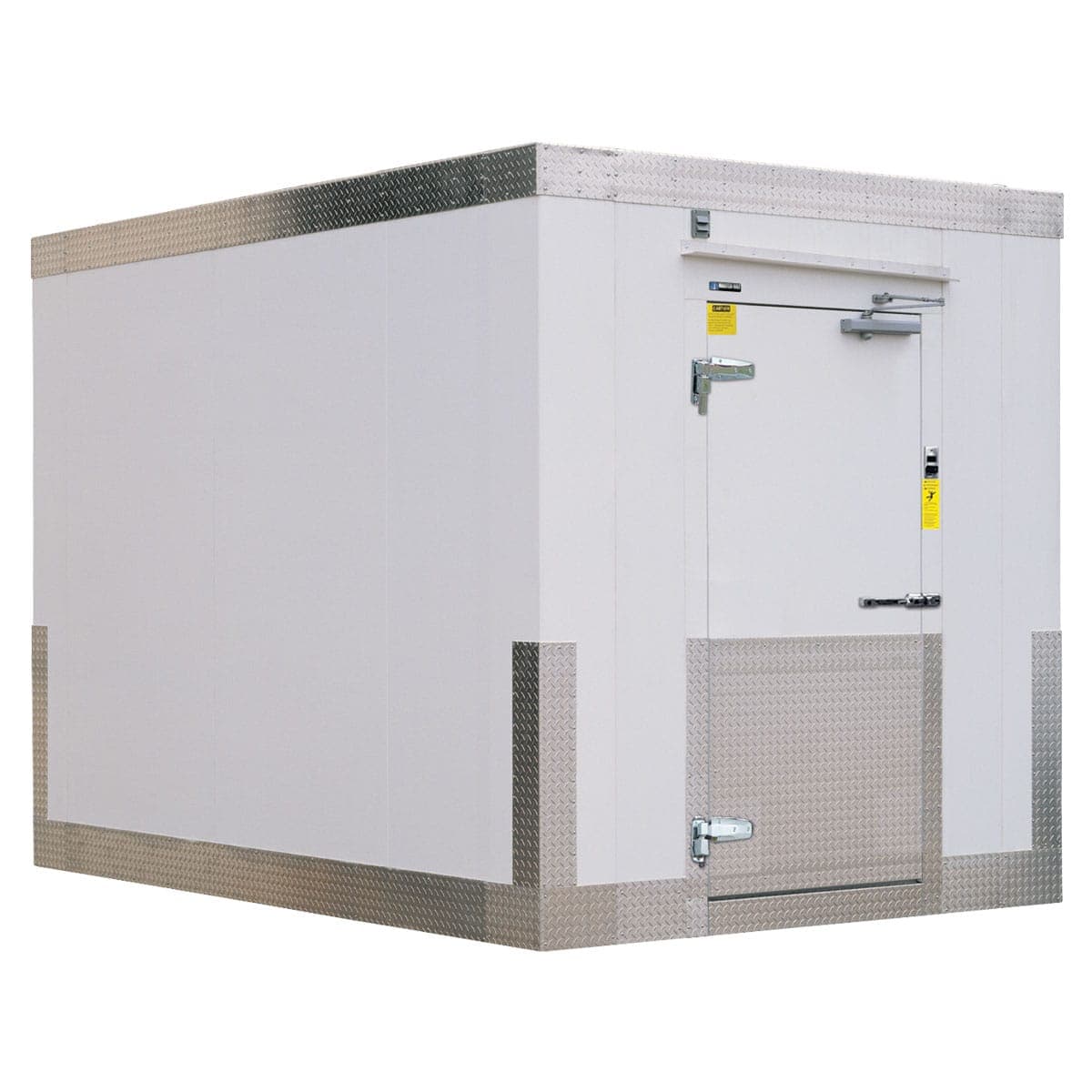
Choose a walk-in cooler for chilled food at about 2 to 4 °C, a walk-in freezer for frozen food at −18 °C or colder, and a combo when you need both and have one stretch of floor. A combo with the freezer behind the cooler is usually the most efficient way to get both.
Key takeaways
- A cooler and a freezer look alike but are built differently: the freezer has higher-rated panels, an insulated floor, a heated door frame and a defrosting refrigeration system.
- A freezer costs more to buy and more to run than a cooler of the same size.
- In a combo, the freezer door opens into the cooler, which cuts frost and saves an outside door.
- Split the space by what you actually stock: most fresh-prep kitchens want more cooler than freezer.
- Decide before ordering: a cooler cannot simply be turned down to become a freezer.
What each one is for
A walk-in cooler holds food that must stay cold but not frozen: produce, dairy, eggs, fresh meat and fish, sauces, prepared food and drinks. It runs at about 2 to 4 °C, which keeps food at or below the 4 °C that Canadian food safety guidance asks for.
A walk-in freezer holds frozen food at −18 °C or colder: frozen meat and seafood, fries, ice cream, frozen dough and bread, and bagged ice. It is storage, not a blast freezer. It keeps frozen product frozen; it is not built to freeze large amounts of warm food quickly.
A combo is a single structure with a cooler room and a freezer room separated by an insulated wall. Each room has its own refrigeration system and its own temperature.
Further reading
How a freezer is built differently
From the outside the two look the same. The differences are in the parts that deal with a temperature about 20 degrees lower.
- Panels: Canada's federal minimum is about R-25 for cooler walls and ceilings and about R-32 for freezer walls and ceilings, so freezer panels are thicker or use a higher-rated foam.
- Floor: a freezer needs an insulated floor, with a federal minimum of about R-28, so the ground under it does not freeze and lift the slab. A cooler on a ground-level slab often needs none.
- Door: a freezer door has a heated frame, and often a heated pressure-relief port, so it does not freeze shut or become hard to open after it closes.
- Refrigeration: a freezer system runs at a lower temperature, uses a larger compressor for the same box and defrosts its coil with electric heaters several times a day.
- Drain: the defrost water leaves through a drain line that is heated where it passes through the freezer.
- Lighting and hardware: fixtures, switches and door closers are rated for the low temperature.
What each costs to buy and to run
For the same footprint, a freezer costs more than a cooler: more insulation, a floor, the door heat and a larger refrigeration system. A combo costs more than either one, but less than a separate cooler and a separate freezer of the same total size, because the two rooms share a wall and usually an entry.
The same order holds for the power bill. A freezer works against a much larger temperature difference, and every door opening lets in warm, damp air that becomes frost on the coil, which the defrost heaters then have to melt. Good habits matter more on a freezer than on a cooler: keep the door closed, hang strip curtains, and do not prop it open during a delivery.
Norpex does not publish a price for a walk-in, because each one is built to its own size and options. The builder takes the size and the choices, and the quote comes back with the box, delivery and optional installation as separate lines.
Further reading
Why a combo puts the freezer behind the cooler
In the usual combo, you walk into the cooler from the kitchen and reach the freezer through a second door in the partition. The freezer door then opens into air at 3 °C instead of air at 25 °C, so far less heat and moisture gets in each time. The coil frosts more slowly, the freezer holds its temperature better, and the box needs only one outside door.
The cost is convenience: every trip to the freezer passes through the cooler. If staff go to the freezer all day, for fries on a busy fry line for example, a side-by-side combo with two outside doors may suit the kitchen better. Either layout can be drawn in the builder, including which wall each door sits on.
Both rooms of a combo with a freezer need thought about the floor. The freezer room always has an insulated floor; the cooler room can match it, which keeps the two floors level with each other, or sit on the slab with a ramp at the partition door.
Further reading
How to split the space
Start from your order sheets. Add up the cases of chilled product and the cases of frozen product you hold just before a delivery, and let that ratio set the split. As a starting point only:
- Fresh-prep restaurants, cafes and salad concepts: mostly cooler, with a small freezer or a reach-in freezer.
- Pizzerias: mostly cooler for cheese, dough and toppings, with a modest freezer.
- Burger, fried chicken and pub kitchens: closer to an even split, because fries, patties and breaded product arrive frozen.
- Bakeries and ice cream shops: freezer-heavy for frozen dough, fruit and finished product.
- Convenience and grocery stores: a cooler with glass display doors on the sales floor side, and a separate freezer or freezer merchandisers.
When a reach-in is the better answer
A walk-in is not always the right purchase. If your frozen stock fits in one or two reach-in freezers, a walk-in cooler with reach-in freezers beside it costs less and uses less power than a combo. And a small kitchen with deliveries several times a week may need no walk-in at all: reach-in refrigerators, undercounter units and refrigerated prep tables put the cold storage at the stations where it is used.
The time to move to a walk-in is when you are buying a third or fourth reach-in, when cases are stacked on the floor on delivery day, or when buying in bulk would save more than the room costs.
What to have ready when you ask for a quote
A walk-in can be priced accurately from a short list of facts. Have these ready, or enter them in the builder, which asks for each in turn:
- The type, and for a combo the size of each room.
- The outside width, length and height, and the shape if it is not a rectangle.
- Where each door goes, its width and which way it swings.
- Self-contained or remote refrigeration, and where a remote unit will sit.
- Floor or no floor, and whether carts or pallets will roll in.
- Indoors or outdoors.
- The delivery address, and whether you want installation priced.
Further reading
Common questions
Can I use a walk-in cooler as a freezer?
- No. A cooler's panels, floor, door and refrigeration system are built for about 2 to 4 °C. Run colder, the door freezes, the floor can frost and lift, and the system cannot hold the temperature. A freezer has to be ordered as a freezer.
Is a combo cheaper than a separate cooler and freezer?
- Usually, for the same total size. The two rooms share an insulated wall and often one outside door, so there is less panel and one fewer door to buy. A combo also takes one stretch of floor instead of two. Each room still needs its own refrigeration system.
What temperature should a walk-in cooler be set to?
- Most kitchens set a walk-in cooler to about 2 to 3 °C so that food stays at or below 4 °C even when the door is opened often. A walk-in freezer is set to −18 °C or colder. Check both with a thermometer placed away from the door and the coil.
Does the freezer in a combo need its own refrigeration unit?
- Yes. A cooler and a freezer run at very different temperatures and on different defrost cycles, so each room of a combo has its own evaporator and its own condensing unit. They can be the same style, both self-contained or both remote, or one of each.