
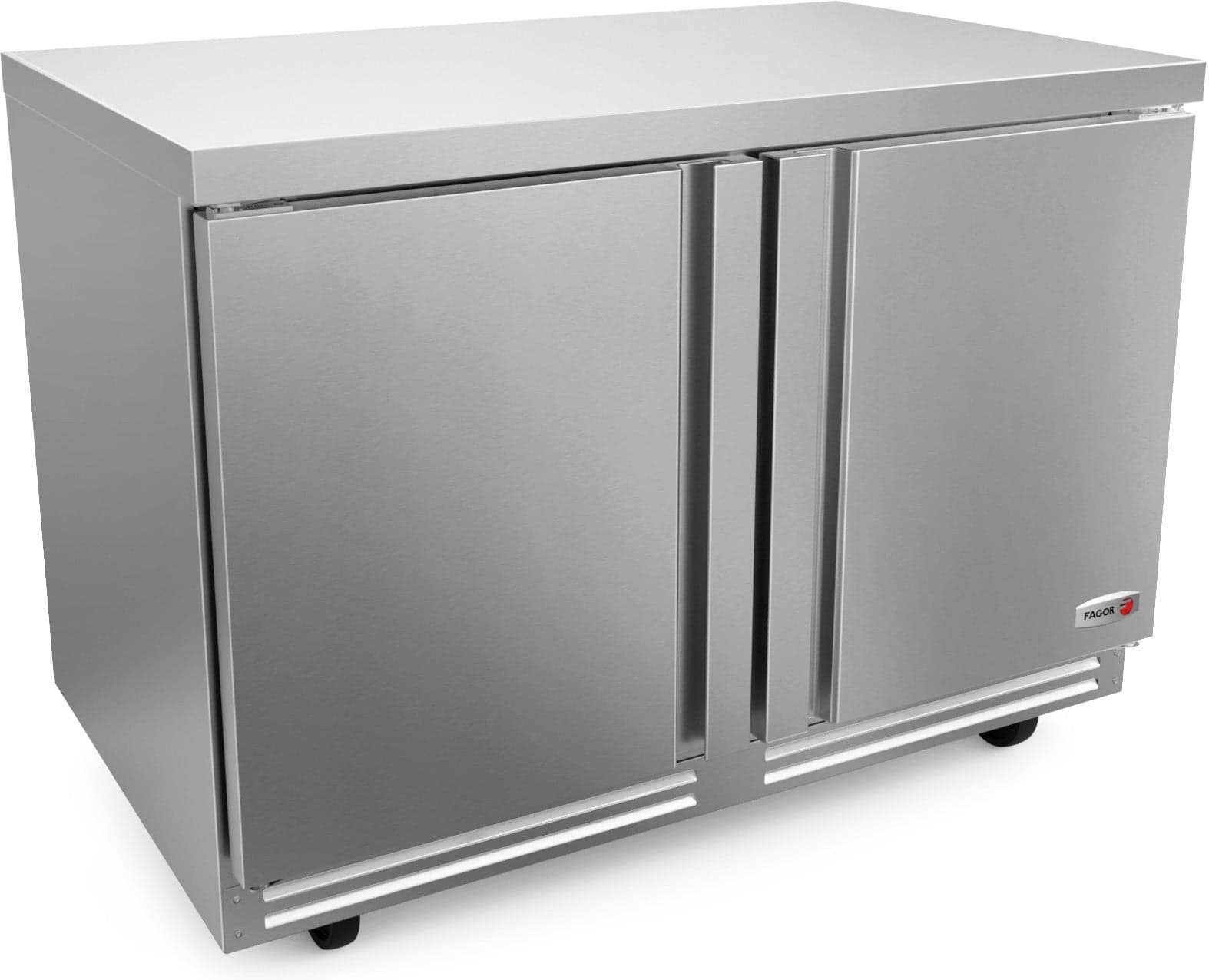
Choose an undercounter refrigerator by the width of the gap under your counter, then by doors or drawers for what you grab, and confirm the ventilation, clearance and plug before ordering. Standard units run about 35 inches tall and plug into a regular 115-volt outlet.
Key takeaways
- Measure the gap first: undercounter units come in widths from 27 to 72 inches, and a 36 in or 48 in cabinet loses a few inches to its walls inside.
- Doors suit bulk storage; drawers suit a station where cooks pull small pans all day, and a drawer unit keeps the cold in better.
- A worktop model has a flat stainless top you can prep on; an undercounter that is built in needs front-breathing ventilation.
- Compare interior pan capacity, not the cubic feet on the label: makers rate cabinets differently.
- Confirm voltage, plug and clearance before you order, because all sales are final.
What commercial undercounter refrigerators cost at Norpex
- Most models
- $3,300 – $7,800
- Median price
- $5,300
- Priced models
- 157
Median by type
- undercounter $5,400 (144 models)
- worktop $4,500 (3 models)
List prices in CAD before tax and delivery, read from the catalogue as it stands. Models without a listed price are quoted on request.
What an undercounter does that a reach-in cannot
An undercounter refrigerator is a low cabinet, about 35 to 36 inches tall, that slides under a counter or stands on its own as a work surface. Its job is cold storage at the station: the proteins, dairy and sauces a cook needs within one step, so nobody walks to a full-height reach-in mid-service.
That makes it a different tool from a reach-in. A reach-in holds back-up stock for the whole kitchen; an undercounter holds the working supply for one station, and a busy line often has several. If you are deciding between the two for a given spot, the short answer is in the undercounter versus reach-in answer, and the reach-in buying guide covers the tall cabinets.
The same cabinet is also made as an undercounter freezer, with the same widths and the same door and drawer choices, so most of this guide applies to both. The temperature section below covers where they differ.
Pick the width: 27, 36, 48, 60 or 72 inches
Width decides everything else, because the gap under the counter is fixed and the cabinet has to fit it. Measure the opening, then measure it again at the back, where a pipe or an outlet box often takes a few inches. A cabinet sold as 48 inches wide is about that wide on the outside, so it needs the full 48 inches plus a little air.
These are the sizes the catalogue shows, with figures read from the product specs:
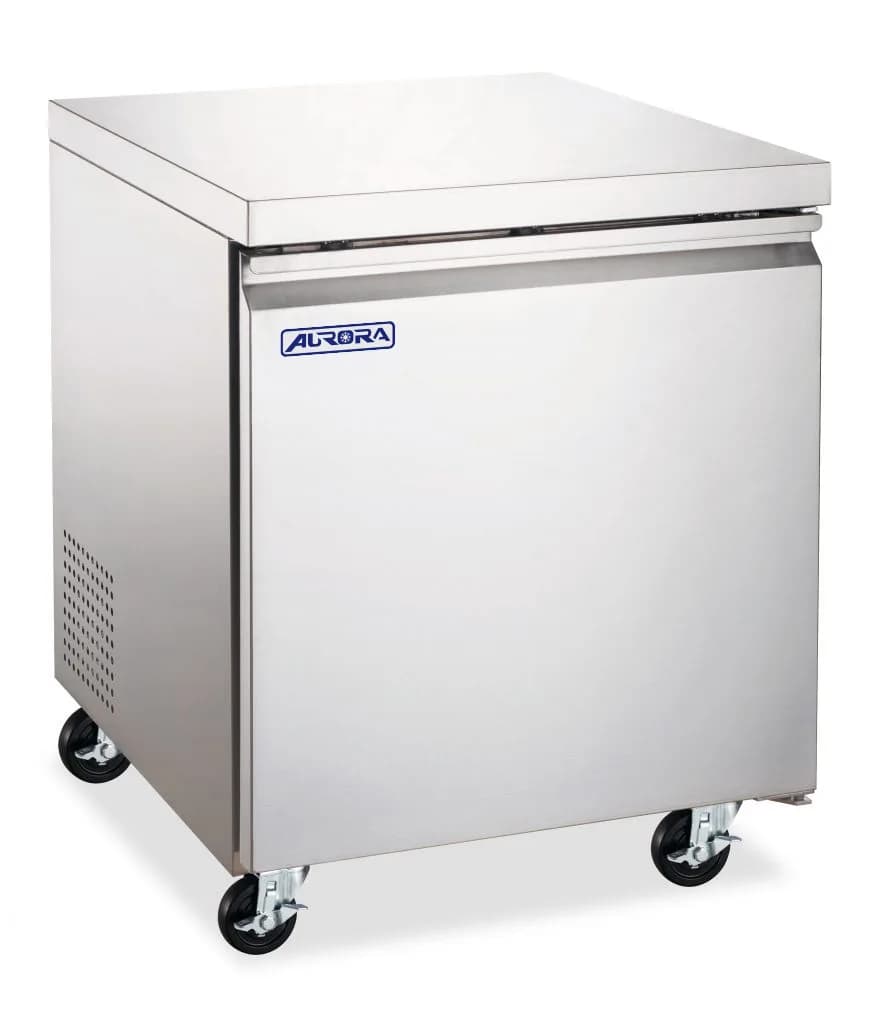
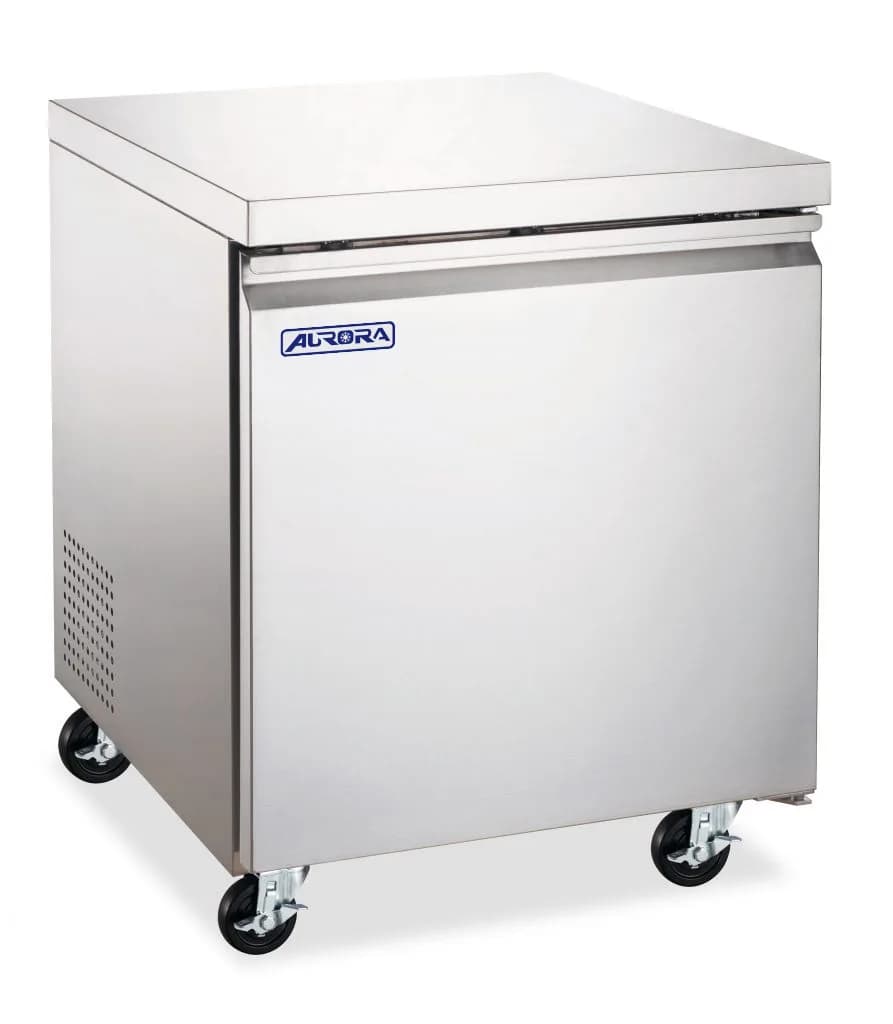
- 27 in, one door: about 6 cubic feet (6.3 cu ft on the Aurora one-door refrigerator and freezer). One shelf, on casters.
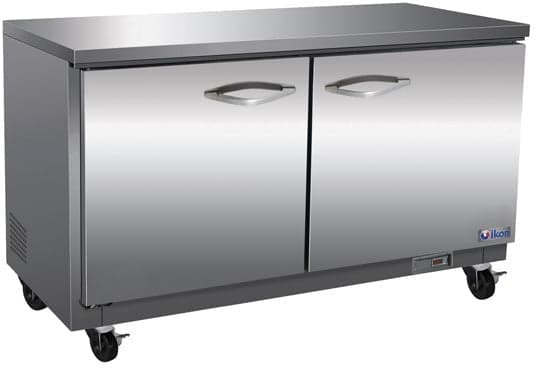
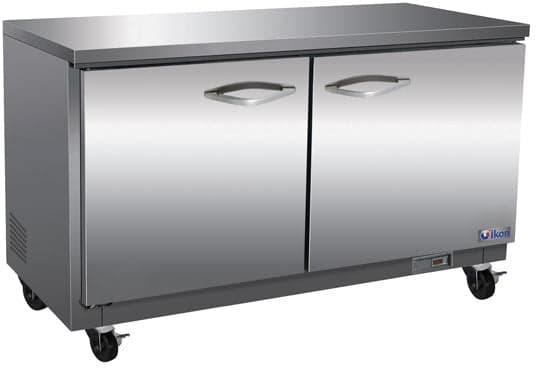
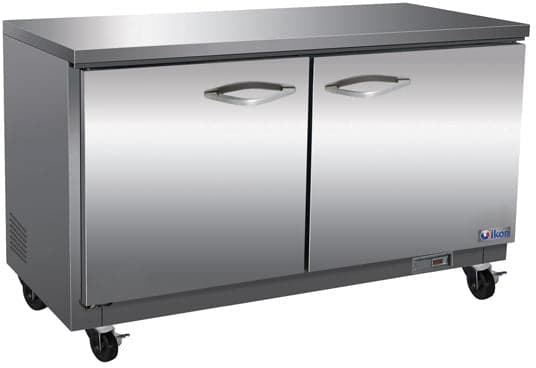
- 36 in, two doors: a freezer width above all. Interior width is about 31.5 in on the Ikon 36 in freezer; the Turbo Air J Series 36 in narrow freezer is rated 5.66 cu ft.
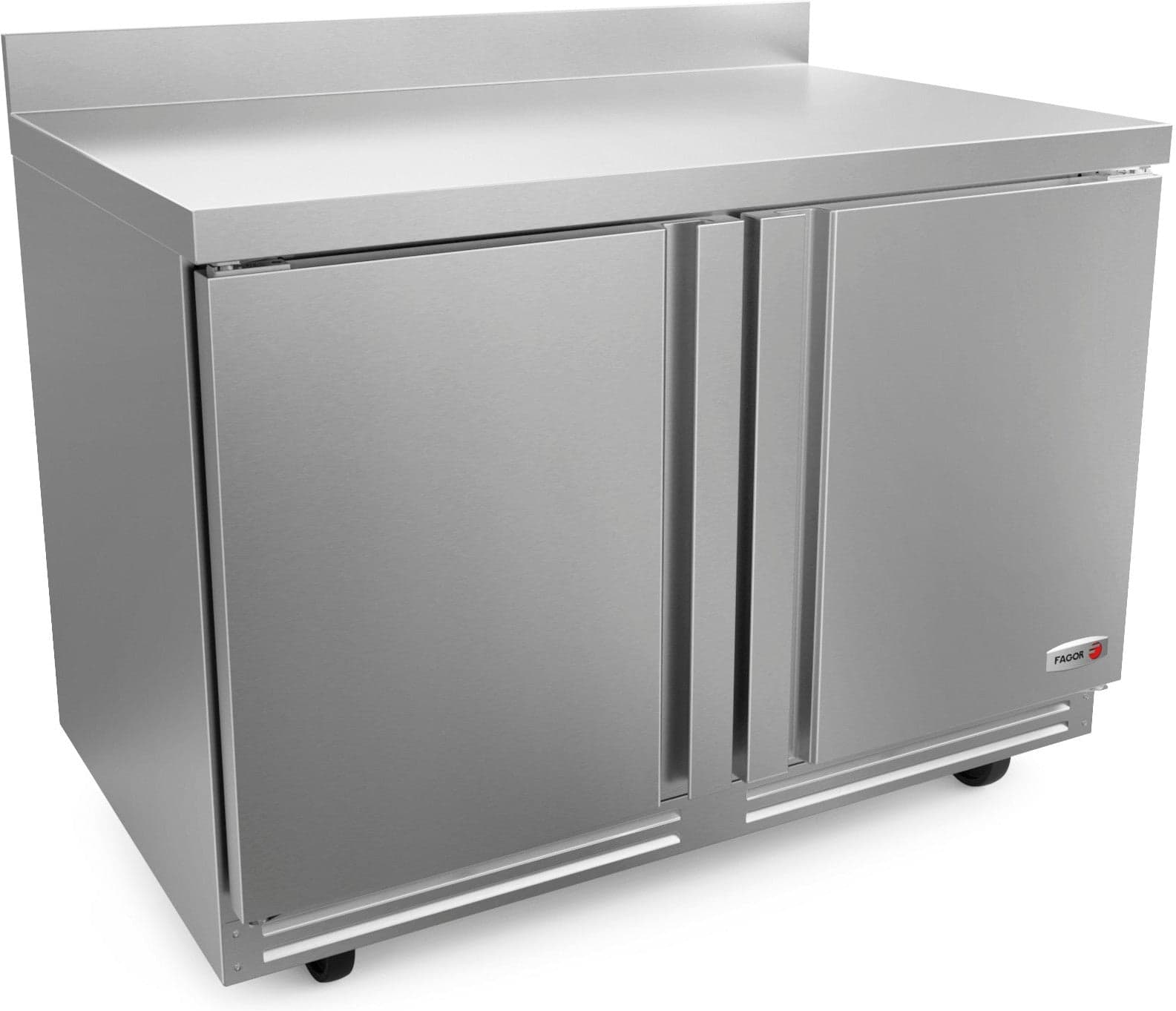
- 48 in, two doors or one door with two drawers: the most common refrigerator size. The Fagor 48 in is rated 16.7 cu ft; the Ikon 48 in is 48.2 in wide, 29.9 in deep and 35.5 in tall.
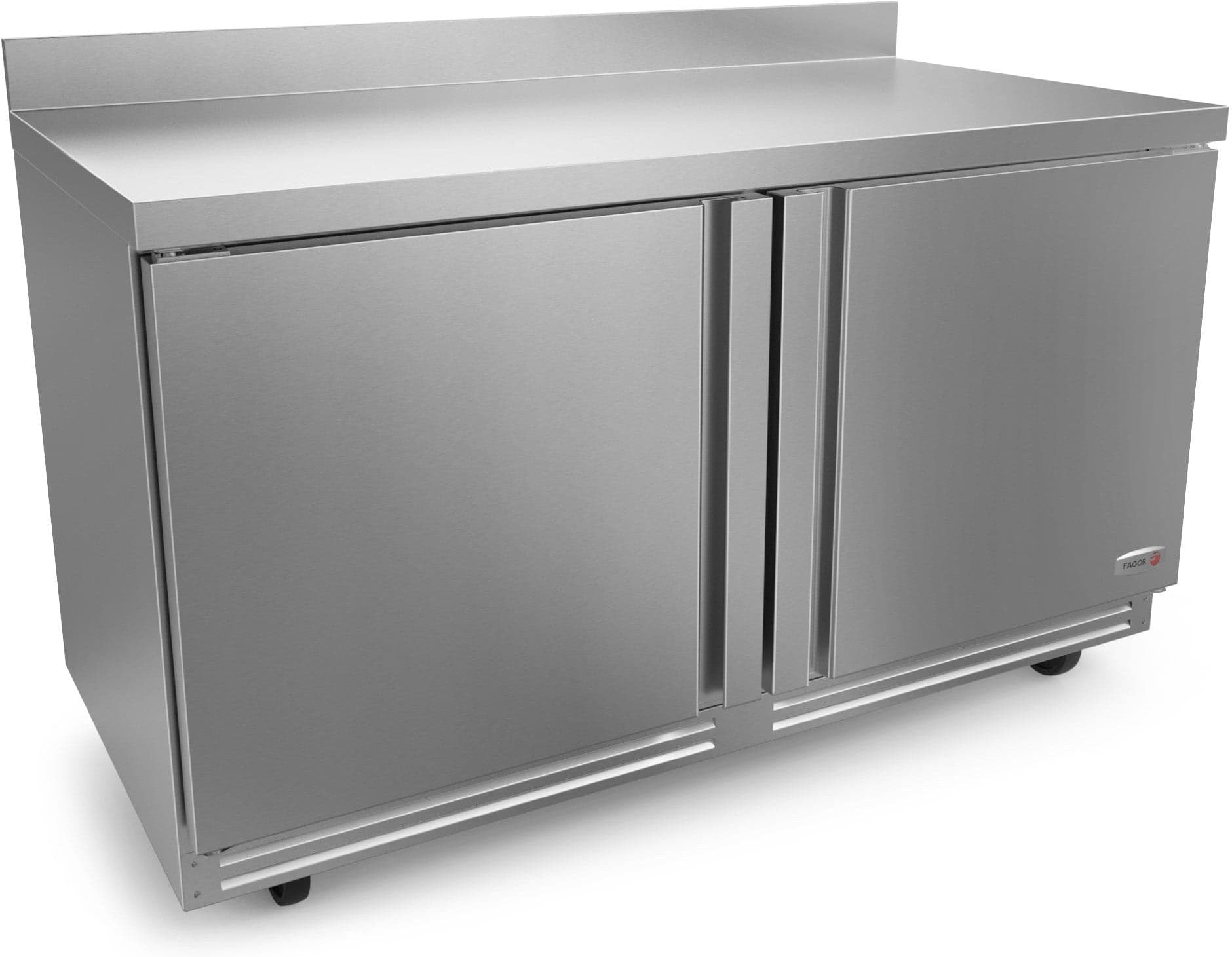
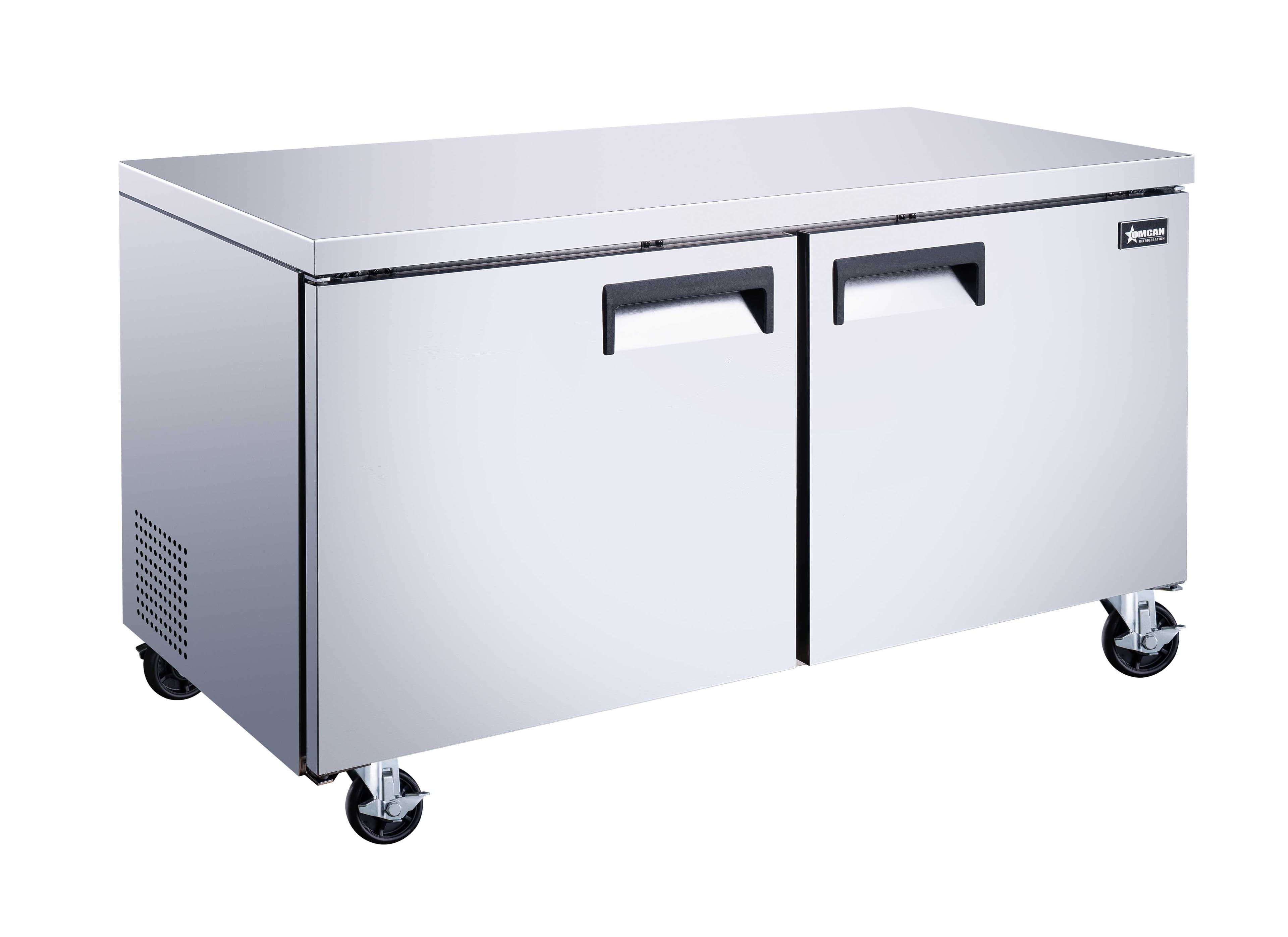
- 60 in, two doors: the freezer rated 15 cu ft in the catalogue is a 60 in unit with two doors.
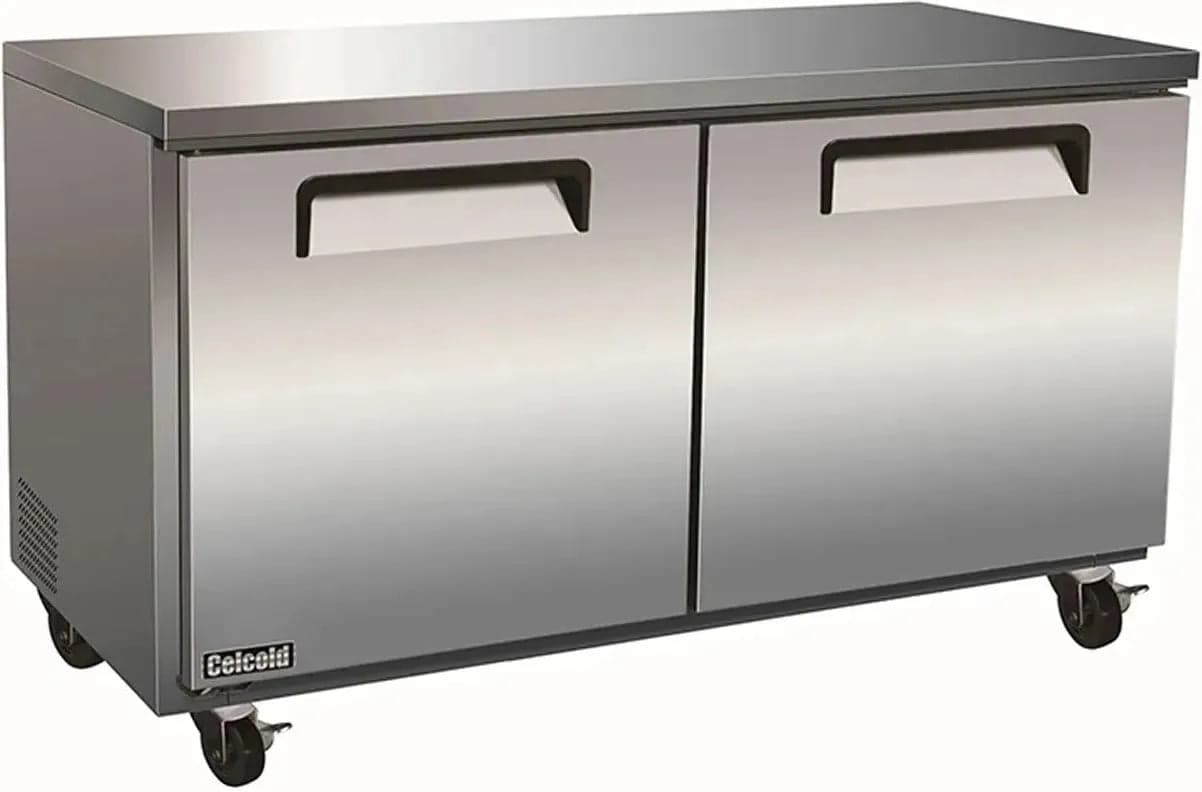
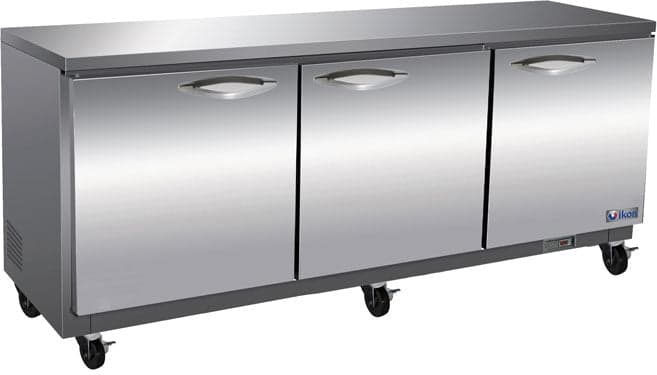
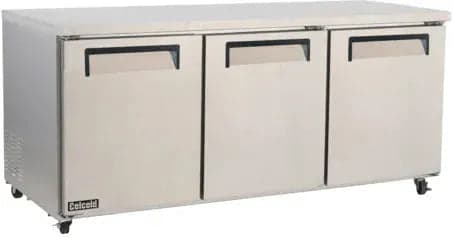
- 72 in, three doors: the Aurora and Omcan 72 in refrigerators are rated 15.5 cu ft, the Celcold 72 in is rated 18 cu ft, and the Ikon 72 in measures 71.7 in wide.
Products named in this section
Why the cubic feet on the label mislead
Look at the sizes above. A 48 in Fagor lists 16.7 cu ft and a 72 in Aurora lists 15.5. The 72 in cabinet is two feet wider and rated lower. Makers measure the interior differently: some count the whole cavity, some count it after the evaporator and shelf rails, and pan slides, drawers and the compressor housing all take space.
So plan from what has to go in. List the pans, the cases and the deli containers for the station on your busiest day, then check how many a cabinet holds: shelf count and shelf capacity (the Aurora shelves are rated 88 lb each) and, for drawers, which pan fits. Fagor's drawer units say each drawer takes a 12 by 18 by 6 inch box or a half-plus-third pan.
Doors or drawers
Doors give the most room per inch of cabinet and fit tall containers. They also open a whole section to the room each time, so the compressor works harder on a station that is opened all service long.
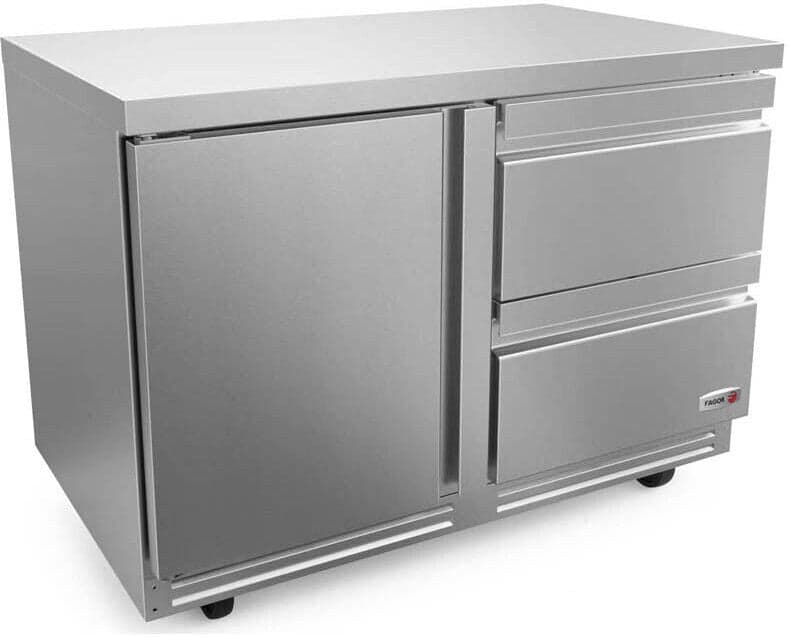
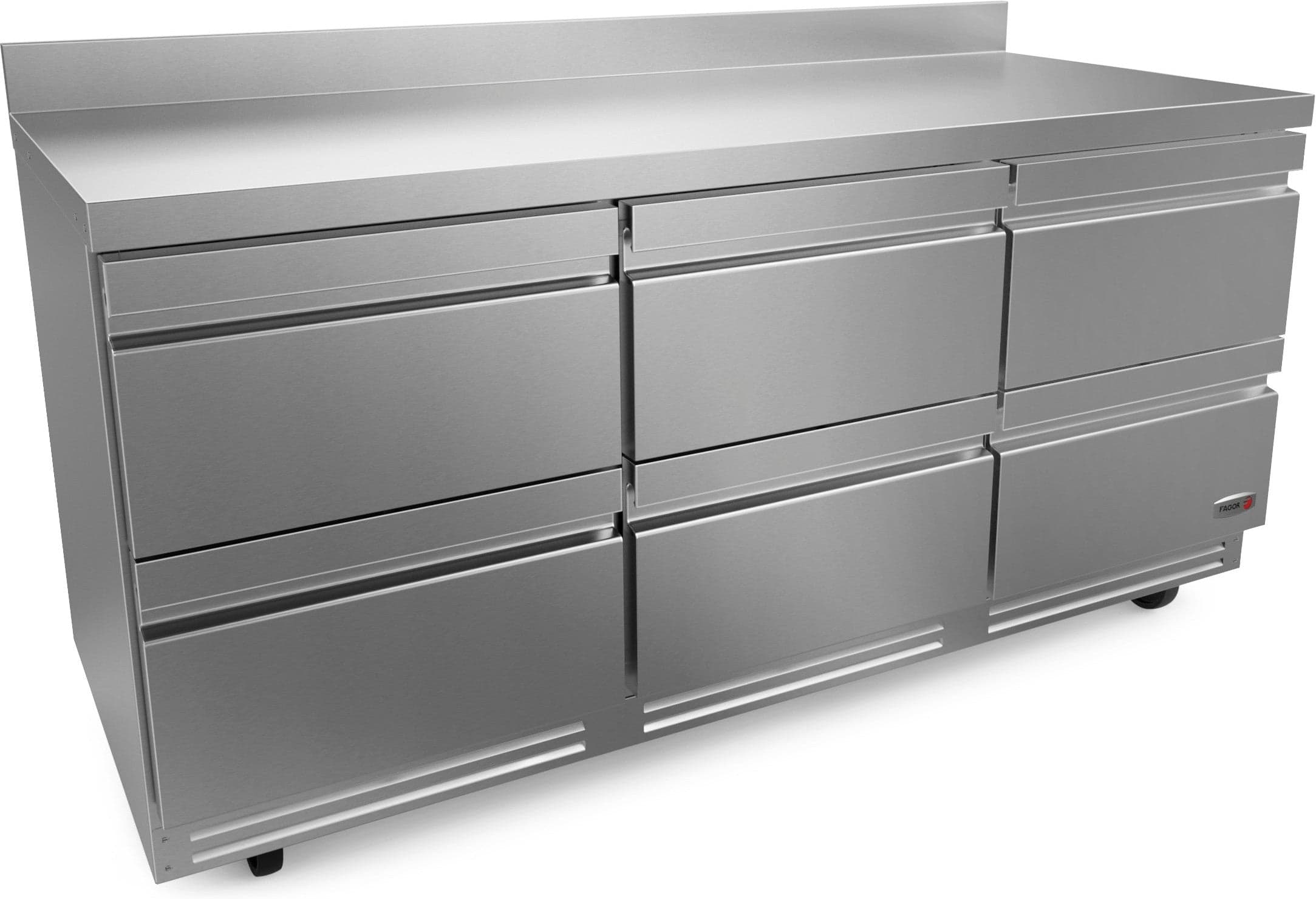
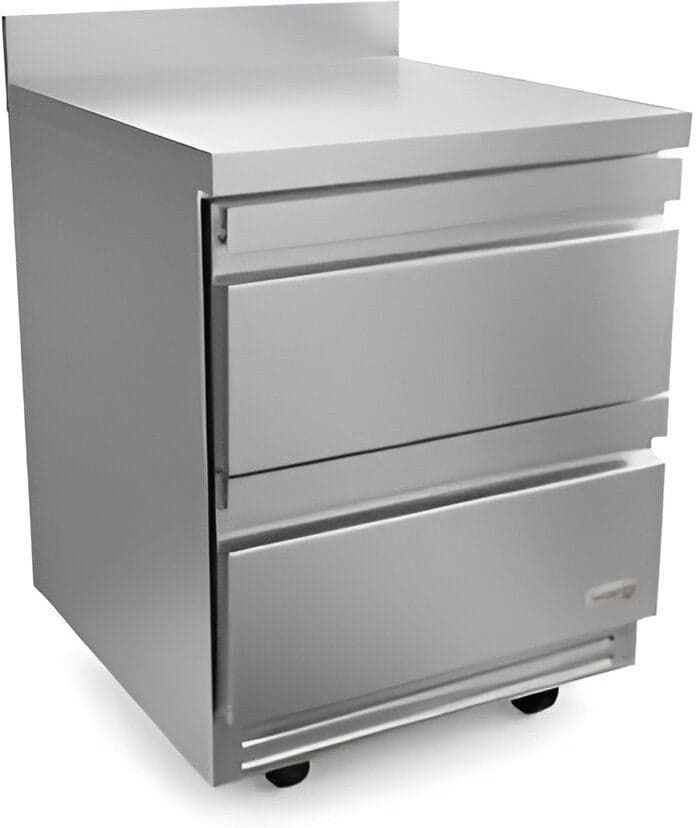
Drawers open only the pan you want. On a grill or sauté station where cooks pull small amounts all day, a drawer unit loses less cold air, keeps pans at a better height and stops things falling out of the back of a deep shelf. The trade-off is that a drawer cannot hold a tall container, and drawers need a pan size you stock, so check the pan size before you choose. Fagor builds both: the FUR series is an undercounter with a door and drawer layout, and the FWR worktop series comes with two, four or six drawers.
Many cabinets mix the two: a door on one side and drawers on the other. If you are not sure, doors on the lower-use stations and drawers where the cooks stand are the usual split.
Products named in this section
Undercounter, worktop or low-profile
A true undercounter has a top that is meant to sit under another surface. A worktop refrigerator has a flat, finished stainless steel top, usually with a backsplash, so it is the work surface and you do not need the counter. If your station has no counter, buy a worktop. If you already have a counter and a gap of about 35 inches, an undercounter saves you the cost of a second top.
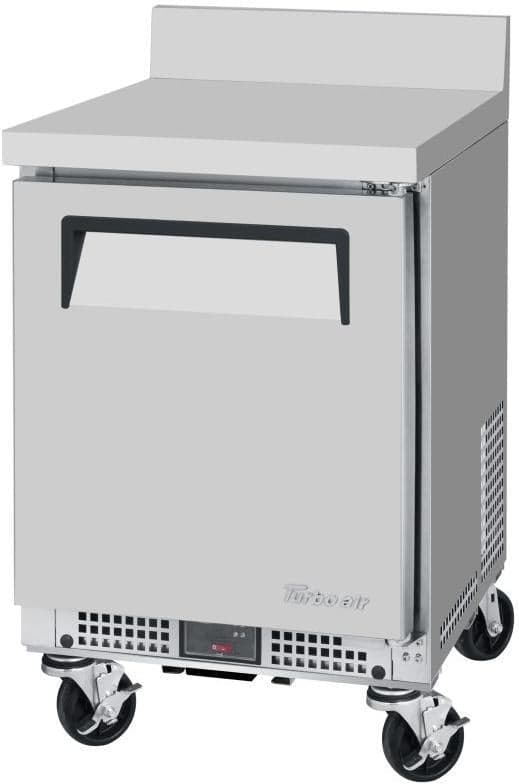
Worktop units come in the same widths: the Fagor FWR series runs 27 in at 9.5 cu ft, 48 in at 16.7 cu ft, 60 in at 20.6 cu ft and 72 in at 25.4 cu ft with six drawers. A shallow worktop such as the Turbo Air MWR-20S, rated 2.29 cu ft, suits a space where depth is the limit. For a station that needs cold pans on top, not below, the prep table guide covers the sandwich and pizza tables.
Products named in this section
Further reading
Refrigerator or freezer, and the room it runs in
A refrigerator holds product at 33 to 41 degrees Fahrenheit (about 1 to 5 degrees Celsius). A freezer holds it at 0 degrees Fahrenheit (-18 degrees Celsius) or colder: the Ikon freezers are rated 0 to -10 degrees Fahrenheit, and the Omcan 60 in freezer lists -8 to 0.
Every unit is rated for the room it stands in. The Ikon freezers, for example, list an ambient range of 40 to 90 degrees Fahrenheit. A station beside a fryer or a pizza oven will push a cabinet to the top of that range or past it, and it will run constantly and read warm. If the spot is hot, choose a unit with a larger compressor and keep it as far as you can from the heat.
A freezer undercounter stores frozen product for a station; it does not replace a reach-in or chest freezer for bulk storage. The freezer buying guide covers the full-height and chest options.
Products named in this section
Ventilation, clearance and power: where orders go wrong
The compressor and condenser sit at the back, the side or the front of the cabinet, and they need air. A unit that vents out the back needs room behind it; a unit built into a run of cabinets needs to breathe through the front, and a unit that was not made for that will overheat in the gap. Turbo Air's J Series puts the compressor on the side, and the Celcold 72 in is listed as a rear-mount cabinet, so read where the air goes before you commit to the spot.
Most undercounters plug into a standard 115-volt, 15-amp receptacle (NEMA 5-15P). The listed units draw about 2 to 5 amps. Stay on a circuit that is not shared with a toaster or a coffee machine, and confirm the cord length reaches the outlet. The cabinet also needs clearance for the door swing: a hinge side against a wall can stop a door opening past 90 degrees. Many models let you move the hinges, but not all.
Before you order, check three numbers: the opening width and height, the delivery route to the spot, and the listed clearances in the installation manual.
Further reading
Mistakes to avoid
Most undercounter problems are not the unit; they are the spot. Check these before you pay, because all sales are final, with no returns or exchanges.
- Ordering to the label width without measuring the opening, the pipes behind it and the doorway the crate has to pass.
- Building a rear-venting unit into a closed cabinet run.
- Placing a refrigerator beside a fryer, a range or a pizza oven, then wondering why it will not hold temperature.
- Choosing doors for a station that needs small, fast grabs, or drawers when you stock tall containers.
- Plugging a freezer and a refrigerator into the same overloaded circuit.
- Forgetting the door swing: hinges on the wrong side, or a swing that hits a prep table.
- Buying a freezer for a refrigerator job, or the reverse. The two look the same from the front.
Further reading
How to buy it from Norpex, and lease or buy
Each product page says whether the unit can be bought online by card or goes to a quote. For a unit that can be bought online, the delivered price, built from live carrier rates, shows at checkout before you pay. Anything that cannot be bought online is priced by a person with freight included, and quotes come back within one business day.
If you are fitting out a whole line, a lease can spread the cost of several cabinets instead of paying for them up front. Financing is available on approved credit. Apply from the financing page and a Norpex rep sets it up within one business day.
Further reading
Common questions
How tall is a commercial undercounter refrigerator?
- Most are about 35 to 36 inches tall, which is what lets them slide under a standard 36 inch counter. The Ikon 48 in unit measures 35.5 inches tall, 48.2 inches wide and 29.9 inches deep. Always read the exact height on the spec sheet before you measure your opening.
What is the difference between an undercounter and a worktop refrigerator?
- An undercounter is built to sit under an existing counter; a worktop has a finished stainless top and usually a backsplash, so it is the counter. Buy a worktop where there is no counter and an undercounter where the counter already exists.
Do undercounter refrigerators need ventilation?
- Yes. The compressor rejects heat into the room, and the unit needs clear air at the vent it was designed for, which can be the back, the side or the front. A unit built into cabinetry needs a front-breathing design; read the installation manual for the clearances.
Should I choose doors or drawers?
- Doors hold more and fit tall containers; drawers open only the pan you need, which keeps cold in on a busy station. Many cooks prefer drawers at the grill or sauté line and doors for general storage.
Can I use an undercounter refrigerator as a freezer?
- No. The two are built differently, with a more powerful compressor and different controls in the freezer, and a refrigerator will not reach freezing temperatures. Buy the model that matches the job; freezers are listed at 0 degrees Fahrenheit or colder.