
This guide explains how to properly install, operate, and maintain Gemm BCB, BCT, and BCC4008 blast chillers, using the manufacturer's manuals for clearances, cycles, cleaning, and troubleshooting.
Key takeaways
- Gemm blast chillers require at least 30 cm (about 12 in) from walls and more if near heat sources.
- Always use a qualified electrician for installation and wait two hours after positioning before powering on.
- The main cycles are chilling and freezing, controlled by time or core probe temperature.
- Clean the core probe before every cycle and the condenser every 30 days, as the BCB manual's maintenance table sets out.
- For any error codes or alarms, consult the manual and contact the manufacturer's authorized service.
Understanding the Gemm blast chiller lineup
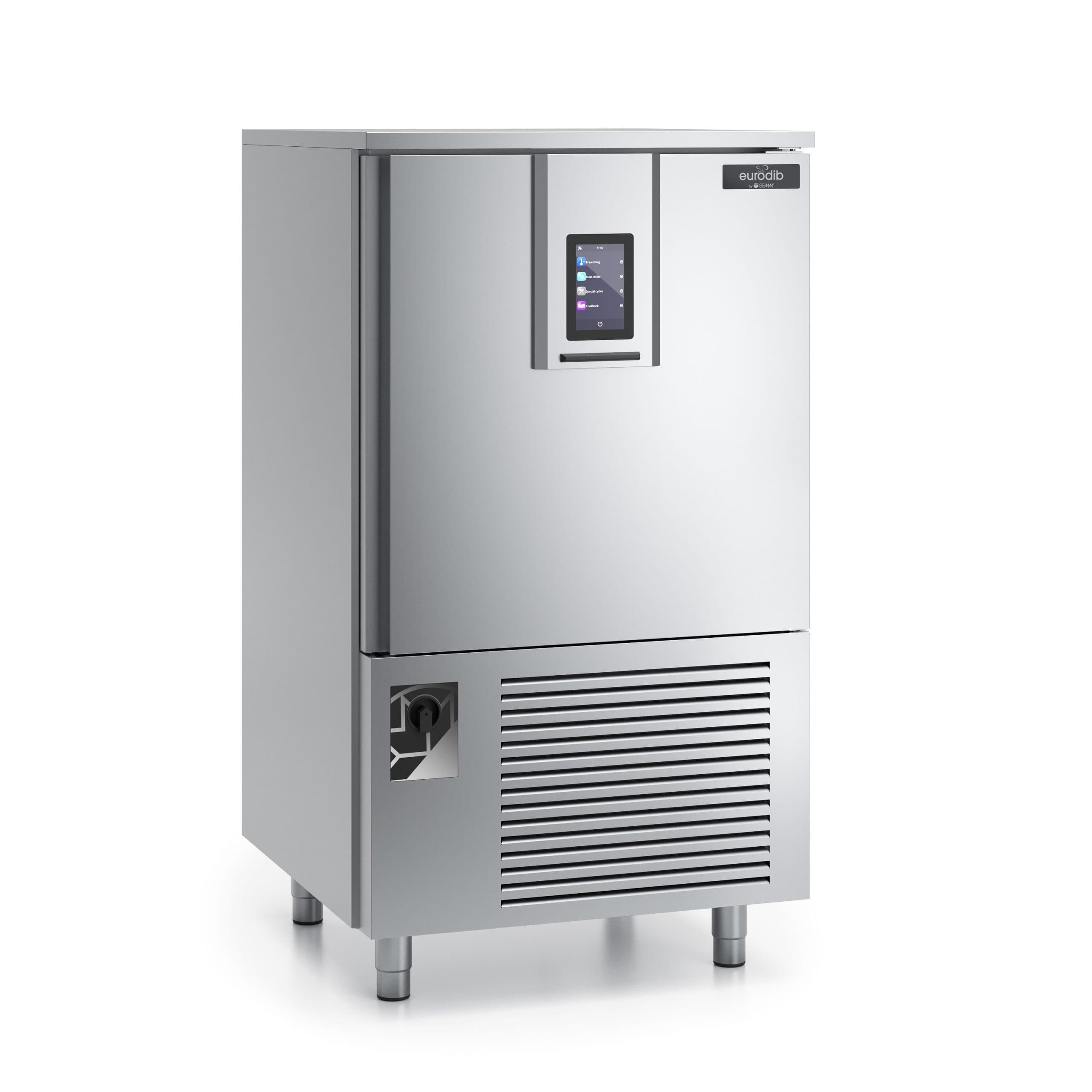
Gemm offers reach-in blast chillers in the BCB and BCT series, plus the BCC4008 trolley model. The BCB series uses the EVJS-824 control panel, while BCT and BCC4008 models feature a full touch control panel. The video "New Runner blast chillers - Basic: how to use the 2.8" digital touch control panel" demonstrates the touch interface on BCT units.
The BCB series includes models with 5, 10, or 15 tray capacities, using R290, R404A, or R449A refrigerant depending on the specific model. For example, the BCB05USN uses R290 on 115 V. The BCT series also offers 5, 10, and 15 tray models, with R290 or R449A refrigerant. The BCC4008 is a larger trolley-loading unit with R449A, 230 V three-phase power, and automatic hot gas defrost.
The spec sheets list the models as cETLus Listed and ETL Sanitation Listed by Intertek, and most as HACCP. Tray capacities are for GN 1/1 or 18" x 26" trays, which are not included with the unit.
Installation requirements
The Gemm user manual for BCB models states that the minimum distance between the appliance and walls must be at least 30 cm (about 12 in). If the chiller must be placed near equipment that reaches high temperatures, provide a space of at least 50 cm (19.6 in) on the side and 70 cm (27.6 in) at the back, or erect an insulating wall. The BCT manual adds that the installation room should have a temperature between 15 °C and 40 °C (59 °F to 104 °F) and relative humidity below 70%.
Electrical connection must be performed by a qualified, licensed electrician in accordance with local codes. The BCB manual specifies that the appliance must be installed per ANSI/ASHRAE 15. The BCB manual lists 115 V, 60 Hz versions with a NEMA 5-20P plug and 230 V, 60 Hz versions with a NEMA 6-20P plug, each on a 9 ft cord, and the BCT manual lists NEMA 5-20P or 5-15P plugs for its 115 V versions; the ID plate on your unit gives its supply. The BCC4008 needs a 230 V three-phase supply.
After positioning the unit, the BCB manual instructs to wait at least two hours before turning it on. This allows the refrigeration system to settle after transport. The appliance must remain upright during handling; never tilt it horizontally.
Daily operation and control panels
The BCB series uses the EVJS-824 control panel, while the BCT and BCC4008 models use a full touch control panel. The video "New Runner blast chillers - Basic: how to use the 2.8" digital touch control panel" shows how to navigate the touch interface on BCT units. Both panel types allow selection of chilling and freezing cycles.
The main cycles are chilling (positive temperature) and freezing (negative temperature). Each cycle can be controlled by time or by a core probe. In temperature-controlled mode, the cycle ends when the core probe reaches the set temperature. In time-controlled mode, the cycle stops after the set duration. The BCB manual also lists special functions: pre-cooling, defrost, fish sanitization, ice cream hardening, and recipe storage.
A door sensor triggers a "DOOR OPEN" alarm if the door is left open beyond a preset time; the display shows the message and an acoustic alarm sounds, and the compressor switches off. On the BCB, holding down the standby button for 3 seconds puts the machine in standby whatever it is doing.
Cleaning and routine care
The BCB manual's routine maintenance table gives the operator four jobs: clean the chamber when needed, clean the outside when needed, clean the condenser every 30 days and clean the core probe at every cycle. For each one the main switch goes to O (off), and for the chamber, outside and condenser the plug is disconnected from the mains as well.
For the chamber, the manual says to clean the inside, the door closure surface and the gasket with a non-abrasive sponge soaked in neutral detergent, rinse with a sponge soaked in water and dry with a clean cloth; proper cleaning prevents bad odours that could affect the product. The outside (steel base and panelling) is cleaned the same way. Use only water and non-abrasive neutral detergent, no abrasive sponges, no cloths that leave lint and no water jets.
Every 30 days the air condenser must be cleaned so that air can circulate freely. The manual says to remove the control panel by loosening its screws, brush the dust and fluff from the fins with a non-metal brush (a vacuum cleaner keeps the dust out of the air), remove greasy deposits with a brush soaked in alcohol, and never scrape the surfaces with pointed or abrasive objects. The condenser has sharp edges, so wear safety gloves, goggles and a face mask.
The core probe must be cleaned before each new cycle so it cannot contaminate the product: remove all residue with a sponge soaked in neutral detergent, rinse with plenty of water and apply a sterilising product. The BCT manual adds a warning not to use mechanical devices or other means to accelerate defrosting other than those the manufacturer recommends.
Troubleshooting common alarms and errors
The BCB manual describes several operator-level alarms. A "DOOR OPEN" message with an acoustic alarm appears if the door stays open beyond a preset time, and the compressor switches off. A sensor on the cooling circuit detects overheating and places the machine on standby to protect components.
If the appliance does not start, check that the power cord is securely connected and that the circuit breaker is on. The display may show error codes; the user manual for the specific model provides their meanings.
For any persistent anomaly, the BCT manual advises to disconnect the appliance from the electrical supply and contact a service centre authorized by the manufacturer. Do not attempt to repair the refrigeration circuit or electrical components yourself.
When to call for service
The manufacturer's manuals state that servicing must be performed only as recommended by the manufacturer. All extraordinary maintenance, such as work on the refrigerant circuit or electrical components, must be carried out by a specialized technician authorized by the manufacturer.
To request service, locate the appliance's ID plate on the outside, bottom right-hand corner of the front. Provide the model and serial number when contacting the manufacturer's after-sales service. Norpex does not perform installations or repairs; for service, reach out to the manufacturer's authorized network.
Videos from the maker
Common questions
What is the difference between BCB and BCT models?
- The BCB models in the user manual use the EVJS-824 control panel; the BCT models have a touch control panel, shown in Gemm's New Runner video. Both take GN 1/1 or 18 x 26 in trays, not included; refrigerant and voltage depend on the model, so check its spec sheet.
How much clearance does a Gemm blast chiller need?
- The BCB manual requires at least 30 cm (about 12 in) from walls. If placed near high-temperature equipment, allow 50 cm on the side and 70 cm at the back, or install an insulating wall.
How often should the condenser and core probe be cleaned?
- The BCB manual sets the condenser at every 30 days and the core probe at every cycle. Clean the condenser fins with a non-metal brush after removing the control panel, and clean the probe with neutral detergent, rinse it and apply a sterilising product before the next cycle.
How long should I wait before switching a new chiller on?
- The BCB manual says to wait at least two hours after installing the appliance before turning it on. It must also be handled upright: never turn it upside down or place it horizontally.
What should I do if the display shows "DOOR OPEN"?
- Close the door fully. The door sensor shows the message with an acoustic alarm when the door stays open beyond a preset time, and the compressor switches off while it does.