
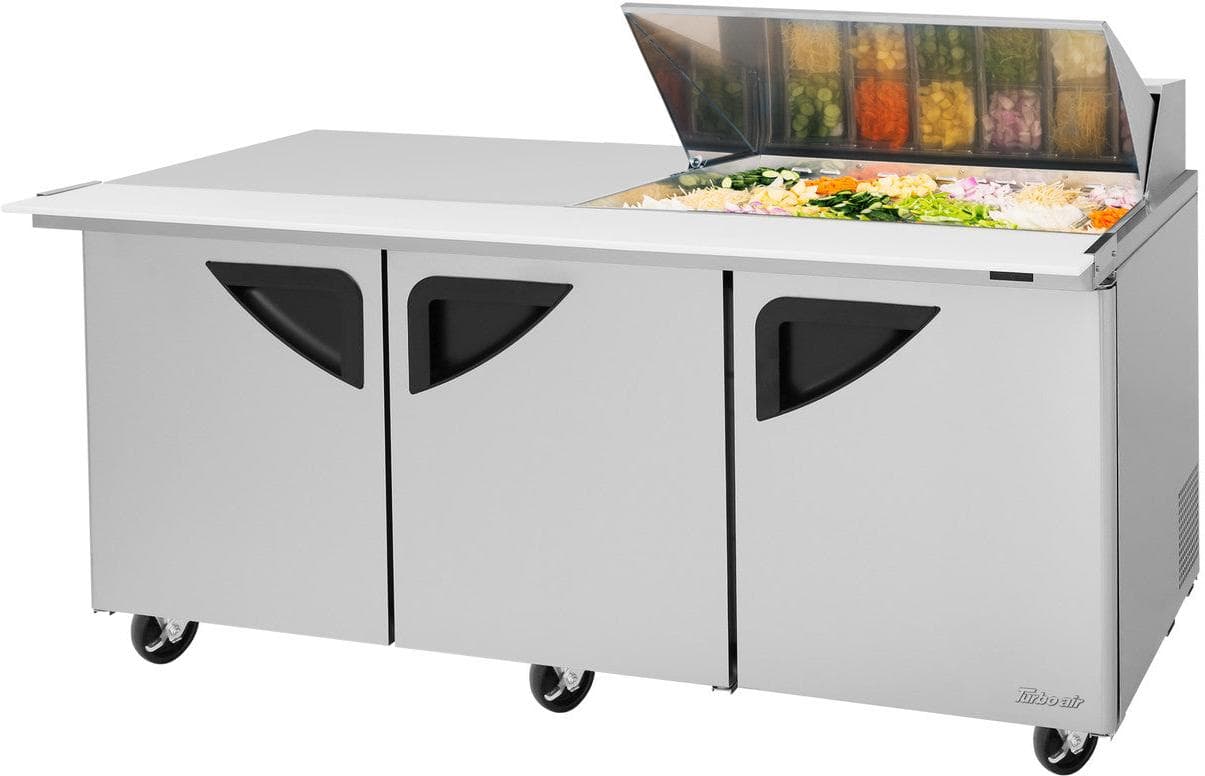
Set up a Turbo Air prep table on a firm, level floor with 5 inches behind it, and run it 24 hours before loading pans. Turbo Air's J Series manual sets the controller default at No. 4. Care means wiping the cabinet and gaskets with neutral detergent and cleaning the condenser at least every three months.
Key takeaways
- The J Series installation and operation manual says to run the unit 24 hours before loading food.
- Keep the rear at least 5 inches from the wall and install indoors where the temperature stays between 50°F and 100°F.
- On J Series units the controller defaults to No. 4, with 1 the warmest setting and 8 the coldest; other series' manuals give their own scale.
- Unplug the unit before cleaning, and clean the condenser fins at least every three months (90 days).
- Route repairs through the manufacturer's authorized service network; hydrocarbon refrigerant units must be repaired only by trained service personnel.
The Turbo Air prep table lines
Turbo Air's prep tables in our catalogue span the Super Deluxe, PRO, M3, E-Line and J series in sandwich/salad, Mega Top and pizza configurations. The PRO Series PST-60-24-N is a 60.25 inch Mega Top unit with two solid doors that holds 24 pans and 19 cu. ft. of net capacity. The M3 Series MST-36-N6 is a 36 inch two-door sandwich prep table that holds 10 pans, and the J Series JST-48-N holds 12 pans with 11 cu. ft. of net capacity.
The E-Line CTST models are refrigerated countertop salad prep tables. The CTST-1200-13-N accepts 8 sixth-size or 4 third-size pans and runs on 115/60/1 with a NEMA 5-15P plug and a 9 ft cord. The models named here run on 115/60/1 with a NEMA 5-15P plug; refrigerant is R-290 on many models and R-600a on others, such as the M3 Series MST-36-N6.
The steps below come from Turbo Air's J Series installation and operation manual, which covers the JST sandwich/salad units and JUR and JUF undercounters. Super Deluxe, PRO, M3 and E-Line units ship with their own manuals, so check yours where a setting or step differs. The J Series manual warns that R-290 (propane) and R-600a (isobutane) are flammable refrigerants, and that the refrigerant tubing, condenser and evaporator coils are prone to damage while handling, moving, installing and cleaning. Handle the cabinet with care and never start a unit that shows signs of damage.
Placement, casters and levelling
The J Series installation and operation manual says to install the refrigerator on a firm and level floor, and that Turbo Air recommends the rear of the unit be no less than 5 inches from the wall. Air must be allowed to flow to the rear and sides of the unit; insufficient space causes vibration noise, inefficient refrigeration and damage to the refrigeration system. Install the unit indoors only, where the temperature is not over 100°F (43°C) or below 50°F (10°C), and away from hot corners such as near stoves.
The manual says to use the casters or legs, to level the unit front to back and side to side, and to keep it stable with the front wheels locked while in use. An unlevel appliance may make unusual noises and cool poorly. Turbo Air covers this in its video How To Install Casters & Level Prep Tables, Undercounters, & Underbar Units.
Plug the unit into a grounded 3-prong wall socket used exclusively for this appliance. The manual says not to use an extension cord or adapter plug, not to cut or remove the ground prong, and the plug must be accessible without moving the unit. It also states that installation work must be performed in accordance with the National Electric Code by qualified and authorized personnel only, so have a qualified, licensed installer make the electrical connection to local code.
First start-up and pan loading
The manual's notice to customer section says you must run the refrigerator 24 hours prior to usage. Turn on the power switch located on the top side of the unit front cover; the display panel will light and make a beep sound, and the compressor will begin to run. If the unit is unplugged, wait at least five minutes before plugging it back in.
When loading, keep product from pressing against the back wall or reaching within four inches of the evaporator compartment, because good air flow in the unit is critical. The manual's loading note sets 110 lb (50 kg) on a shelf, and loads must not overhang the front and rear edges of the shelves. Do not put hot food in the unit, and do not store volatile or flammable substances in it.
The digital controller
The J Series manual says the default temperature setting is No. 4. Set the level toward 1 for higher temperature and toward 8 for lower temperatures. The compressor is automatically cycled by the electronic controller (PCB), and the defrost cycle is automatically controlled by the PCB.
The display panel shows an indicator when the inside temperature is lower than -49°F (-45°C) or higher than 64.4°F (18°C). Turbo Air covers the controller in a set of how-to videos: How To Set The Temperature For Prep Tables & Undercounter Units, How To Change The Fan Option For Prep Tables & Undercounter Units, How To Change The Model Setting For Prep Tables & Undercounter Units, How To Set The PCB For Prep Tables & Undercounter Units, and How To Test The Units For Prep Tables & Undercounter Units.
The button sequences for the fan option, model setting and PCB functions are not spelled out in the J Series manual. The manufacturer's manual for the model gives the steps for the controller shipped with your unit; ask Norpex if you need help locating it.
Daily and weekly care
Unplug the refrigerator before cleaning. The manual says to clean the product with a soft damp cloth, and to use a cloth with a little neutral detergent when it is too dirty; pull out the shelves to clean them. Do not spray water directly at the interior or exterior of the appliance.
For the door gasket, the manual warns that grease and food wastes will destroy the gasket surface, especially the bottom side, and says to wipe it with a cloth with neutral detergent.
For stainless steel, the manual says not to use steel wool, abrasive or chlorine based products. Scrub along the visible polish lines with a soft cloth or plastic scouring pad, use alkaline or non-chloride cleaners, rinse and wipe dry immediately after chlorinated cleaners, and never use hydrochloric acid. The condenser coil must stay free of dust, dirt and grease: the manual says condenser fins should be cleaned at least every three months (90 days) or as needed.
Troubleshooting and service
The manual's troubleshooting guide lists common symptoms, causes and solutions. Work through these before calling for service.
The manual notes that some things are not malfunctions: a water-flowing sound when the compressor stops is the refrigerant flowing, the compressor does not run during the defrost cycle, condensation around the door edge and the front of the cabinet is normal, and gurgling noises inside the circuit are normal.
Before calling for service, the manual says to read the troubleshooting guide, restart the appliance to check whether the fault repeats, and if it persists, switch off and try again after an hour. Then contact service with the nature of the problem and the model and serial number; the serial number is on the rating label on the left interior wall. Repairs must be performed by a qualified and authorized service professional using genuine replacement parts, and hydrocarbon units are to be repaired only by trained service personnel, so route repairs through the manufacturer's authorized service network.
- Cooler is freezing food: the thermostat is set too cold; turn the setting to a higher temperature position.
- The unit does not refrigerate at all: check the power cord and plug it in correctly.
- The unit does not refrigerate well: the condenser may be clogged, the door may be opened too frequently or left open too long, or the unit may contain hot food or too much food.
- There is a loud noise: the floor may be too weak, the levelling feet may be set incorrectly, or the back of the unit may be too close to the wall.
- The door does not close tightly: level the unit again, or reposition the door gasket if it has come off.
Videos from the maker
Common questions
How long should a Turbo Air prep table run before I load food into it?
- The J Series installation and operation manual says you must run the refrigerator 24 hours prior to usage.
What temperature setting should the controller be on?
- On J Series units the default is No. 4, with 1 for a higher temperature and 8 for a lower one. Other series ship with their own manuals; the manual for your model gives its controller's scale and steps.
How much clearance does a Turbo Air prep table need?
- Turbo Air recommends the rear of the unit be no less than 5 inches from the wall, with air allowed to flow to the rear and sides. The manual also says to install the unit indoors where the temperature is not over 100°F (43°C) or below 50°F (10°C).
Can I run a prep table on an extension cord?
- No. The manual says to plug into a grounded 3-prong wall socket used exclusively for this appliance, and not to use an extension cord or adapter plug.
How often should I clean the condenser?
- The manual says condenser fins should be cleaned at least every three months (90 days), or more often if needed, so the coil stays free of dust, dirt and grease.