
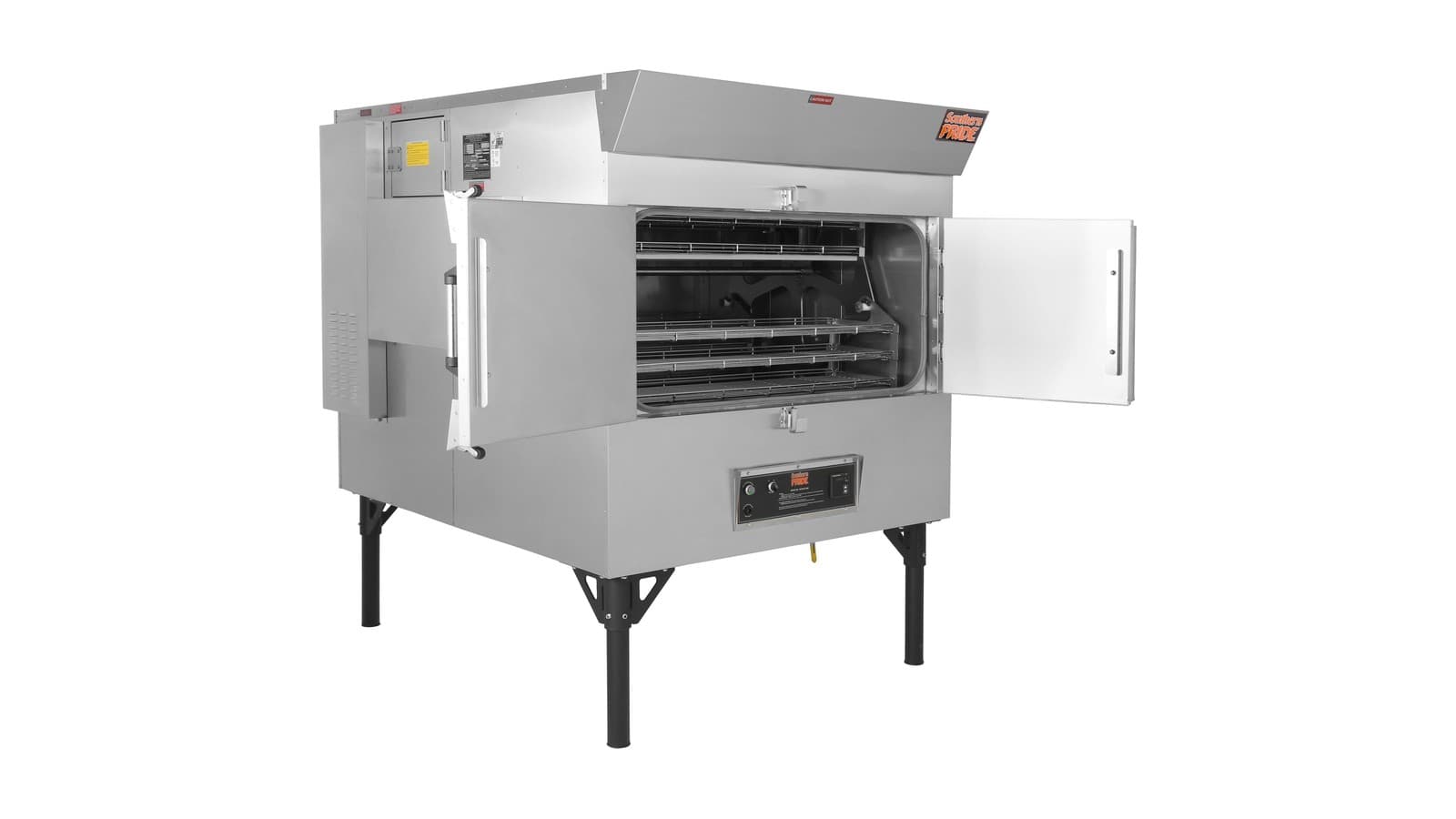
This guide consolidates essential use and care instructions for Southern Pride MLR, SPK, SPX, SRG, and SC series smokers directly from the owner's manuals. It covers proper installation by qualified technicians, daily operating procedures, wood loading, cleaning routines, and what to check before calling for service.
Key takeaways
- Gas-fired models require a qualified service technician for gas and electrical connections according to local codes and the installation manual.
- The SC-100 needs a 120 V, 20 A circuit and the SC-300 a 208 or 240 V, 30 A circuit; the installer works from the data plate and local code.
- The woodchip box on electric smokers must always be in place on the smoke element during operation; remove old ashes before each use.
- Daily cleaning must include emptying the grease drain pan and safely storing ashes in a sealed, non-combustible container.
- For any burner adjustment or internal service, contact the manufacturer's authorized service network—operator adjustments are limited.
Understanding your Southern Pride smoker
The Southern Pride smokers we list fall into three groups. The gas-fired rotisserie models—MLR-150, SPX-300, SPK-500, SP-700, MLR-850, and SPK-1400—are covered by the Gas-Fired Wood-Burning Rotisserie Barbecue Smoker Owner's Manual (Revision 10). Mobile versions of these same models are also available, with the addition of trailer features such as torsion axles and LED lighting.
The stationary rack gas models, SRG-400 and SRG-800, are documented in the Gas-Fired Wood-Burning Stationary Rack Barbecue Smoker Owner's Manual (Revision 7). The electric woodchip-burning models, SC-100 and SC-300, each have their own dedicated manuals (Revision 1 and Revision 6, respectively). Each manual includes unique installation, operation, and maintenance steps, and you should keep the correct manual with the appliance at all times.
Installation and utility connections
Installation of any Southern Pride smoker must be performed by a qualified, licensed installer in compliance with all local codes and the owner's manual. The gas-fired rotisserie manual specifies minimum clearances to combustible materials: 18 inches at the back, 18 inches on top, 48 inches at the front, 24 inches on the firebox door side, and 18 inches on the service bay side. With a through-the-wall insulation kit, the smoker can be in direct contact with the combustible wall, reducing clearance to zero on that surface. The stationary gas models (SRG series) require 18 inches at the back, 18 inches on top, 48 inches in front, and 2 inches on the right and left sides. Both electric models require at least 2 inches of clearance on all sides and must not be exposed to rain or snow.
Gas and electrical connections must be handled by a qualified technician. All gas models use a 1/2-inch NPT inlet and require supply line pressure within specific ranges: natural gas 4.5 to 10.0 inches W.C., and liquid propane 11.0 to 13.0 inches W.C. The gas supply line must be sized according to the piping charts in the installation manual; for example, a 1/2-inch schedule 40 pipe at 20 feet can deliver up to 120,000 Btu/hr for natural gas. The smoker's chassis must be grounded, and the power must be left off during installation. The gas-fired rotisserie models and stationary models require a 120-volt, 15-amp circuit with a NEMA 5-15P plug.
The SC-100 electric smoker requires a 120-volt, 20-amp dedicated circuit, as stated in its owner's manual. The SC-300 manual specifies a 208 or 240-volt, 30-amp circuit; the installer works from the data plate and local code. Venting must comply with NFPA 96 and be approved by local authorities. A Type-1 canopy hood is typically required; the manufacturer recommends a canopy overhang of 18 inches on the loading side and 6 inches on other sides for stationary electric models.
Wood fuel and ash handling
Gas rotisserie and stationary models burn solid wood logs. The MLR-850 specification states the firebox holds 1 to 3 logs (1.5 cubic feet). The electric SC-100 and SC-300 models use a woodchip box that sits on the smoke element. The owner's manuals warn that the woodchip box must be installed on the smoke element at all times during operation; failure to do so can damage the element. Before each use, old coals and ashes must be removed from the woodchip box, as they can block proper smoke generation and create a fire hazard. Do not overload the box. The solid fuel must be handled according to NFPA 96.
Ashes from all models must be stored in a non-combustible container with a sealed lid and kept in a well-ventilated area, because fumes can be hazardous. The gas manual explicitly instructs that ashes should not be stored inside the building in open containers. For cold smoking on the SC-100, the manual suggests leaving the thermostat off while turning the smoker switch on, which produces smoke at the lowest possible cabinet temperature.
Daily operation and controls
Each smoker type has a specific start-up sequence detailed in its owner's manual. For the SC-100, the operator's manual outlines these steps in order: ensure the drain pan is empty and in place, load the woodchip box, turn the main power switch on, set the thermostat to the desired temperature, turn the smoker switch on if smoke is wanted, allow the smoker to preheat for 20 to 30 minutes, load product, and close the door. The SC-300 adds a steam pan step (fill with water if equipped) and uses a digital cook-and-hold control instead of separate switches. Once the cook cycle finishes, turn the control off, remove product, and then empty ashes and the grease drain pan.
Gas models feature a main power switch, rotisserie advance switch (and optional foot switch), and either a standard thermostat or an optional cook-and-hold control. The gas rotisserie manual's diagram shows a thermostat and cook-and-hold control; the MLR-850 specification confirms the thermostat range is 140°F to 325°F. The gas stationary SRG-400 manual notes the digital cook and hold control has the same 140°F to 325°F range.
The manufacturer's cooking chart in the SC-100 and SC-300 manuals provides reference temperatures and times: for example, pork butt at 225°F for 10 to 12 hours to an internal temperature of 190°F to 205°F, chicken quarters at 250°F for 2 to 2.5 hours to 165°F, and beef brisket at 225°F for 6 to 12 hours to 190°F to 205°F. These are starting points; actual time depends on product size and desired doneness. A safety note repeated in all manuals: if you smell gas, open windows, do not touch electrical switches, extinguish open flames, and immediately call your gas supplier.
Cleaning and routine care
All Southern Pride owner's manuals stress that proper cleaning is critical to prevent grease or solids buildup, which can cause a fire. The manufacturer's warning states: 'IT IS EXTREMELY IMPORTANT TO FOLLOW THE PRESCRIBED CLEANING INSTRUCTIONS.' Daily cleaning on both gas and electric models includes removing the grease drain pan, emptying it, and cleaning the pan. After every cook, ashes must be removed from the firebox or woodchip boxes and placed in the appropriate sealed container. The interior of the smoker cabinet should be wiped down to remove grease spatter; never spray water directly on electrical components.
Each manual has a maintenance section for the periodic tasks. The video 'Southern Pride Gas Rotisserie Smoker Operation and Maintenance' demonstrates the cleaning process for rotisserie smokers, and 'Southern Pride SRG-400 Operation and Maintenance' does the same for the SRG-400 stationary model. Operators should regularly check that the rotisserie wheels and drive system move smoothly, which requires the smoker to be level. The gas piping and burner area should be inspected only by a qualified technician as part of a scheduled maintenance plan.
Troubleshooting and service
If the smoker will not heat, check that the main power switch is on, the thermostat or control is set, the circuit breaker has not tripped and, on gas models, that the gas supply valve is open. The gas manuals' burner troubleshooting walks through the ignition sequence (thermostat call for heat, high-limit switch, blower, ignition module, pilot and main valve) for a qualified service technician.
The manuals are explicit: gas burners need a qualified service technician for setting and adjustment, and if a burner does not seem to be working properly, do not adjust it yourself. On electric models the high-limit switches and relays are for qualified personnel with the power off. Anything beyond these checks goes to the manufacturer's authorized service network.
Videos from the maker
Common questions
What are the clearance requirements for a Southern Pride gas rotisserie smoker?
- The gas rotisserie manual (Revision 10) specifies 18 inches at the back, 18 inches on top, 48 inches in front, 24 inches on the firebox door side, and 18 inches on the service bay side. If using an approved through-the-wall insulation kit, the clearance can be zero on the contact surface.
Can I use a Southern Pride smoker outdoors?
- Yes. The gas rotisserie and stationary manuals state the smoker may be operated outdoors. However, the electric SC-100 and SC-300 owner's manuals explicitly warn 'Do not expose to rain or snow.' All models must be installed with proper ventilation and clearance.
How do I load woodchips in the SC-100 electric smoker?
- According to the SC-100 owner's manual, before loading fresh woodchips, remove all coals and ashes from the previous cook cycle. Place the woodchip box on the smoke element. Do not overload the box. The manual warns the box must be installed on the element at all times during operation or damage may occur.
What temperature should I set to cook pork butt on a Southern Pride smoker?
- The cooking charts in the SC-100 and SC-300 manuals recommend a cook temperature of 225°F for pork butt, with an approximate cook time of 10 to 12 hours, until an internal temperature of 190°F to 205°F is reached for tenderness. Gas models with the digital cook and hold control can be set within 140°F to 325°F.
What should I do if I smell gas while operating a Southern Pride gas smoker?
- Immediately follow the safety instructions in the manual: open windows, do not touch electrical switches, extinguish any open flames, and call your gas supplier. Do not attempt to locate the leak with a flame; use a soap solution as directed in the installation section.