
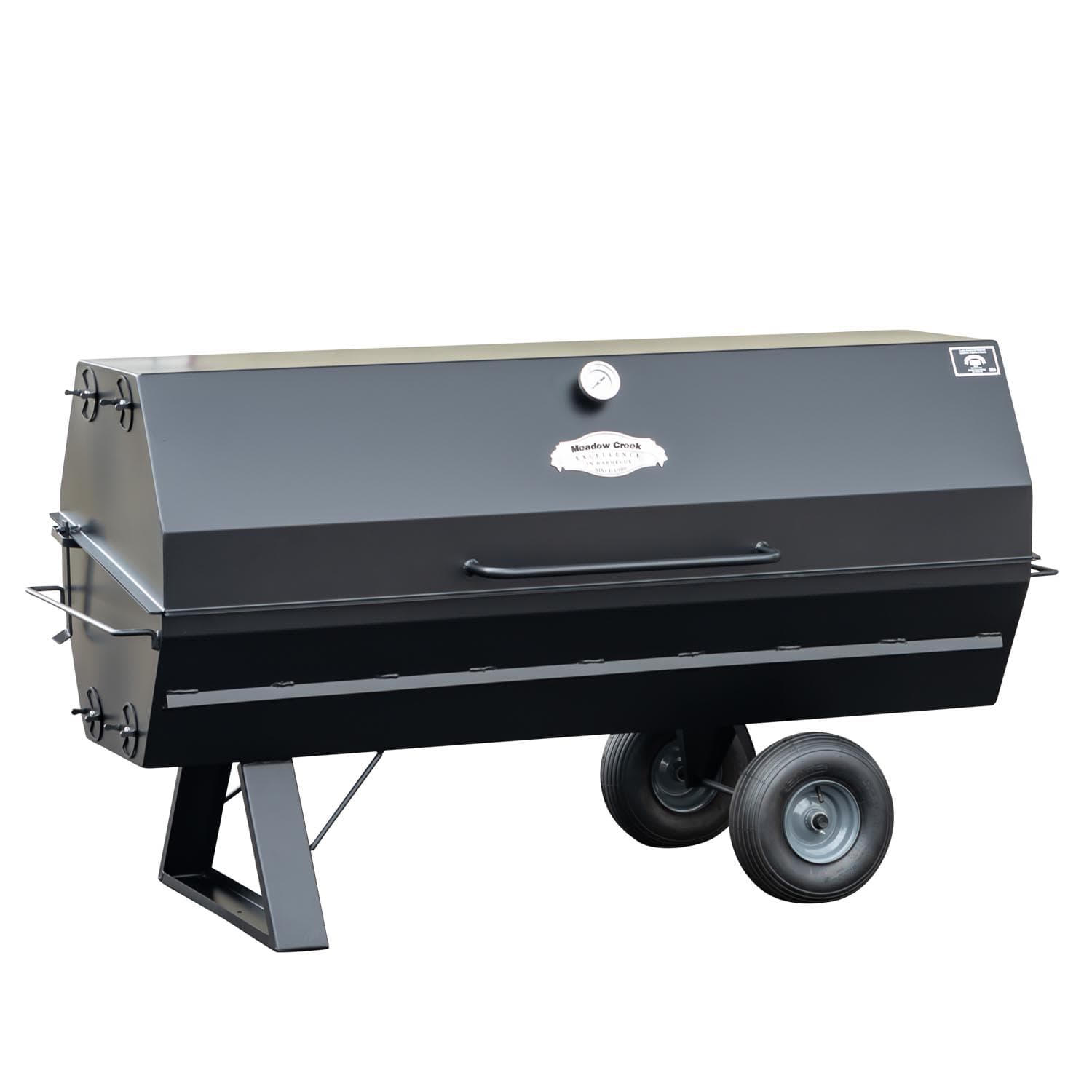
This guide covers the essential steps for breaking in, lighting, cooking, and cleaning Meadow Creek outdoor cookers, from pig roasters and chicken flippers to offset and cabinet smokers, using the manufacturer's own manuals.
Key takeaways
- Always season a new cooker before first use to protect surfaces and improve performance.
- Gas models must be connected by a qualified, licensed installer to meet local codes.
- Use only charcoal lighter fluid or a torch to light charcoal; never use lighter fluid on a cooker with a lid.
- Clean grates thoroughly after each use; do not allow buildup, which can cause corrosion.
- For trailer models, check tire pressure monthly and lubricate wheel hubs once or twice per year.
Which manual covers which cooker
Meadow Creek’s outdoor cooking lineup includes PR pig roasters, BBQ chicken cookers and flatbeds, SQ and TS offset smokers, and BX cabinet smokers. Each series has its own operator’s manual that covers all variants within that family, including gas and trailer-mounted models.
The PR Series Operator’s Manual applies to the PR36, PR42, PR60, PR72 and their gas (PR42G, PR60G, PR72G) and trailer (PR60T, PR60GT, PR72T, PR72GT) versions. The BBQ Series Operator’s Manual covers the BBQ26, BBQ26S, BBQ36, BBQ42, BBQ60, BBQ64P, BBQ96, BBQ144, and the gas flatbeds BBQ36G and BBQ60G. The BX Series Operator’s Manual is for the BX25, BX50, and BX100 cabinet smokers. The TS & SQ Series Operator’s Manual covers the TS70P, TS120, TS120P, TS250, TS500, TS1000 and the SQ36.
Always refer to the manual that matches your model. If you need a copy, ask Norpex.
Break-in and seasoning before first use
Every new Meadow Creek cooker should be seasoned before cooking food. The PR Series Operator’s Manual instructs you to first remove the stainless steel grates and clean them with a general-purpose cleaner and hot water. Spray all interior surfaces with a light coat of cooking oil, build a fire, close the lid, and hold the temperature between 250°F and 350°F for one hour. For gas PR models, simply spray the inside with oil, light the burner as described in the manual, and maintain the same temperature range for an hour.
The BBQ Series Operator’s Manual says to remove the stainless steel grate, spray the whole inside of the cooker with cooking oil, add a small amount of charcoal, and light it with a torch (or the burner on gas models). Close the lid and let the charcoal burn out. For chicken flippers without a lid, burn off approximately 10 lbs of charcoal.
For BX cabinet smokers, the BX Series Operator’s Manual notes that models with a stainless steel interior need no break-in. For the standard BX, place the smoker on a level surface, add a gallon of water, open all vents, add about 20 lbs of charcoal, light it, add one log or a few wood chunks, slide the basket back in, and let the charcoal burn out.
The TS & SQ Series Operator’s Manual describes a different process: remove the stainless steel racks, spray the entire cooking chamber with cooking oil, then build a fire with 10 lbs of charcoal and one log. Heat the smoker to 225°F, then let it rise to 300°F. Open the cooking chamber lid, mist the inside with water, close the lid, and repeat the misting three or four times when the temperature returns to 300°F.
Setting up and lighting
All Meadow Creek cookers must be placed on level ground. For charcoal models, the PR Series Operator’s Manual recommends using a torch to light charcoal because lighter fluid can leave a petroleum aftertaste. If you use lighter fluid, drench unlit charcoal with ¾ to one full quart, let it soak for 5 to 10 minutes, then light with an approved barbecue lighter or long match. Allow the coals to burn until a white ash forms, typically 30 minutes. The BBQ Series Operator’s Manual warns never to use lighter fluid on a cooker that has a lid; instead, use a long-handled lighter or propane torch.
For gas models, a qualified, licensed installer must connect the appliance to the gas supply according to local code. The PR Series Operator’s Manual details the lighting procedure for PRG roasters: ensure the burner shut-off valve and gas safety valve are off, open the tank valve fully, turn the gas safety valve to pilot, hold a long-stem lighter to the pilot, depress the safety valve for about 10 seconds until the pilot lights, then continue to depress for an additional 30 seconds until the pilot stays lit. Replace the drip pan and grate, close the lid, open all vents, and open the burner valve fully. The BBQ Series Operator’s Manual gives a similar sequence for gas flatbeds: check all valves are off, slowly open the tank valve, light the pilots with a long-stemmed lighter, replace burner covers and grates, then open burner valves as needed.
For offset smokers, the TS & SQ Series Operator’s Manual says to open the slide vents on both sides and the rain cap on the stack. Place 20 lbs of charcoal and one good-sized log in the firebox, angle the log, and use a torch to heat the tank while lighting the fire. The tank must be heated to draft properly. Once the smoker reaches 225°F, remove the torch and close the firebox door. The BX Series Operator’s Manual offers three lighting options: wax-type fire starters placed in the charcoal, a map torch aimed at the charcoal from the side, or a weed burner torch inserted into the basket after sliding it into the smoker. Never use lighter fluid in a BX smoker.
Cooking and temperature control
For pig roasters, the PR Series Operator’s Manual provides specific charcoal amounts: a PR-60 cooking a 200 lb live weight (120 lb dressed) pig needs 80–90 lbs of charcoal; a 250 lb live weight pig needs 100 lbs. A PR-42 cooking a 125 lb live weight pig needs 60 lbs. Place the pig belly down on the grate, close the lid, open all vents, and let the temperature rise to 300°F. Then adjust both top and bottom vents to maintain 275°F–300°F. Cooking times vary: at 250–275°F, a 125 lb pig takes 10–12 hours; at 300–325°F, 8–9 hours. The manual says a meat thermometer is the most accurate way to determine doneness, with pork shoulder done at 185°F and the manual’s own thermometer indicating 170°F.
For chicken cookers, the BBQ Series Operator’s Manual recommends ¾ to 1 lb of charcoal per pound of chicken. Pile charcoal in the centre of each ash pan, drench with lighter fluid (½ to ¾ bottle per section), let soak 5–10 minutes, and light. While coals burn, place chicken on grates skin-side all the same direction, season, and lock the grates. When coals are white-edged, spread them, with fewer coals in the middle and more toward the outer edges. Place grates in the turn slots and turn frequently to prevent charring. Cooking takes 1–1½ hours. A clean, low-pressure sprayer can control flare-ups.
For offset smokers, the TS & SQ Series Operator’s Manual says to tilt the smoker slightly forward so grease drains into a bucket. Keep the chimney vent fully open at all times. Adjust the firebox slide vent: generally, a 1-inch opening maintains 225°F. Add hardwood charcoal or wood as needed, preferably pre-lit charcoal for consistent temperature. Approximate cooking times at 225–250°F are: back ribs 2½–4 hours, pork butt or brisket 10–12 hours, whole chicken 2–3 hours. The SQ36 can also be used as a grill: place a charcoal grilling pan in the cooker, pile 10 lbs of charcoal, light, let burn until white, spread, and adjust the vents on both ends of the main chamber.
For BX cabinet smokers, the BX Series Operator’s Manual says to fill the water trough about three-quarters full, open all vents, and add about 20 lbs of charcoal. Once lit, if using a temperature controller (guru), install it in the port and close the vents. Otherwise, leave vents open until the smoker is within 25°F of the target, then close the bottom vents halfway and adjust. Add four or five wood chunks or a small log for smoke. The same approximate cooking times apply as for the TS series.
Cleaning, maintenance, and rust care
All Meadow Creek manuals stress thorough cleaning after each use. The PR, BBQ, BX, and TS/SQ manuals describe cleaning with a 3500 lb pressure washer and a general-purpose household cleaner. Spray the cleaner on warm surfaces, rinse, and let the unit dry completely. Clean the stainless steel grates thoroughly; a household oven cleaner may be used on grates but never on painted surfaces. Wet wood and charcoal ash create acid that corrodes steel, so after coals are fully cooled, dispose of them in a responsible way. Hot coals must go into a safe, covered metal container.
Rust prevention varies by model. The PR Series Operator’s Manual notes the interior is painted to inhibit rust; over time the paint may break down and should be cleaned but not necessarily repainted. The BX Series Operator’s Manual says the interior has a high-heat primer; if rust spots appear, buff or sand them. The TS & SQ Series Operator’s Manual states the inside of the cooker is purposely left unpainted and will rust, but frequent use and a light spray of cooking oil on the interior and hinges after drying will help. For all models, before off-season storage, buff out any rust with fine sandpaper, wipe away dust, and touch up with heat-resistant spray paint available from Meadow Creek.
Check all hardware for looseness before storing. Lug nuts on trailer units must be kept tight. Tire pressure on trailer and push-around units should be checked monthly. Replace worn tires as needed. Store the cooker in a dry place, under a waterproof cover or tarp secured against wind.
Towing and transport for trailer models
Meadow Creek trailer units comply with standards established by the American Trailer Association, according to the PR, BBQ, BX, and TS/SQ manuals. Most can be licensed for road travel, but a certificate of origin may be required from Meadow Creek. All trailer units have easy-lube hubs.
The manuals instruct you to check tire pressure monthly; under-inflated tires are a travel hazard and wear faster. Once or twice per year, remove the dust cap from the wheel hub and pump high-quality gear grease into the fitting until excess appears at the outer seal. Always ensure lug nuts are tight before towing. If you need replacement tires, they can be ordered mounted on rims through Meadow Creek.
Safety warnings and service
The manuals contain critical safety warnings. Never use lighter fluid on a cooker that has a lid (BBQ Series Operator’s Manual). Never walk away from a lit torch in a cooker (PR Series Operator’s Manual). If grease ignites inside a PR roaster, do not raise the lid; close the top and bottom vents to extinguish the flame. If draining grease ignites, use baking soda—never water (PR Series Operator’s Manual). For gas models, if the pilot will not stay lit, the PR Series Operator’s Manual troubleshooting table suggests checking alignment of the pilot and thermocoupling, or replacing defective parts.
For any repair or service beyond routine maintenance, contact the manufacturer’s authorized service network. For questions about a specific model or its accessories, such as a second-tier grate, chip pan or vinyl cover, ask Norpex.
Common questions
How much charcoal do I need for a whole pig on a PR60?
- The PR Series Operator’s Manual says a 200 lb live weight (120 lb dressed) pig requires 80–90 lbs of charcoal, and a 250 lb live weight (150 lb dressed) pig requires 100 lbs.
Can I use my SQ36 as a grill?
- Yes. The TS & SQ Series Operator’s Manual explains that you can place a charcoal grilling pan in the cooker, pile about 10 lbs of charcoal in the centre, light it, let it burn until white, spread the coals, and adjust the vents on both ends of the main chamber to regulate temperature.
How do I prevent rust on the inside of my smoker?
- The TS & SQ Series Operator’s Manual recommends spraying cooking oil on the inside of the cooker and on the hinges after it is dry. For BX smokers, the manual says to buff or sand any rust spots and touch up with heat-resistant paint. Frequent use also helps.
Do I need a special license to tow a Meadow Creek trailer smoker?
- The manuals state that most trailer units can be licensed for road travel, but a certificate of origin may be required from Meadow Creek. Check your local regulations.
What should I do if the gas pilot won’t stay lit on my PRG roaster?
- The PR Series Operator’s Manual troubleshooting table suggests ensuring the pilot and thermocoupling are aligned so the pilot flame is directly under the thermocoupling. If that does not work, the thermocoupling or safety control may need replacement.