
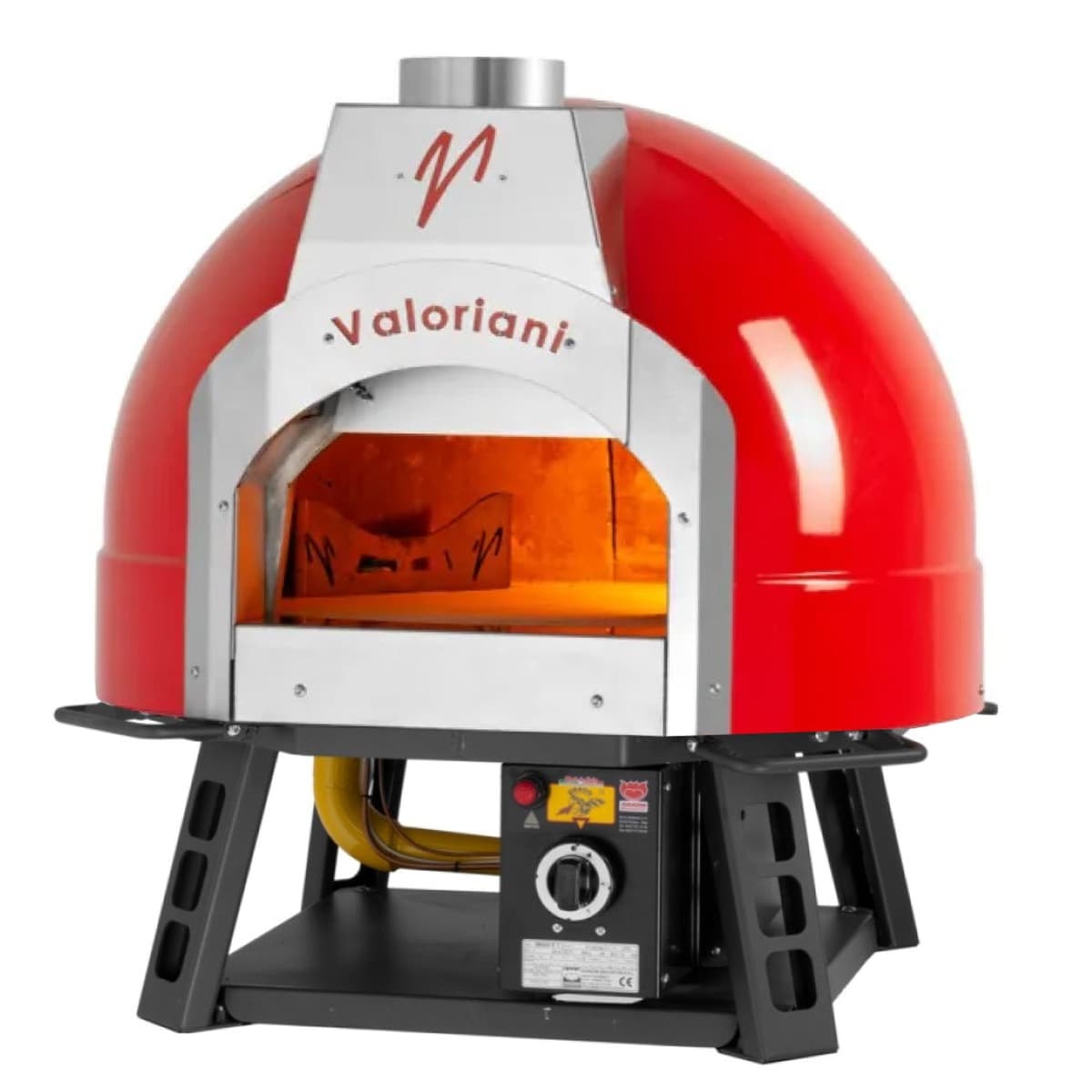
This guide walks you through the proper installation, curing and daily care of Valoriani wood-fired and gas pizza ovens, including the Baby, Igloo and Rotativo series, using the manufacturer's exact procedures.
Key takeaways
- Always have a qualified, licensed installer handle gas connections, venting and electrical work to meet local codes.
- Follow the model-specific first-fire curing schedule exactly to prevent cracks from thermal shock.
- Use only dry hardwood, never exceed 3 kg of wood per load, and avoid resinous woods like pine.
- Clean the cooking floor with a brass brush only; never use water, wet rags or salt inside the oven.
- For any repair or service, contact the manufacturer's authorized service network; ask Norpex for model-specific questions.
Valoriani oven series and which manual to use
The Valoriani wood-fired and gas pizza ovens in our list are the Baby 60 and Baby 75, the Igloo series (100, 120, 140, 160, 180), and the Rotativo 120 with a rotating deck. All models can operate with wood or gas, and the gas burners are factory-set for natural gas or liquid propane depending on the model.
The Baby 60 and Baby 75 are covered by the Valoriani instruction manual for items 48144, 48142, 48137 and 48143. The Igloo series (items 48126, 48127, 48203 through 48207) are covered by the Valoriani instruction manual for item 48203. The Rotativo 120 (item 48145) has its own dedicated manual. Moving instructions for the Igloo and similar ovens are provided in the separate Valoriani Igloo moving instructions document.
Each manual contains critical safety warnings, technical specifications, installation requirements, first-firing schedules, daily operation steps, maintenance and troubleshooting tables. Always refer to the manual that matches your oven's item number.
Moving and placing the oven
The Valoriani Igloo moving instructions state that the oven must be moved with a forklift of adequate capacity and forks long enough to support the entire base. Load the oven from the back, never from the front. For lifting with a jib crane, place two rigid bars under the metal base, keep the lifting ropes spaced so they do not press against the dome or sheet metal, and use rubber strips to increase friction.
Once on site, position the oven on its metal base on a flat, non-yielding floor with adequate load capacity. The Igloo moving instructions show that after placing the oven on its base, you can use a pallet truck under the base crosspieces for final positioning on a smooth, resistant floor. Do not move the oven while it contains fuel or is still hot.
For the Baby series, the manual warns that if optional wheels are installed, move the oven only on plain, perfectly level floors; inclined surfaces, stairs, ramps, lawn or gravel may cause tipping. Always move the oven with more than one person.
Installation: flue, gas and electrical
All Valoriani ovens require a properly installed chimney flue. The Igloo and Rotativo manuals specify that single-wall and B-type vent pipes are not acceptable. Installation of the exhaust vent must comply with NFPA 96, referencing UL 737 for direct venting and UL 2162 for indirect venting. In Canada, the chimney installation must also conform with CAN/CSA-B365. Do not connect the oven to a chimney flue serving another appliance.
A qualified, licensed installer must handle the gas connection. The Rotativo manual states that the installation must conform with local codes or, in the absence of local codes, with the National Fuel Gas Code ANS Z223.1/NFPA 54 or the Natural Gas and Propane Installation Code CSA B149.1. The gas pressure range for the Spitfire NEXT 99 burner on the Rotativo is from 5 mbar to 50 mbar (2" wc to 20" wc). For Igloo models, the intake pressure should be within 18–25 mbar for methane gas and 20–45 mbar for propane LPG, with a supply pipe not less than 1/2" diameter.
Electrical connections also require a qualified professional. The Rotativo 120 needs two industrial 110/120V 60Hz 500W 6A outlets, and the control panel has more than one power supply connection point—disconnect all before servicing. The Baby and Igloo models have a 300W, 1A electrical requirement at 110-120V/60Hz/1Ph. Always install an omni-polar switch upstream with at least 3 mm contact opening and a sensitive protective device.
First firing and curing schedules
Curing a new oven is essential to drive out residual moisture without cracking the refractory. The Valoriani instruction manual for Baby ovens (item 48144) prescribes a three-day wood firing: on day one, light a small fire in the centre and keep the temperature constant at 100–150°C. On day two, raise the temperature by 50°C every four hours. When the dome begins to whiten, you can start baking tests. For gas firing on the Baby, ignite the pilot flame only for at least four hours, then switch to minimum flame for another four hours. On day two, run minimum flame for two hours, then increase to maximum flame until the desired temperature is reached, then set an intermediate position.
The Igloo manual (item 48203) requires a longer wood curing: keep the oven at 100–150°C constantly for the first two days, then raise the temperature by 50°C each day from day three onward until the handwork is fully dehumidified—this takes about one week. For gas curing on the Igloo, set the burner to minimum flame for six to eight hours on days one and two. On day three, switch to automatic mode with a set point of 200°C for six to eight hours; on day four, use 250°C for six to eight hours. From day five, you can set the desired operating temperature and begin baking tests.
The Rotativo 120 manual (item 48145) emphasizes that the refractory cement contains about 10% water by weight—roughly 26 gallons in the dome—and must be dried slowly. It recommends running the Spitfire burner on minimum flame for 48 consecutive hours, or until the temperature control unit reads over 320°F. Cover the burner box and control panel with plastic film to protect them from dripping water during drying. Even a used oven that has been idle for more than two weeks must be re-cured with a slow minimum-flame heating, as the refractory will have reabsorbed humidity.
Daily firing, gas burner operation and the rotating deck
For wood firing, the Baby and Igloo manuals advise using small, dry hardwood logs no longer than 20 cm and about 4 cm in diameter. Never load more than 3 kg of wood at once, and keep the flame entirely inside the oven—it must never reach the metal flue manifold. Avoid resinous woods like pine and fir, as well as poplar and birch, which leave high carbonic residues. Alternate the fire between the left and right sides over time to balance thermal expansion.
Gas burner operation varies by model. On the Baby, you press and turn the gas knob to the star position to light the pilot, then to position 2 for high flame. The maximum flame should reach about 15 cm from the baking floor on the opposite side of the burner; the minimum flame should be half that length. The Igloo's Spitfire GOLD burner control box offers minimum flame, maximum flame (adjustable from 40% to 100% power), automatic temperature control with a set point, and a timed blaze function that delivers 100% flame for 15 seconds. The Rotativo's Spitfire burner panel includes similar controls: press MIN for 20% power, MAX for full power, AUTO for thermostatic control, and a timed blaze by pressing MAX for less than one second.
The Rotativo 120 features a rotating cooking floor and an RHS (Recirculating Heat System) fan. The control panel lets you select three rotation speeds (baking, baking/cooking, cooking) and a fourth fast speed activated by the timer start button. The RHS system draws superheated air from the chamber and circulates it under the floor to maintain even surface temperature; its fan speed is adjustable from 1 (minimum) to 6 (maximum). The video 'VALORIANI ROTATING OVEN - HOW IT WORKS' demonstrates these features in operation.
Cleaning and care of the floor and dome
The Igloo manual recommends using proper brass brushes to clean the inside of the oven. Never beat a shovel or tool against the baking surface, as this can damage the refractory. Do not use wet rags or any material containing moisture, and never throw water inside the oven—thermal shock can crack the handwork. Salt must also be kept out of the oven.
Small cracks that appear in the crown elements are normal and result from thermal expansion; they do not affect performance and indicate proper dehumidification. The oven crown must have a thermal expansion joint that may widen or narrow over time—this movement is expected and does not compromise stability. After extended inactivity, always relight the oven slowly over 24 to 36 hours to avoid rapid drying stress.
Troubleshooting and service
The Igloo manual's troubleshooting table lists common issues. If the oven does not heat, possible causes include insufficient gas flow rate, excessive chimney extraction, lack of combustion air, or lack of air reinstatement in the room. If the oven emits smoke, check for insufficient chimney extraction, inadequate flue design, lack of air reinstatement, or a gas burner in need of maintenance.
For any repair or extraordinary maintenance, the manuals state that only qualified personnel should carry out the work, using original spare parts. Contact the manufacturer's authorized service network for service. For questions about a specific Valoriani model or its operation, ask Norpex.
Videos from the maker
Common questions
How long does the first curing take for a Valoriani Igloo wood-fired oven?
- The Valoriani instruction manual for the Igloo series specifies a one-week curing process: keep the oven at 100–150°C for the first two days, then raise the temperature by 50°C each day from day three until the handwork is fully dehumidified.
Can I move a Valoriani Igloo oven with a pallet truck?
- Yes, after the oven is positioned on its metal base, the Valoriani Igloo moving instructions allow moving it on a flat, non-yielding floor using a pallet truck placed under the base crosspieces. Do not move the oven while it contains fuel or is still hot.
What type of wood should I use in a Valoriani oven?
- The manuals recommend small, dry hardwood logs no longer than 20 cm and about 4 cm in diameter. Avoid resinous woods like pine and fir, as well as poplar and birch. Never exceed 3 kg of wood per load.
How do I clean the cooking floor of a Valoriani oven?
- Use a brass brush to clean the inside. Do not beat tools on the surface, do not use wet rags or water, and never put salt inside the oven. These precautions prevent thermal shock and damage to the refractory.
What should I do if my Valoriani oven emits smoke into the room?
- The Igloo manual's troubleshooting table suggests checking for insufficient chimney extraction, an inadequate flue, lack of air reinstatement in the room, or a gas burner needing maintenance. Have a qualified professional inspect the venting system.