
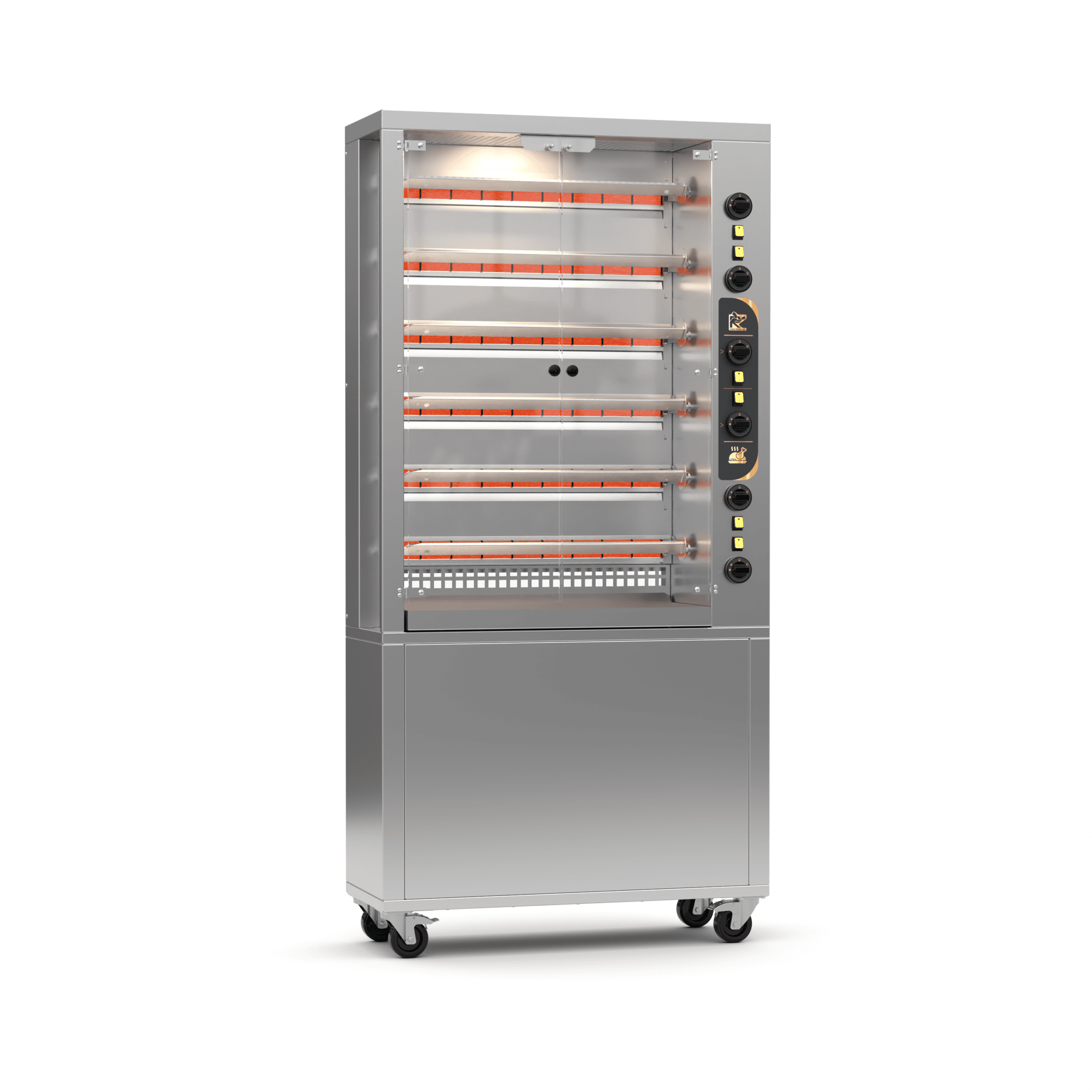
This guide covers the Rotisol lines at Norpex, what their spec sheets give, how to place a unit and install its roof, how to load spits or baskets, and how to clean Master Clean models automatically and other lines manually as each model's manual directs.
Key takeaways
- The Rotisol lines Norpex carries include Master Clean, Star Clean, Performance, Millenium, Roti Roaster, Faux Flame, Olympia and Brasilia, in spit and basket, gas and electric, countertop and floor formats.
- The Faux Flame spec sheet rates the FF1175-4G at 16/20 chickens and the FF1175-6G at 24/30; the Brasilia spec sheet rates the Brasilia.G at 27 open poultries.
- Rotisol's roof installation video walks through the roof step by step, for a new unit or after maintenance that removes the roof.
- Master Clean models run an automatic 3-cycle cleaning system, with a self-clean cycle the maker describes as under 1 hour; other lines are cleaned manually per the model's manual.
- Gas and electrical connections must be made by a qualified, licensed installer to local code, and repairs go through Rotisol's authorized service network.
The Rotisol lines and what the names tell you
Rotisol sorts its rotisseries into lines, and the line names carry the format. The Rotisol lines Norpex carries include Master Clean, Star Clean, Performance, Millenium, Roti Roaster, Faux Flame, Olympia and Brasilia. Within those lines, models split along spit versus basket, gas versus electric, and countertop versus floor, as the names state.
Most spit machines we list carry a capacity in chickens per batch. The Olympia gas spit rotisserie 975.2OLG is rated at 4/6 chickens, while the Millenium gas spit rotisserie 1375.8MLG is rated at 40/48. The Performance gas line runs from 16/20 chickens on the 1160.4PG to 40/48 on the 1400.8PG, and the Special Market gas rotisseries run from 4/6 on the 1175.4SMIG to 30/36 on the 1425.6SMIG.
Basket machines roast spatchcock, or butterflied, birds. The Brasilia line is dedicated to the spatchcock cooking method, and the Millenium Spatchking 1375.6MAI is listed at 24/30 open chickens. The Faux Flame spec sheet positions that line for mobility instead: lightweight and compact, designed for markets and food trucks.
What the spec sheets give
Rotisol's spec sheets for the Faux Flame and Brasilia lines give capacity, gas power, power supply, electrical power, weight and size. For other models, the product listing gives the details we have, such as spit counts and capacities, and the manufacturer's manual for the model gives the installation and operating details.
Rotisol's Faux Flame spec sheet rates the FF1175-4G at 16/20 chickens, 41000 BTU/h of gas power, a 208-240V~60Hz supply at 2.5 Amps, 0.47 kW of electrical power, 200 lbs, and 69 7/8 x 23 1/4 x 46 1/4 inches in height, depth and width. The FF1175-6G is rated at 24/30 chickens, 61500 BTU/h, 208-240V~60Hz at 3 Amps, 0.53 kW, 298 lbs, and 74 5/8 x 23 1/4 x 46 1/4 inches.
The Brasilia spec sheet rates the Brasilia.G at 27 open poultries, 15 kW of gas power, a 208-230V~50Hz/60Hz supply, 0.23 kW of electrical power, 165 kg, and 1792 x 535 x 1110 mm. The same sheet notes 27 chickens in 30 minutes, gas consumption of 41000 BTU/h across its 9 spits, and a shallow depth of 535 mm.
Placement, setup and the roof installation
Start with weight and width. The Optima gas spit rotisserie 1050.6OPTIG is listed at 145 kg with its base and 105 kg without, and Millenium oven widths run from 40-3/8 inches on the 975.2MIG to 68 inches on the 1675.8MLG. Countertop models such as the Millenium 1375.2MILG need a counter that carries the load; floor models such as the 1375.8MIG stand on their own base.
The roof is its own step in setup. Rotisol's video How to Install the Roof on Your Rotisol Rotisserie Unit | Step-by-Step Guide walks through the installation from start to finish, and it applies both when you set up a new unit and when you reinstall the roof after maintenance. Work through it in order, since the maker ties correct installation to performance, stability and a professional finish.
For an outdoor cooking station, Rotisol's video Olympia Garden: Set Up your Rotisserie in Minutes! shows the assembly and preparation steps. Gas and electrical connections, indoors or out, must be made by a qualified, licensed installer to local code. The Faux Flame spec sheet notes that the gas and electric chambers are separated to avoid any risk of explosion, but that design point does not replace code-compliant connection work.
Loading spits and baskets
On spit machines, the Performance infrared and Millenium oven models in the list use stainless steel V-shaped spits. The Faux Flame spec sheet lists an independent motor for each spit, Bakelite handles on the spits, and independent floating, swinging and adjustable motors that make placement and removal of the spits easy.
Rotisol sells spit accessories for products beyond whole chickens. The Faux Flame spec sheet names the following, each with its reference:
- CUI1175 anti-cutting prongless V-spit
- BPOR1175 porchetta spit
- BRC1175 rectangular basket spit
- BS1175 spit for ham or turkey
- BRRO1175 roast-clamp spit
- BA1175 lamb and suckling-pig spit
- BCR1175 spatchcock chicken basket
- DEC spit mover
- PID1175 tray for unspitting
Cleaning: auto-clean on Master Clean, manual on the rest
Cleaning splits along the lines. On Master Clean models, Rotisol's videos describe an automatic 3-cycle cleaning system; the Master Clean Rotisserie — Load. Roast. Self-clean. video shows the cycle taking over once the roasting is done. In the video Master Clean: The new Standard in Auto-Clean Rotisserie Ovens!, Rotisol describes a full self-cleaning cycle in less than 1 hour, along with up to 40 chickens per batch, optional ventless hood technology and an integrated cooking drip pan.
On lines without auto-clean, the manufacturer's manual for the model sets the cleaning method and schedule, so follow the manual rather than a rule of thumb. The hardware helps either way. The Faux Flame spec sheet lists a bottom drip tray with drainage tap, removable inside side-panels that double the protection of the motors against grease, and K-glass doors that come off for transport. The Brasilia spec sheet lists the same bottom drip tray with drainage tap.
Between cleans, the Faux Flame spec sheet notes that the glass overlaps the drip pan to keep splatters inside and that the anti-scald K-glass reduces external thermal radiation. Drain the drip tray through its tap and refit the side panels the way the manual directs.
Service, repairs and next steps
Repairs go through the manufacturer's authorized service network. When you arrange service, give the full model number, such as 1375.8MLG or FF1175-6G, so the technician arrives prepared.
For questions about a specific model, its accessories or its manual, ask Norpex. The related guides below cover general rotisserie buying advice and holding finished birds hot.
Videos from the maker
Common questions
Which Rotisol lines does Norpex carry?
- Master Clean, Star Clean, Performance, Millenium, Roti Roaster, Faux Flame, Olympia and Brasilia, in spit and basket, gas and electric, and countertop and floor formats as the names state.
How do I install the roof on a Rotisol rotisserie?
- Follow Rotisol's video How to Install the Roof on Your Rotisol Rotisserie Unit | Step-by-Step Guide, which covers the process from start to finish for a new unit and for reinstalling the roof after maintenance.
Does the Master Clean clean itself?
- Rotisol's videos describe an automatic 3-cycle cleaning system on Master Clean models, with a full self-cleaning cycle in less than 1 hour.
How should I clean a Rotisol model without auto-clean?
- The manufacturer's manual for the model sets the method and schedule. Both the Faux Flame and Brasilia spec sheets list a bottom drip tray with a drainage tap.
Who should connect the gas and electricity?
- A qualified, licensed installer must make gas and electrical connections to local code. Repairs afterward go through Rotisol's authorized service network.