
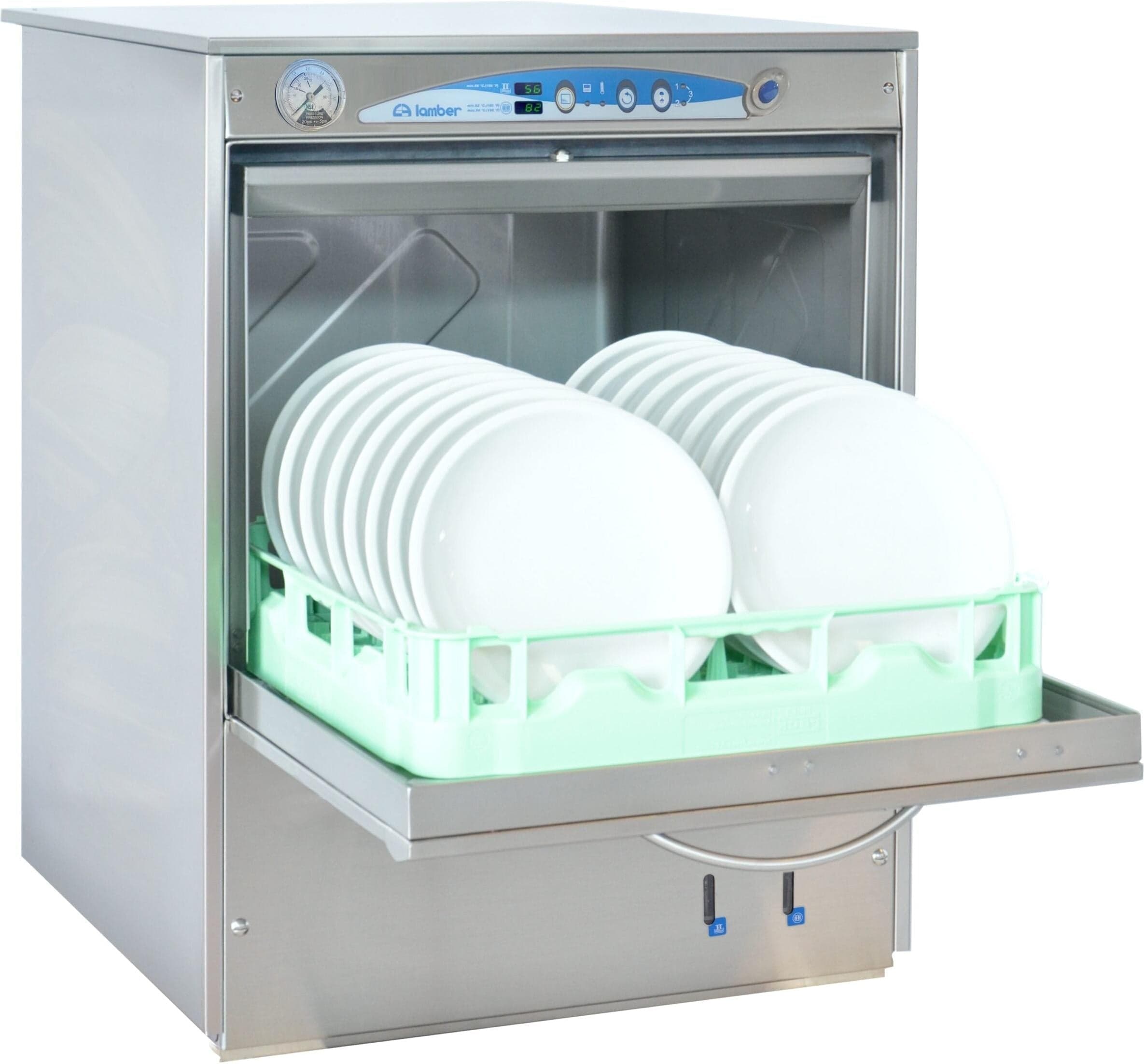
This guide covers daily operation, routine cleaning, and basic troubleshooting for Lamber undercounter, pass-through, and glasswasher models. Follow the manufacturer's instructions to maintain hygiene and performance.
Key takeaways
- Always use non-foaming industrial alkaline detergent and rinse aid suitable for commercial washers.
- Before each start, check that the filters are in their housings and the wash and rinse arms are free to pivot.
- Choose the wash cycle based on soil level: 2-minute short, 3-minute medium, or 4-minute long.
- At the end of the day, drain the tank completely and perform the daily cleaning routine outlined in the manual.
- For any repair, contact the manufacturer's authorized service network; do not attempt to service the machine yourself.
Overview of Lamber warewashers
Lamber produces several series of commercial warewashers for different kitchen needs. The F99 and DSP4 are high-temperature undercounter dishwashers, the DSP3 is a dedicated glasswasher, the L21 and L25 are pass-through hood dishwashers, and the P700 is a pot and pan washer. Each model comes with a user manual that provides specific instructions for installation, operation, and care. For example, the F99EKDPS manual covers the F99 series, the DSP3 manual covers the DSP3 glasswasher, the L25EKS1PH manual covers the L25 pass-through, and the P700EKDPS manual covers the pot and pan washer.
These machines are intended exclusively for washing dishes, glasses, cups, cutlery, trays, and common kitchen utensils in a commercial setting. They are not designed for residential use or for washing items that contain electrical components, fabric, metal sponges, or iron utensils. The Lamber user manuals emphasize that the equipment must be used only by trained and authorized personnel.
Installation requirements
Installation must be carried out by a qualified, licensed installer in accordance with all local codes and the manufacturer's instructions. The Lamber manuals state that the machine should be placed in an area with adequate air recirculation and that complies with local work hygiene rules. The installer must verify that the model plate data matches the electrical and water distribution network before connecting.
Level the machine carefully during installation; the F99EKDPS manual calls good levelling a prerequisite for correct operation. The manual says the dishwasher must be installed to local codes and, in Canada, to the Canadian Electrical Code, Part 1, CSA C22.1, and that the machine and its accessories must be connected by a company specialized in electrical installations, with the mains voltage matching the voltage on the machine's data plate.
The machine needs water, drain and electrical connections made by qualified, licensed trades. Before operation the F99EKDPS manual says the water valve must be open and the outer general feeding switch must be ON. The machine's protection degree is IP21, so it must not be washed with direct high-pressure water jets.
Daily operation and controls
Before starting the machine, ensure the water valve is open, the tank filters and overflow are correctly seated, and the wash and rinse arms can rotate freely. Load the detergent and rinse aid dispensers with products suitable for commercial warewashers. The F99EKDPS user manual instructs to turn on the machine via the wall switch and then press button 'A' on the control panel. The tank will fill, and when full, the cycle lamp '2' will light. Wait for lamp 'D' to illuminate, indicating the wash and rinse water has reached the ideal temperature.
Load the basket without overloading; dishes must not be stacked, and water must reach all surfaces. The DSP3 glasswasher manual similarly advises placing glasses so they do not touch.
Select the wash cycle using button 'B': a flashing lamp 1 gives a 2-minute short cycle, flashing lamp 2 a 3-minute medium cycle, and both lamps lit together a 4-minute long cycle. Close the door (or hood on pass-through models) and press cycle button 'C'. The cycle runs, followed by a 5-second pause and a rinse with clean water at 82–90°C (180–195°F) for 18 seconds on the F99EKDPS, or 23 seconds on the P700EKDPS. The L25EKS1PH manual specifies a rinse temperature of 85–90°C (180–195°F). The control lamp flashes until the cycle ends. Do not open the door during the cycle; if opened accidentally, the cycle stops and resumes when closed.
At the end of the cycle, open the door carefully. Remove the basket and let dishes air-dry by evaporation. For models equipped with a drain pump, at the end of the working day, open the door, remove the overflow pipe, and press button 'F' for 3 seconds to drain the tank. The drain pump runs for up to 5 minutes and stops automatically. The L25EKS1PH manual describes a similar drain procedure for models with a drain pump.
Cleaning and routine care
The F99EKDPS manual's end-of-day routine follows the drain: switch the machine off with button A, wash the tank and the filter housing thoroughly to remove all impurities, take the filters out and clean them under running water, refit the overflow pipe and the filters, check and clean the wash and rinse jets, and clean the outer surface with a wet sponge, never with water jets or abrasive detergents. If the machine will stand idle for a long time, drain the water from the boiler (the drain plug is on its lower side) and from the electropump, and leave the wash tank open.
For the interior, the manual says to disconnect the mains power first and suggests gloves and protective glasses. Remove the bottom filter, the front tank filters, the central support, the pump inlet filter and the overflow pipe, take any residual dirt out of the tank with a brush or cloth, and clean the pump inlet filter with a brush. Check that the upper and lower wash and rinse arms are free to rotate before refitting everything. The wash and rinse arms themselves are removed and cleaned every six months. Never wash the machine or the area around it with fire hydrants, steam jets or high-pressure cleaners.
The manuals also suggest descaling dishes from time to time to remove calcareous or starchy sediments, by soaking them in a solution from your cleansing-agent supplier, generally one containing phosphoric acid.
Always use non-foaming industrial alkaline detergent and rinse aid. The P700EKDPS manual warns that using residential dishwasher soap causes excessive foam. Do not mix different detergent products, as this can cause the dosing pump to crystallize and break down.
Troubleshooting common issues
If washed items show visible residue, the F99EKDPS manual advises checking four things: that the washing jets are clean, that there is detergent in the dispenser, that the pump suction filter is clean, and that the dishes are correctly positioned in the rack without overlapping. Each manual also has a table of inconveniences, possible causes and remedies for more specific symptoms.
Halos on glassware point to insufficient rinsing: the manuals say to check that the rinse jets are clean and that there is sufficient pressure in the water distribution network, and, before each start, that the rinse aid and detergent containers are loaded.
If the machine does not start a cycle, ensure the door or hood is fully closed; the control lamp 'E' flashes when it is open. Also confirm that the water has reached temperature (lamp 'D' is lit). For any persistent issue, consult the troubleshooting table in your model's manual. Do not attempt repairs yourself; contact the manufacturer's authorized service network.
Service and support
The Lamber manuals state that adjustments and repairs must be carried out only by qualified personnel. Repair by unskilled individuals may be dangerous. If the power cable is defective, it must be replaced by the manufacturer, a technical assistance service, or a qualified technician.
For service, contact Lamber's authorized service network. For questions about a specific model or to order accessories such as racks and cutlery baskets, ask Norpex.
Common questions
What type of detergent should I use in my Lamber dishwasher?
- Use only non-foaming industrial alkaline detergent and rinse aid formulated for commercial warewashers. The L25EKS1PH manual warns that residential dishwasher soap creates excessive foam.
How do I drain the tank at the end of the day?
- For models with a drain pump, open the door, remove the overflow pipe, and press button 'F' for 3 seconds. The drain runs for up to 5 minutes and stops automatically. Refer to your model's manual for exact instructions.
What do the cycle lamps on the control panel mean?
- Lamp 1 flashing indicates a 2-minute short cycle, lamp 2 flashing a 3-minute medium cycle, and both lamps lit together a 4-minute long cycle. Lamp 'D' shows the water has reached the correct temperature. Lamp 'E' flashes if the door is open.
How often should I clean the filters and rinse arms?
- The F99EKDPS manual's daily routine takes the filters out and cleans them under running water and cleans the pump inlet filter with a brush, then checks that the wash and rinse arms rotate freely. The arms themselves are removed and cleaned every six months.
What should I do if the machine stops mid-cycle?
- If the door or hood is accidentally opened, the cycle stops. Close it and, as the manual says, the cycle starts again from the point where it stopped. If the machine stops due to a fault, check the troubleshooting table in your manual. For repairs, contact the manufacturer's authorized service network.