
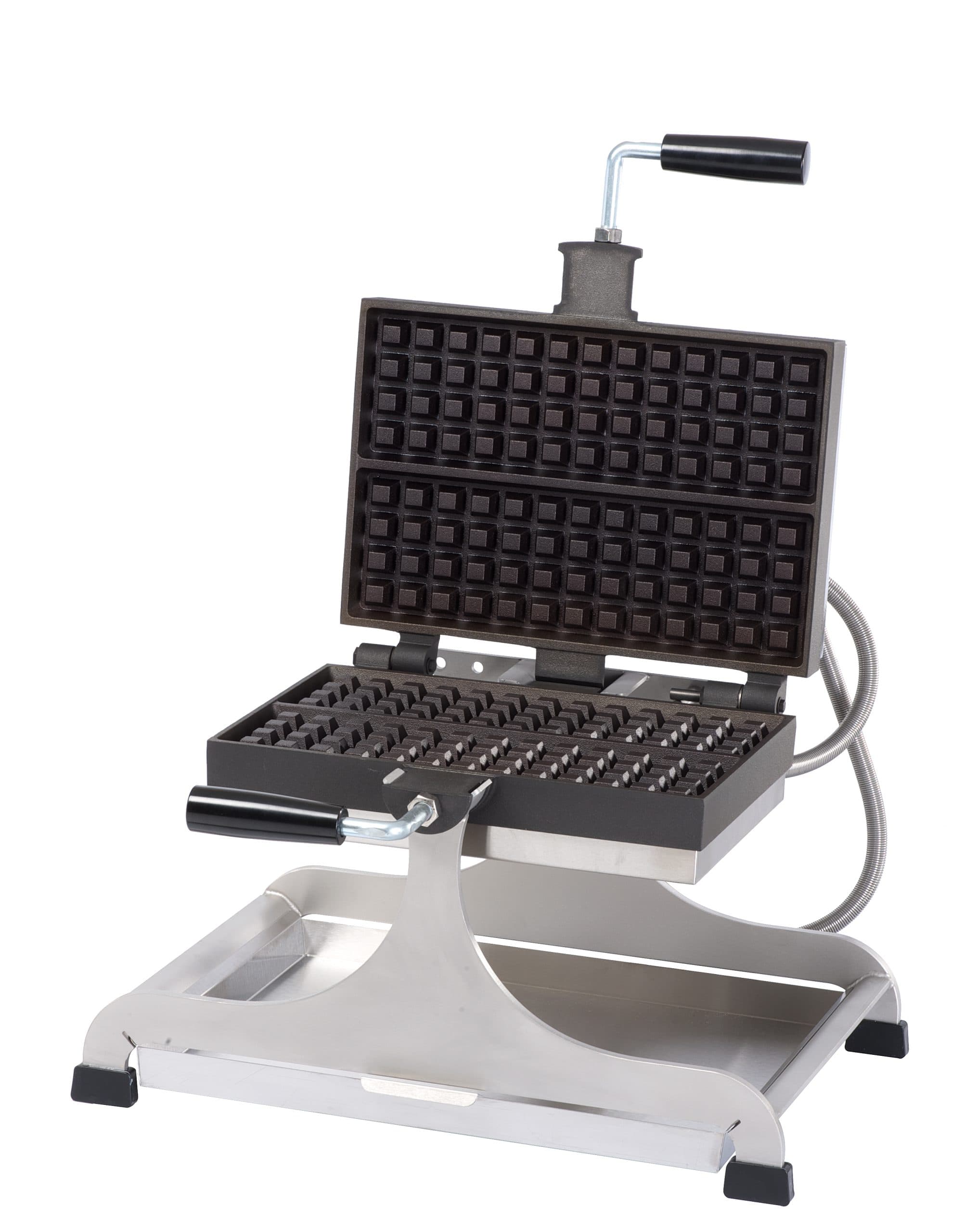
Learn how to install, season, operate, and clean Krampouz commercial waffle makers and electric crêpe machines, following the manufacturer's instructions for safe, long-lasting performance.
Key takeaways
- Season cast iron plates with vegetable oil before first use to create a non-stick surface.
- Place the appliance on a dry, stable surface at least 20 cm from any heat-sensitive wall.
- Use the thermostat (50–300 °C) to set the exact temperature recommended by your recipe.
- Clean frames and drip trays with a sponge and mild liquid detergent; never use abrasive products or immerse the appliance.
- For repairs, contact the manufacturer’s authorized service network; a qualified technician must handle all electrical or gas work.
Understanding your Krampouz equipment
Krampouz manufactures professional electric waffle irons and electric crêpe makers designed for high-volume commercial use. The waffle maker range includes single and double irons with 90° or 180° openings, swivel models, and specialty units for bubble waffles, churros waffles, and Liège-style waffles. The crêpe maker line offers single and double round cast iron griddles with a diameter of 40 cm (16 inches).
All models share a stainless steel frame, removable drip trays, a thermostat adjustable from 50 to 300 °C, a heating indicator, and an on/off switch with an indicator light. The cast iron cooking surfaces contain shielded heating elements that spread heat evenly. The manufacturer’s instructions for use cover installation, seasoning, daily operation, cleaning, and basic troubleshooting for these appliances.
Installation and placement
Krampouz’s professional electric waffle iron instructions for use state that the appliance must be placed on a dry, stable work surface. The top of the irons should be between 85 and 95 cm from the ground for comfortable use. Maintain a minimum clearance of 20 cm from any vertical surface that is not heat-resistant. If the appliance must be near a wall or partition, that surface must be made of non-flammable material or covered with appropriate heat-insulating, non-combustible material, paying close attention to fire prevention regulations.
For electrical connection, the waffle iron manual specifies a single-phase supply of 120 V, 208 V, or 240 V depending on the model. The appliance is delivered with a power cable type SJTOW, 3 conductors (phase + neutral + earth), cross-section 14 AWG. The crêpe maker manual indicates a single-phase 240 V network using a 16-amp two-pin plug with earth pin, and a cable type SJTOW 3 conductors, cross-section 1.5 mm². A qualified, licensed electrician must perform the final connection according to local code. Gas models need a qualified, licensed gas installer working to local code.
The manuals also require that the appliance be connected to a residual current device with a rated residual operating current of 30 mA maximum. Do not use an extension lead unless it is fully unwound to prevent overheating. Always connect or disconnect the power cord with the control knob set to the minimum or ‘off’ position.
Seasoning cast iron plates
Both waffle irons and crêpe griddles require seasoning before first use to protect the cast iron and create a non-stick surface. The waffle iron manual describes the following procedure: plug in the appliance, open the irons, and set the thermostat to 300 °C. Let it heat for about 30 minutes, then reduce the thermostat to 270 °C and wait 5 minutes for the temperature to stabilize. Using a brush, apply a fine coat of frying oil (with no other ingredients) to all blocks and grooves, ensuring no excess oil pools. Let this first layer cook for 10 minutes, apply a second layer in the same way, wait another 10 minutes, then turn off the appliance. A properly seasoned surface will have a chestnut-coloured, varnish-like appearance.
For crêpe griddles, the manufacturer’s instructions for use and installation outline a different process. The video ‘Krampouz professional-use crêpe maker: How to season the cast iron plate’ demonstrates this method. Set the thermostat to 250 °C and wait until the orange indicator light goes out. For the first four layers, pour 1 teaspoon of vegetable oil onto the plate, spread it uniformly with the cleaning pad (using 3 piled wipes), and allow each layer to dry until no more smoke appears (5 to 10 minutes). For the fifth through ninth layers, use only ½ teaspoon of oil per layer, spreading and drying in the same way. For the final layer, pass the pad over the plate without adding any fat. The result should be a light chestnut-coloured seasoning that looks like varnish.
After seasoning, the crêpe manual advises greasing the plate well between each crêpe during the first cooking session. For waffle irons, the manual recommends lightly greasing the irons with a brush dipped in oil before the first waffle of each session.
Daily operation and controls
To make waffles, preheat the appliance with the thermostat set to the temperature specified in your recipe and the irons closed. The manual provides example recipes: Brussels waffles cook at 210–220 °C for about 3 minutes 30 seconds; Liège waffles at 180 °C for 3 to 4 minutes; and churros waffles at 220 °C for 2 to 3 minutes. Once the irons reach temperature, open them, brush all plate surfaces with oil, and pour or place the batter. For liquid batters (Brussels and churros), fill only one side so the tops of the blocks are barely covered, then close the irons and, except for 90° opening models, turn them over. Remove the waffle with a waffle fork and cool on a rack to keep it crisp.
For crêpe making, the manual recommends a cooking temperature between 200 °C and 230 °C. Lightly grease the griddle before the first crêpe of each session. Pour a ladle of batter onto the hot griddle and spread it with a Krampouz wooden spreader. While cooking, simply wipe the griddle to remove residue. If the appliance stays heated without use for a long period, lightly grease the griddle before re-use. The manual suggests using sunflower oil for greasing and lists essential accessories: a spreader (18 to 20 cm), cleaning pad ATE1, cleaning wipes ATE2, a brush and water tray for the wooden spreader, a spatula, a ladle, and a batter container.
Both appliance types feature a thermostat knob graduated from 50 to 300 °C, a heating indicator light, and a power indicator. On some crêpe models, an on/off switch with a green light is present. Always set the knob to the minimum position before plugging or unplugging the unit.
Cleaning and routine care
Before any cleaning, unplug the appliance and allow all surfaces to cool completely. The waffle iron manual instructs you to clean the stainless steel frame and removable drip trays with a sponge soaked in warm water and liquid detergent. Stubborn marks can be removed with a specific commercial product, but never use abrasive products or metal brushes. Do not immerse the appliance in water or use a water jet. The iron covers can be cleaned the same way; it is normal for them to brown over time due to high heat.
The cast iron waffle plates require regular attention to prevent a thick buildup of carbonized fat, which acts as an insulator and can flake off. The manual recommends dismantling the heating element packs and irons for cleaning (the instructions include dismantling diagrams). Regular brushing helps control buildup; do not be afraid of scratching the metal. For Liège waffle irons, burnt caramel from pearl sugar can be removed by dismantling the irons and soaking them in hot water until the caramel dissolves. Never suddenly cool irons that are hotter than 100 °C by immersing them in water.
For crêpe griddles, the manual states that after use you should simply wipe the griddle; do not wash it. Never suddenly cool the plate. Over time, fats from lubrication and batter will thicken the seasoning. If the seasoning becomes too thick, use the Krampouz abrasive stone (ref. APA1) regularly to strip it. If stripping by abrasive stone is insufficient, the plate can be stripped by sand blasting (contact the manufacturer’s customer service). After any stripping operation, you must re-season the griddle as if it were new.
Clean the crêpe maker frame with a sponge dipped in warm water and unchlorinated liquid detergent. Do not use abrasive products or metallic brushes, and do not clean the appliance under running water or immerse it.
Troubleshooting common issues
The crêpe maker manual includes practical advice for common problems. If the batter runs on the griddle or sticks to the spreader, do not add more grease; instead, remove excess oil, as poorly made batter can cause the same effect. If the batter only bubbles, it may be too runny, badly made, or the griddle is too hot. If the griddle sticks, lightly grease it with a little cooking oil. When batter both bubbles and sticks, the seasoning may be insufficient (continue the seasoning operation), or the griddle may be charred (scrape and re-season). If the seasoning flakes off, scrape the griddle with an abrasive stone and start a new seasoning.
For waffle irons, the manual notes that if waffles are difficult to remove, you can use a mixture of one spoonful of oil and one egg yolk to help release them. If the appliance remains heated for a long time without use, lightly grease the plates and close the irons to protect the surface. Should the iron plates develop a thick, flaking layer of carbonized fat, dismantle and clean them as described in the cleaning section, or have them stripped by sand blasting or pyrolysis, followed by a new seasoning.
If the appliance fails to heat or shows signs of electrical malfunction, immediately disconnect it and contact the manufacturer’s authorized service network. All repairs must be carried out by a qualified technician.
Service and support
Repairs belong to the manufacturer’s authorized service network; the crêpe maker manual says a griddle whose seasoning will not strip with the abrasive stone can be sand blasted through the manufacturer’s customer service.
For any repair or maintenance beyond routine cleaning, the manuals specify that a qualified technician must perform the work. Norpex is an online store and does not provide installation, service, or repair. For service, contact the manufacturer’s authorized service network. If you have questions about a specific Krampouz model, ask Norpex for assistance.
Videos from the maker
Common questions
How do I season a new Krampouz waffle iron?
- The waffle iron manual says to heat the open iron to 300 °C for 30 minutes, then reduce to 270 °C. Apply a fine coat of frying oil with a brush, let it cook for 10 minutes, apply a second coat, wait another 10 minutes, and turn off the appliance. The surface should look like dark brown varnish.
How do I season a new Krampouz crêpe griddle?
- The crêpe maker manual instructs you to heat the griddle to 250 °C. Apply four layers of 1 teaspoon of vegetable oil each, spreading with the pad and drying each layer 5–10 minutes until no smoke appears. Then apply five layers using ½ teaspoon of oil each, and finish with a dry pass of the pad. The video ‘Krampouz professional-use crêpe maker: How to season the cast iron plate’ shows this process.
What temperature should I use for cooking waffles or crêpes?
- The waffle iron manual suggests 210–220 °C for Brussels waffles, 180 °C for Liège waffles, and 220 °C for churros waffles. The crêpe maker manual recommends a cooking temperature between 200 °C and 230 °C for crêpes. Always follow your specific recipe and adjust after a few trial runs.
How do I clean the cast iron plates without damaging them?
- For waffle irons, dismantle the plates once cool and brush them regularly to prevent buildup; for Liège caramel, soak in hot water. Never suddenly cool plates hotter than 100 °C. For crêpe griddles, simply wipe after use; do not wash. If seasoning becomes too thick, use the Krampouz abrasive stone (ref. APA1) or have the plate sand blasted, then re-season.
What should I do if my crêpe batter sticks or bubbles?
- The crêpe manual advises: if batter runs or sticks to the spreader, remove excess oil and check batter consistency. If it only bubbles, the batter may be too runny or the griddle too hot. If it bubbles and sticks, the seasoning may be insufficient or the griddle charred; scrape and re-season as needed.