
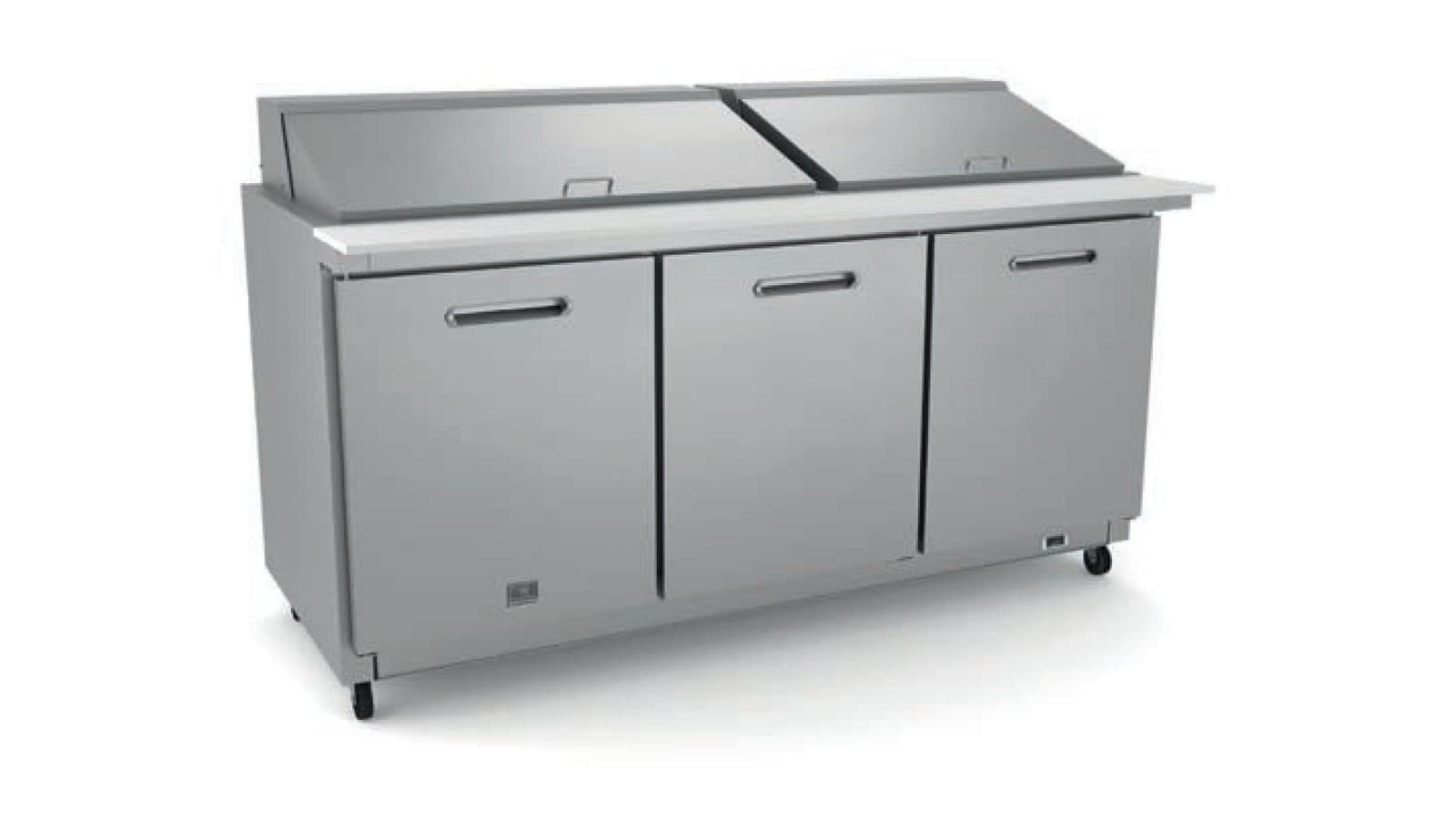
This guide covers the proper installation, daily operation, control settings, cleaning and basic troubleshooting for Kelvinator Commercial reach-in refrigerators and freezers, prep tables, chest freezers, back bar coolers, and undercounter units, based on the manufacturer's manuals.
Key takeaways
- Always have a qualified, licensed installer handle electrical connections and ensure local code compliance.
- Maintain at least 2 inches of clearance from walls and 12 inches above for most units; chest freezers need 5 inches at back and sides.
- Factory temperature settings are 34–38°F for refrigerators and -7 to -3°F for freezers, with automatic defrost every 6 hours.
- Use the solid-state thermostat to view setpoint, start manual defrost, and check min/max temperatures.
- Clean the condenser coil every 90 days, or every 30 days where dust or grease builds up, and leave sealed-system work to factory-authorized service.
Which manual covers your Kelvinator Commercial unit
Kelvinator Commercial refrigeration products are grouped into several families, each with its own service and installation manual. The reach-in refrigerators and freezers—including solid door, half-solid door, glass door, and half-glass door models—are covered by the reach-in refrigerators and freezers manual. Glass door merchandisers with swing or sliding doors have a dedicated glass door merchandiser manual. Back bar bottle coolers, whether solid, glass, or stainless steel door, are detailed in the back bar bottle cooler manual.
Sandwich and salad prep tables, pizza prep tables, and mega top prep tables are all addressed in the prep tables manual. Undercounter and worktop refrigerators and freezers, including drawer units, are covered by the undercounter and worktop manual. Chest freezers, both solid lid and glass lid novelty models, have their own chest freezer manual. The serial number for all self-contained units is located inside the cabinet on the left wall near the top; always have it ready when contacting service or ordering parts.
Installation requirements from the manuals
All Kelvinator Commercial units are intended for indoor use only. The floor must support the total weight of the cabinet and its contents; a fully loaded unit can weigh as much as 1500 pounds, so reinforce the floor if needed. For reach-in, glass door merchandiser, back bar, prep table, and undercounter/worktop models, the manuals recommend installing the unit no closer than 2 inches from any wall and with at least 12 inches of clear space above the unit. Chest freezers require 5 inches of space between the back and sides and should be located away from direct sunlight and heat sources.
Level the cabinet using a spirit level. Units with legs have adjustable bullet feet; casters do not allow levelling, so ensure the floor is level. Lock the front casters once the unit is in place. If a unit has been transported on its side or back, allow at least 24 hours before start-up so compressor oil can flow back into place. For chest freezers, let the unit stand upright for approximately 2 hours before connecting power.
Electrical connection must be performed by a qualified, licensed installer in accordance with local codes and the National Electrical Code. Refer to the amperage data on the serial tag and in the manual. Chest freezers must be plugged into a grounded 3-prong outlet; do not use an adapter or extension cord. A separate 15-ampere circuit is recommended. For all other units, a protected circuit of the correct voltage and amperage must be provided. The chest freezer manual also instructs to clean the interior with lukewarm water and a soft cloth before first use.
Daily operation and control panel
Reach-in refrigerators run the evaporator fans continuously, even when a door is open. The door switch activates the interior lights. Every 6 hours the unit turns off to defrost; the controller displays a defrost symbol. Defrost ends when the evaporator coil reaches 41°F or after 20 minutes. The factory temperature range is 34°F to 38°F. Reach-in freezers cycle the evaporator fans on only when the coil temperature is below 54°F, and the fans stop during defrost. An electric heater defrosts the coil every 6 hours, ending when the coil reaches 45°F or after 20 minutes. The factory range is -7°F to -3°F.
Glass door merchandiser freezers operate similarly: the evaporator fan runs when the coil is below 54°F, defrost occurs every 6 hours with a heater, and the factory setting is -7°F to -3°F. Back bar bottle coolers maintain 34°F to 38°F; a light switch is located next to the on/off switch on the front bottom panel. Prep tables keep the internal cabinet at 34°F to 38°F and the rail at 33°F to 41°F. The prep table manual warns that the top section is not for overnight storage—product must be removed from pans, though empty pans may stay. Always operate prep tables with pans and covers in place to maintain efficiency.
Undercounter and worktop refrigerators are factory set to 34°F to 38°F, and freezers to -7°F to -3°F. Chest freezers use a mechanical thermostat instead of the digital control.
All units except chest freezers share a solid-state thermostat control panel. Press the SET key briefly to view the setpoint; hold it for more than 2 seconds to change the setpoint using the UP or DOWN arrows. Press the DEF key for more than 2 seconds to start a manual defrost. Press the UP key to see the maximum stored temperature, and the DOWN key for the minimum. To lock the keyboard, hold UP and DOWN together for more than 3 seconds until “POF” appears; unlock with the same combination until “Pon” appears. Chest freezers do not have this digital control; adjust the mechanical thermostat as needed.
Cleaning and routine care
Disconnect power before cleaning, and never use a high-pressure water wash. The interior and exterior clean with soap and warm water; if that is not enough, use ammonia and water or a non-abrasive liquid cleaner. Rub stainless steel with the grain, and never use abrasive cleaners, which scratch the steel and plastic and damage the breaker strips and gaskets. Many foods are acidic and attack the finish, so clean food residue off stainless surfaces. The chest freezer manual adds lukewarm water and a soft cloth for the interior, with no solvents or abrasives.
The condenser coil needs cleaning every 90 days, or every 30 days where dust, debris or grease builds up faster. Light dust comes off with a brush; heavier build-up needs a vacuum or compressed air blown through the coil, and grease needs a degreaser made for refrigeration coils followed by blowing through. Never use steel pads, wire brushes, scrapers or acid-based cleaners on the coil. A dirty coil causes high temperatures and long run times, and running continuously with it can lead to compressor failure.
Troubleshooting and when to call for service
The digital control shows alarm codes. P1 is a room probe failure (the compressor then runs on its backup settings) and P2 an evaporator probe failure (defrost ends on time); HA and LA are maximum and minimum temperature alarms; HA2 and LA2 are condenser high and low temperature alarms; dA means a door has been left open; EA is an external alarm and CA a serious external or pressure switch alarm that switches all outputs off. To see the stored alarm, press the up or down key; to reset it, hold SET while the code is shown until rst appears.
When a cabinet runs warm, check the door and gaskets, the condenser coil and the clearances first. The units use flammable refrigerant, so repairs to the refrigeration system are for factory-authorized service personnel only.
Service and support
Use the manufacturer's authorized service network for repairs, and have the serial number ready: on self-contained refrigerators and freezers it is inside the unit. Electrical, gas or water connections are for a qualified, licensed installer.
Common questions
What clearance do I need around my Kelvinator reach-in refrigerator?
- The reach-in manual recommends at least 2 inches from any wall and 12 inches of clear space above the unit.
How often does the automatic defrost cycle run?
- Every 6 hours, the unit turns off to defrost. For refrigerators, defrost ends when the coil reaches 41°F or after 20 minutes; for freezers, when the coil reaches 45°F or after 20 minutes.
Can I store food in the top rail of a prep table overnight?
- No. The prep table manual states the top section is not intended for overnight storage. Product should be removed from pans, though empty pans can remain.
What should I do if my chest freezer was transported on its side?
- The chest freezer manual says to let it stand upright for approximately 2 hours before connecting to power, to allow compressor oil to settle. For other units, if laid on side or back, allow at least 24 hours before start-up.
How do I lock the control panel to prevent tampering?
- Press and hold the UP and DOWN keys together for more than 3 seconds until “POF” appears. To unlock, press and hold the same keys until “Pon” appears.