
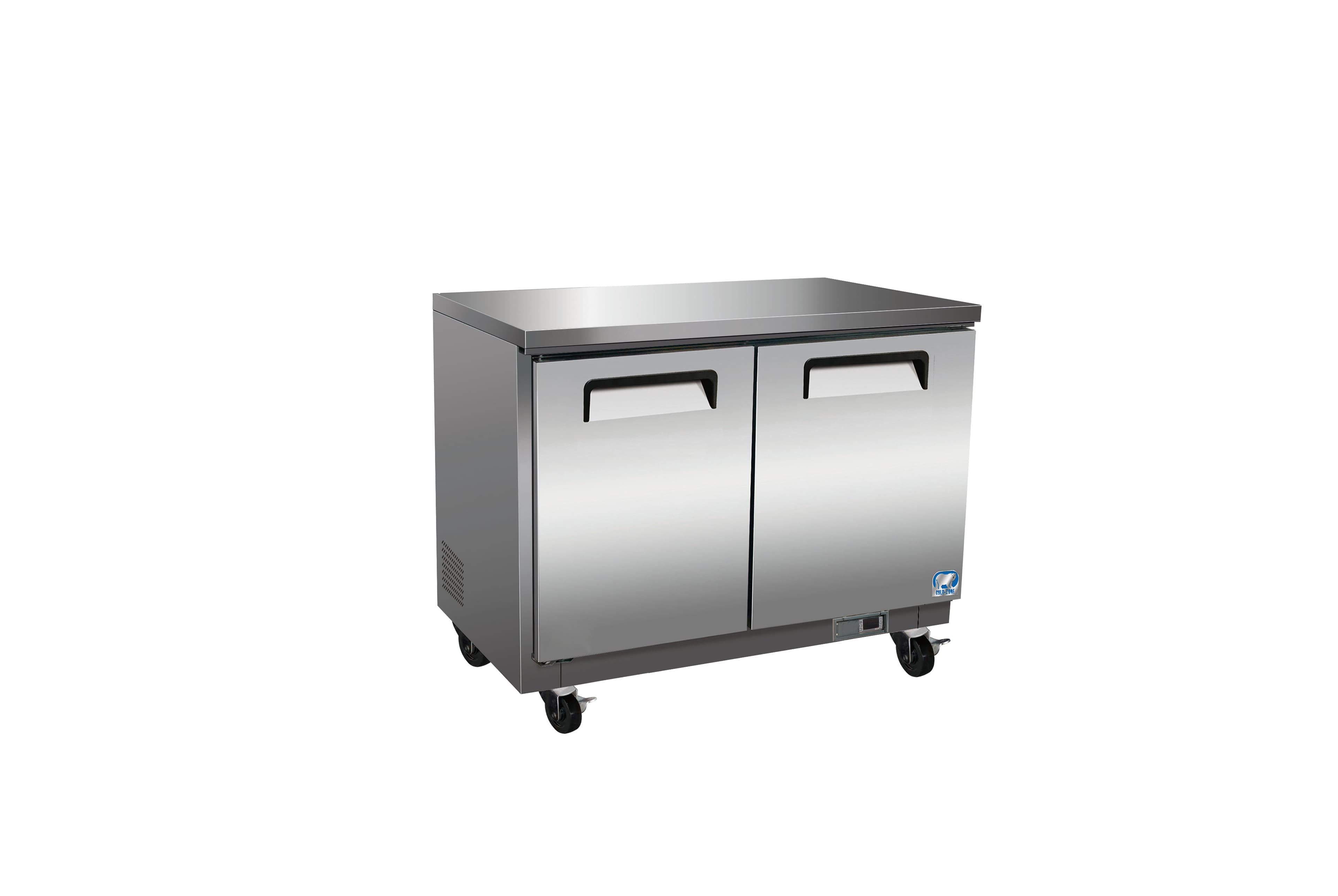
This guide explains how to install, set, clean and troubleshoot COLDZONE reach-in refrigerators and freezers, prep tables and undercounters, topping rails, keg coolers, chest freezers and combined island freezers, using COLDZONE's own service, installation and care manuals.
Key takeaways
- Reach-ins go no closer than 2 inches to a wall with 12 inches clear above; topping rails and island freezers need 100 mm all round, chest freezers 4 inches.
- Reach-in refrigerators run 34 to 38°F and freezers -7 to -3°F; prep table rails hold 33 to 41°F; chest freezers -10 to 0°F.
- Clean the condenser every 90 days, or every 30 days where grease or dust is heavy, with a brush, vacuum or compressed air, never a pressure washer.
- Chest freezers are defrosted by hand when the frost reaches 5 to 8 mm, island freezers weekly, with a plastic or wooden scraper only.
- The units use flammable R-290 refrigerant: repairs go to the manufacturer's authorized service network.
Which COLDZONE manual covers your unit
COLDZONE publishes a separate service, installation and care manual for each family. The Reach Ins manual covers the solid door reach-in refrigerators and freezers (33R-1D, 33F-1D, 49R-2D, 49F-2D and the rest of the range). A combined manual covers pizza prep tables, sandwich/salad units, undercounter and worktop refrigerators and freezers, such as the 36UC-2DF, 48UC-2DF and 72UC-3DF.
The Topping Rail X manual covers the TR-40X and TR-40XG rails and their larger sizes, the Beer Dispensers manual the BCBD keg coolers, and the F-Series Chest Freezer manual the solid door and glass lid chest freezers such as the F21.2 and F17.70CG. The 19L and 22L combined island freezers come with their own installation instructions. Keep your model number handy so you can match it to the right manual.
Installation clearances, levelling, and electrical connection
All COLDZONE units are intended for indoor use only, on a floor strong enough to support the fully loaded weight. For reach-in refrigerators and freezers, the manufacturer's manual (33F-1D) recommends installing the unit no closer than 2 inches from any wall and with at least 12 inches of clear space above the unit. The topping rail manual (TR-40XG) specifies at least 100 mm (approximately 4 inches) of free space all around the cooler. Chest freezers (F17.70CG) require at least 4 inches of free space around them. For combined island freezers (19L), keep a minimum of 100 mm from any peripheral surface; when installing multiple island freezers side by side, the lateral gap should be 0–5 mm and the longitudinal spacing between units 100–150 mm.
Levelling is essential. Use a spirit level to check front-to-back and side-to-side alignment. Reach-in units, prep tables, and undercounter models come with casters; lock the front wheels after placing the cabinet in its final position. If the unit has adjustable legs, turn the bullet feet until the cabinet is stable and does not rock. If a unit must be laid on its side during transport, let it stand upright for at least 24 hours before plugging it in, so compressor oil can settle.
A qualified, licensed electrician must handle the electrical connection in accordance with local code. The equipment is designed for 115 V / 60 Hz / 1 Ph service (as shown on the nameplate) and comes with a NEMA 5-15P plug for most models; a few larger units may use a different plug. The circuit must be properly rated and protected. COLDZONE's manuals stress that the unit must be turned OFF and disconnected from power before any service or cleaning inside the refrigerated compartment.
Daily temperature settings and operation controls
COLDZONE reach-in refrigerators and freezers, sandwich/salad prep tables, undercounter units, and topping rails all use a solid-state digital thermostat with the same keypad layout. The front panel has a SET key, a manual-defrost key, and UP/DOWN arrow keys. An on/off switch (glows green when on) is located on the front panel or bottom shroud. The controller displays the current cabinet temperature and LED indicators show compressor, defrost, and fan status.
Factory temperature setpoints vary by equipment type. For reach-in refrigerators, the manual (33F-1D) sets the range at 34°F to 38°F. Reach-in freezers are factory-set to -7°F to -3°F. Prep-table cabinet sections run 34°F to 38°F, while the top rail maintains 33°F to 41°F. Topping rails (TR-40XG) automatically regulate to keep stored product below +2°C. To see the current setpoint, push and release the SET key. To change it, hold SET for more than 2 seconds until the display blinks, then use the arrow keys to adjust the value and press SET again to lock it in.
Chest freezers (F17.70CG) use a dial thermostat on the back of the cabinet marked 0 (off) through 7 (coldest). The factory temperature range is -10°F to 0°F. A digital display on the lid or lamp box shows the inside temperature. Combined island freezers rely on an ECS-180 (A) thermostat; the separate instructions for that controller define the operation. In all units, avoid packing product so tightly that air cannot circulate: air enters at the top rear and must flow down to the bottom. Do not block the evaporator fan inlets or outlets.
All refrigerated models defrost automatically every 6 hours: the compressor stops, and the defrost symbol lights up; the coil warms until it reaches a termination temperature (41°F for refrigerators, 45°F for freezers) or after 20 minutes, then cooling resumes. You can start a manual defrost at any time by holding the defrost key for more than 2 seconds. Chest freezers and combined island freezers do not have automatic defrost; they must be defrosted manually when the frost layer reaches 5–8 mm, as explained in the cleaning section.
Cleaning and preventive maintenance
Before cleaning any unit, turn it OFF and unplug it. The interior and exterior can be wiped down with warm water and a mild detergent; for stubborn stains, ammonia and water or a non-abrasive liquid cleaner may be used. Always rub stainless steel exteriors with the grain to avoid scratching. Do not apply cleaners that contain chlorine.
Condenser coil maintenance is critical. The coil sits behind the front grille or at the back bottom of the cabinet. COLDZONE's manuals recommend cleaning the condenser every 90 days under normal conditions. In kitchens with heavy grease or dust, clean it every 30 days. Light dust can be removed with a soft brush. Heavier buildup requires a vacuum cleaner or compressed air blown through the fins. For greasy deposits, use a degreasing agent made for refrigeration coils, followed by compressed air. Never use a high-pressure water spray: it can damage electrical components. A clogged condenser will cause high temperatures, longer run times, and eventually compressor failure.
Chest freezers (F17.70CG) must be defrosted manually. The manufacturer instructs: unplug the freezer, open the lid, and leave it open. Loosen the frost with a plastic or wooden scraper—never a sharp or pointed tool. To speed defrosting, place bowls of hot water inside. After the frost is gone, clean and dry the interior thoroughly before restarting. For combined island freezers (19L), a weekly manual defrost is recommended: remove food, unplug the unit, let the frost melt, clean the sink and drain, dry, then restart and wait until the display reads -22°C before reloading.
Topping rail pans and prep-table pan openings should be cleaned regularly. The rail's instruction manual (TR-40XG) says the lid may be cleaned the same way as the cooler body. Do not leave food in the rail overnight; remove product and empty the pans, though empty pans can stay in place. This prevents the rail from working excessively to hold temperature.
Troubleshooting: what to check before calling for service
To view the last alarm, press and hold the UP or DOWN arrow key; the display shows the code. To reset the recorded alarm, hold the SET key while the code is displayed until 'rst' appears, then press SET again. If a code persists or the unit remains inoperative, stop troubleshooting and contact the manufacturer's authorized service provider.
- P1: Room probe failure – the compressor cycles based on backup parameters.
- P2: Evaporator probe failure – the defrost ends based on time only.
- HA: Maximum temperature alarm – the cabinet has exceeded the high-temperature threshold.
- LA: Minimum temperature alarm – the cabinet has fallen below the low-temperature threshold.
- EA: External alarm – triggered by a connected sensor or switch.
- CA: Serious external alarm – all outputs are shut off.
- dA: Door open alarm – a door has been left ajar; the compressor and fans restart when closed.
Service and repair: follow the manufacturer's network
COLDZONE equipment uses R-290 (propane) refrigerant, which is flammable. The manuals contain a specific caution: 'Risk of fire or explosion due to flammable refrigerant used. Follow handling instructions carefully in compliance with U.S. Government Regulations.' For that reason, only factory-authorized service personnel may open the refrigeration system. Component parts must be replaced with like components to minimize ignition risk.
If a unit requires attention beyond the troubleshooting steps listed above—whether a refrigerant leak, a failed compressor, or a control board issue—you must arrange service through COLDZONE's authorized service network. Have the model number and serial number (found inside the cabinet on the left wall near the top) ready when you call. Do not attempt to repair the sealed system yourself.
When disposing of an old unit, the manufacturer reminds you to remove the doors to prevent child entrapment and to follow local regulations for appliances containing flammable blowing gas (C5H10) and refrigerant.
Common questions
How often should I defrost a COLDZONE chest freezer?
- The F-Series manual says to defrost when the frost layer reaches 5–8 mm thick. Unplug the unit, leave the lid open, and use a plastic or wooden scraper to loosen the ice. Bowls of hot water can speed up the process. After defrosting, clean and dry the interior before restarting.
What temperature should my sandwich prep table rail be set to?
- The prep table manual (36UC-2DF) specifies a rail temperature range of 33°F to 41°F. The cabinet section underneath runs at 34°F to 38°F. Keep pans in place during operation and remove product overnight.
Why does my reach-in freezer display 'HA' on the controller?
- 'HA' stands for High Temperature Alarm. It means the cabinet has exceeded the maximum allowable temperature. Check whether the door was left open, the condenser coil is dirty, or the unit is in a hot location. Clear the alarm by pressing the SET key as described in the manual, but if the condition recurs, request service from a factory-authorized provider.
Can I clean the condenser coil with a hose or pressure washer?
- No. COLDZONE's manuals explicitly warn against using a high-pressure water wash. Water can damage the electrical components near the coil. Use a soft brush, a vacuum cleaner, or compressed air. For heavy grease, apply a coil-safe degreaser and then blow out the fins.
Do I need a special electrical circuit for my COLDZONE unit?
- Yes. The installation manuals state that the unit must be connected to a properly rated, dedicated circuit matching the voltage and amperage on the serial tag. A licensed electrician must install the connection to meet local code. Most units run on 115 V / 60 Hz and use a NEMA 5-15P plug.