
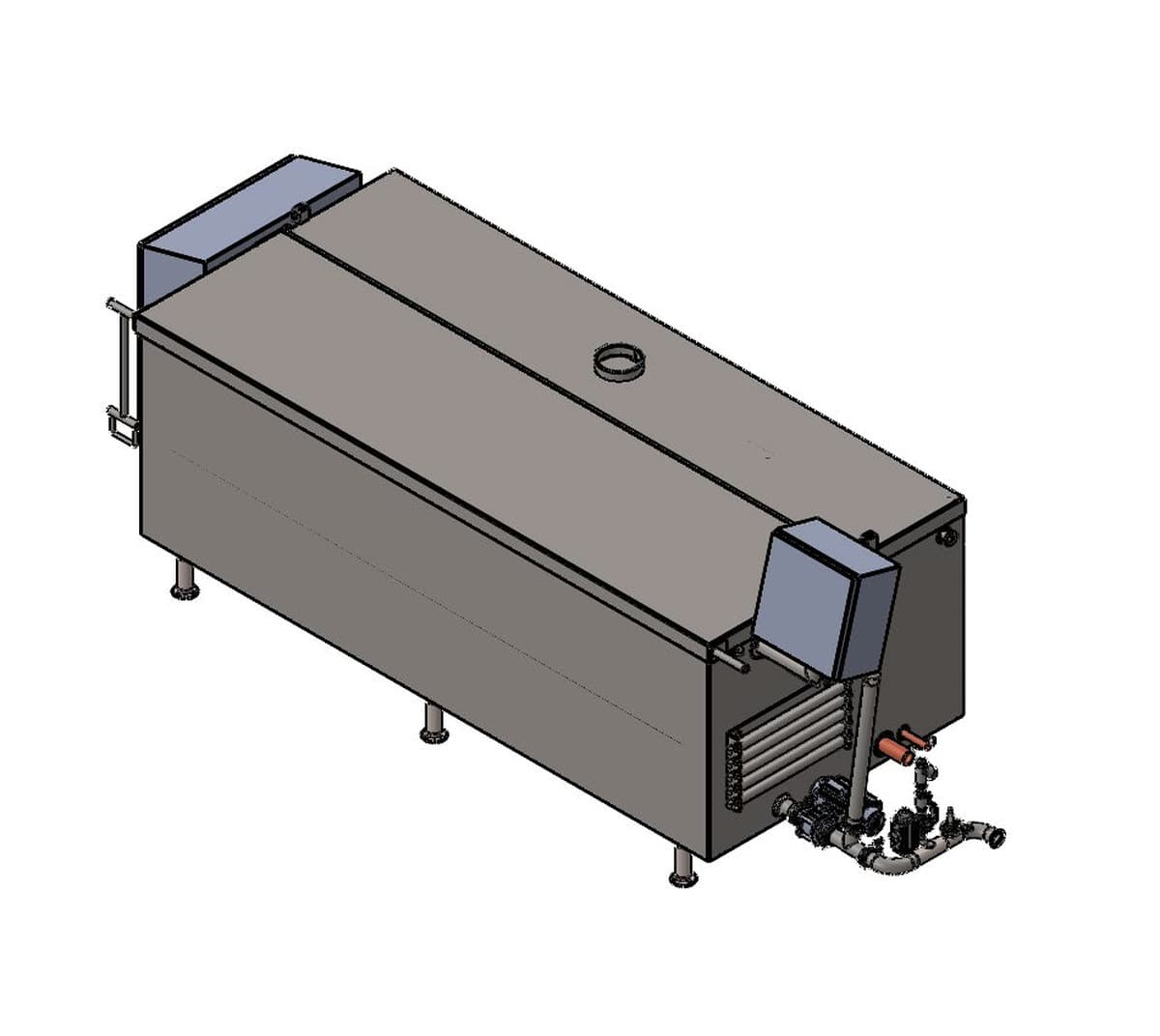
This guide explains how to safely install, operate, clean and maintain CapKold cook-chill systems. It covers DH and INA2 kettles, CKCP control stations, CKTC-320 tumble chillers and cook tanks, with steps drawn from the manufacturer's manuals.
Key takeaways
- Always have a qualified, licensed installer handle gas, water and electrical connections to local code.
- Check kettle jacket water level and vacuum daily before starting.
- The CKCP HMI touch screen controls cooking, cooling, pump-out and batch recording.
- The CKTC-320 tumble chiller chills up to 300 gallons of bagged product using a chilled water bath.
- For any service beyond routine cleaning, contact the manufacturer's authorized service network.
Equipment overview and manuals
CapKold cook-chill systems include steam-jacketed kettles, kettle control stations, casing pumps, tumble chillers and cook tanks. The DH-400L and DH/INA/2-100 kettles are self-contained, gas-heated, floor-mounted tilting kettles with capacities of 400 litres (106 gallons) and 100 gallons respectively, as described in their operator manuals. The CKCP HMI kettle control station monitors and controls agitated steam-jacketed kettles, providing touch-screen control of steam heating, jacket cooling, agitator operation and batch time/temperature recording, per the CKCP operator manual. The CKTC-320 tumble chiller is a front-loading batch unit that chills up to 300 gallons of bagged product in a chilled water bath, as detailed in its operator manual. Cook tanks can be connected to the CKCP for temperature recording, as noted in the CKCP manual's HACCP recording section.
Installation requirements
All installation work involving gas, water, electrical or steam connections must be performed by a qualified, licensed installer in accordance with local codes. The DH-400L and DH/INA/2-100 manuals specify a minimum clearance of 24 inches from sides and 24 inches from the back, with the unit installed on non-combustible flooring in a well-ventilated room. The CKTC-320 manual requires a minimum of 3 feet clearance around the machine and a level floor with capacity to hold the static weight of the machine, water and product. The CKCP control panel should be located where it will not interfere with hoist systems and where operators can frequently access it, with room to open doors for maintenance.
For the DH-400L and DH/INA/2-100 kettles, electrical supply must be 3-phase at the rated nameplate voltage (208V, 240V or 480V) with branch circuit protection; current draw is 7 amps per line at 208/240V and 3.5 amps at 480V. Gas supply must meet 7-10 inches W.C. for natural gas or 11-14 inches W.C. for propane, connected with a 1-inch NPT line. Water supply requires 30-60 PSIG and a 3/4-inch NPT connection with a check valve if required by local code. The kettle must be levelled using steel shims between the drip tray and frame, starting with the right stanchion, then the left, and finally checking the rim with a 4-foot carpenter's level.
The CKTC-320 requires a 15-amp, 3-pole breaker for 208-480V 3-phase power, air supply at 90-100 PSI through a 1/4-inch pipe, mains and chilled water through 1-1/2-inch pipes, steam through a 1-1/4-inch pipe, and a 2-inch waste drain. Final levelling uses adjustable legs, maintaining a minimum 6-inch clearance from floor to machine bottom. The CKCP main breaker voltage is typically 208/3 to 480/3; agitator motor wiring should be 12 AWG with 75°C insulation rating, and sensor wiring should use shielded conductor cable in its own conduit, as detailed in the CKCP operator manual.
Daily operation and controls
Before starting any kettle, check the jacket water level in the sight glass; it must be in the middle of the bulls-eye. With the kettle cold, verify the pressure gauge shows 20 to 30 inches of vacuum below zero. If either is low, refer to the jacket filling or vacuum procedures in the preventive maintenance section of the kettle manual. To start heating on a DH-400L or DH/INA/2-100, open the main gas supply valve, pull out the emergency stop and turn on the control power switch. The touch screen will power on; then press COOK CONTROL to access the cooking screen. Ensure the kettle is fully upright using the TILT CONTROL, then set the desired cooking temperature in degrees Celsius via the COOK SETPOINT keypad. Tap the COOK switch to ON; the burners will cycle, with LOW FIRE and HIGH FIRE indicators showing green. The kettle must not be heated with less than 25% of its capacity of product or water, or the rate-of-rise feature will shut it down. The TURBO HEAT function provides a 30-second burst of both high and low fire for fine-tuning.
The CKCP HMI control panel provides a main display with navigation to individual kettle screens, a recipe library for storing recipes, agitator speed control (0-100%, maximum 18 RPM), faucet fill with automatic water metering in gallons or litres (hot or cold only, no mixing), and batch control with a Eurotherm chart recorder that continuously records temperature data. The pump-out feature can maintain a set temperature by alternating cooling water and steam. The CKCP can also record temperatures from connected equipment such as cook tanks and tumble chillers, as described in its manual. The trend screen lets operators view temperature trends during cooking.
For the CKTC-320 tumble chiller, complete all preoperational checks: verify air pressure at 80 psi, steam supply, water pressures, and voltage. Close and lock the door, select a chill formula from the touch screen, and press CYCLE START. The drum fills with water, the centrifugal pump and basket start when the low water level is reached, and the chilled water valve opens. The operator is alerted to load bags; after loading, press OK to start the batch timer. When the cycle ends, check bag temperature. If below 40°F, press END CYCLE; if above, press START to add 15 minutes. Drain the water to waste or recycle tank, then unlock the door and unload bags, using the JOG button to redistribute product. A clean cycle uses steam and sanitizer injection; always follow with a rinse cycle if chemicals were used.
Cleaning and routine care
Clean kettle food-contact surfaces as soon as possible after use, preferably while the kettle is still warm. Scrape and flush out large food residues, then wash with a detergent solution and rinse. The DH-400L manual suggests using a high-quality detergent and sanitizer, kettle brushes, spray degreaser (PN 114801), de-limiter/descaler (PN 114800), and a stainless steel cleaner. The DH-400L manual warns never to leave a chlorine sanitizer in contact with stainless steel for longer than 30 minutes; the DH/INA/2-100 manual limits this to 10 minutes. Always follow the specific manual for your model. Never spray or hose down the control console, electrical connections or burners. Use a cloth or soft brush; do not use metal implements that could scratch the kettle.
For the CKTC-320, run a clean cycle as described in the operator manual. After the cycle, clean the in-line filter to prevent pump damage. The exterior can be wiped down with a mild detergent. Do not use high-pressure water on any electrical panels. The CKCP control panel must never be sprayed with any liquid; wipe it with a dry or slightly damp cloth only.
Routine maintenance includes daily checks of kettle jacket water level and vacuum, and periodic inspection of the safety valve by lifting the lever to ensure it vents freely, as cautioned in the kettle manuals. The CKTC-320 manual advises checking the main air pressure regulator setting (80 psi) and inspecting the control panel interior for cleanliness, vacuuming if needed. All manuals stress that any service beyond these routine tasks must be performed by factory-authorized personnel.
Troubleshooting common issues
If a kettle does not heat, first confirm that the main gas supply valve is open, the emergency stop is pulled out, and the control power switch is on. Check that the jacket water level is correct and the pressure gauge shows adequate vacuum. The DH-400L and DH/INA/2-100 manuals note that heating an empty kettle may cause the safety valve to release steam. If the touch screen displays "TEMPERATURE RATE OF RISE EXCEEDED," add more water or product and press the ROR RESET button.
For the CKCP, if the water meter fails, the Kettle Water Meter Alarm will activate after the set alarm time; reset the meter. If the chart recorder is not printing, verify the network connection and IP address as described in the CKCP manual's Review Printing Software set-up section. The CKTC-320 manual indicates that the door must be firmly pressed closed before locking; if the door will not lock, check air pressure and ensure the empty tank light is on. The centrifugal pump must not run dry; if the basket does not rotate, verify that the pump is on and water is present, as the ceramic seal is water-lubricated.
For any persistent issue, consult the troubleshooting sections of the specific equipment manual. If the problem cannot be resolved, contact the manufacturer's authorized service network. Norpex does not provide repair services.
Service and support
All CapKold equipment should be serviced only by factory-authorized personnel. The manuals warn that replacement parts other than the manufacturer's own may cause injury or equipment damage. When contacting service, have the model number, serial number and installation date ready, as recommended in each manual.
To shut down the CKCP or kettle HMI correctly, follow the manual's shutdown procedure: close the HMI application from its Settings screen, then shut down Windows from the start menu, and only then turn off the disconnect. Improper shutdown can corrupt system files. After a power outage, follow the recovery procedure in the manual to restore the HMI program from the backup file. For the CKTC-320, use the panel disconnect to power off, and lock it out during maintenance.
Common questions
What should I check if my kettle won't heat?
- Ensure the main gas valve is open, the emergency stop is pulled out, and the control power switch is on. Verify the jacket water level is in the middle of the sight glass and the pressure gauge shows 20-30 inches of vacuum. If the screen shows a rate-of-rise warning, add more product or water and press ROR RESET.
How often should I clean the kettle?
- Clean food-contact surfaces as soon as possible after each use, preferably while the kettle is still warm. If the unit is in continuous use, clean and sanitize inside and outside at least once every 12 hours, per the operator manuals.
Can I use a high-pressure hose to clean the control panel?
- No. The manuals explicitly warn against spraying or hosing down the control console, electrical connections or burners. The CKCP manual states: "DO NOT SPRAY THE CKCP KETTLE CONTROL PANEL WITH ANY LIQUID." Use a damp cloth only.
What is the maximum capacity of the CKTC-320 tumble chiller?
- The CKTC-320 can chill up to 300 gallons of bagged product, as stated in its operator manual. The basket volume is 70.3 cubic feet, and the machine should not be operated beyond its designed load capacity.
How do I shut down the HMI correctly?
- Follow the shutdown procedure in the manual: close the HMI application from its Settings screen, then shut down Windows from the start menu, and only after Windows has fully shut down turn off the disconnect switch. Turning the power off first can corrupt the system files.