
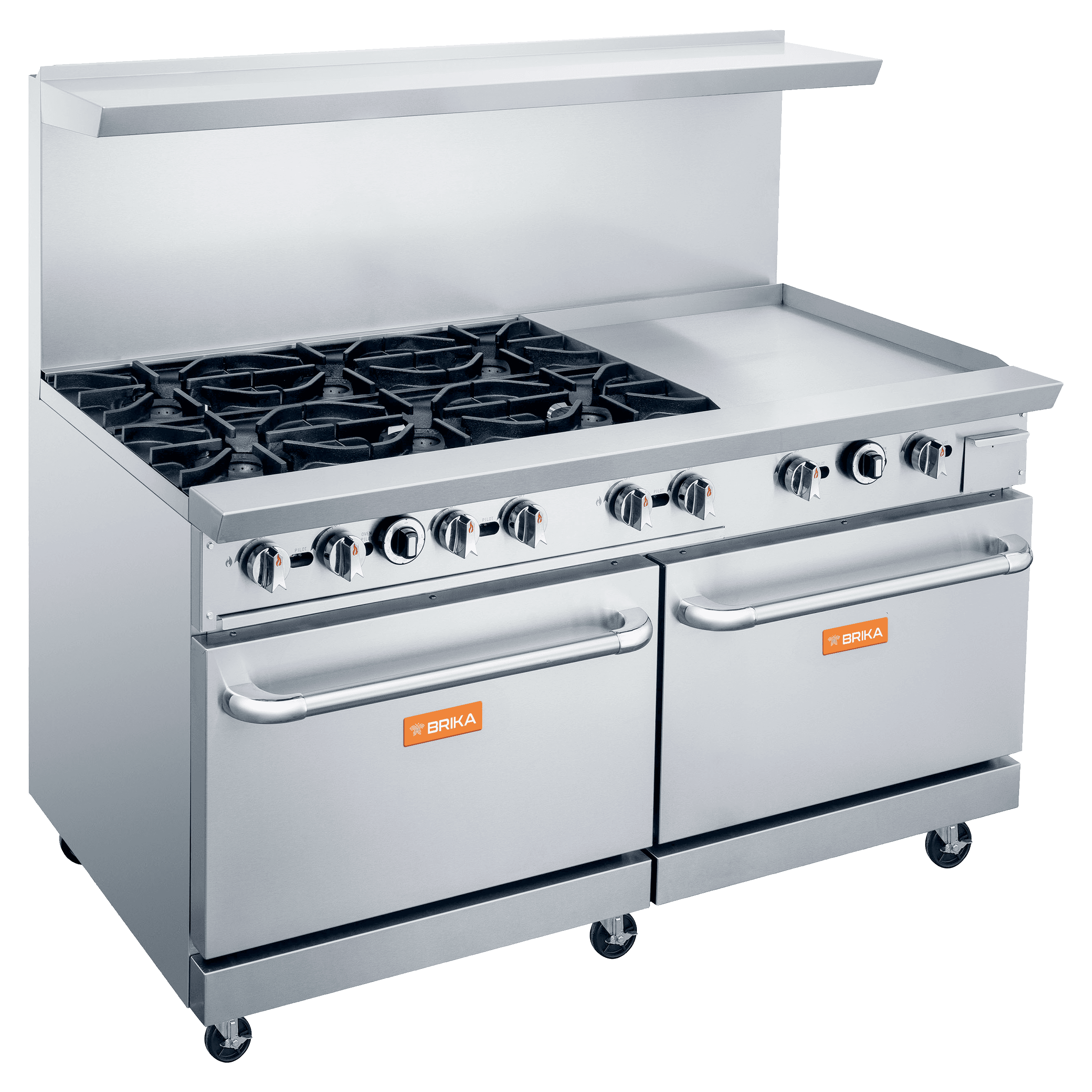
This guide explains how to properly install, operate, clean, and troubleshoot Brika gas ranges, fryers, griddles, hot plates, and stock pot ranges, using the manufacturer's instructions. It covers clearances, lighting pilots, daily cleaning steps, and when to call for authorized service.
Key takeaways
- All Brika gas equipment must be installed by a qualified, licensed gas technician according to local codes and the manufacturer's manuals.
- Each appliance series has specific clearance requirements from combustible surfaces; always check the manual for your model.
- Daily cleaning with non-abrasive cleaners, a weekly fryer boil-out and re-seasoning the griddle plate keep the equipment working.
- Pilot lights must be lit following the exact steps in the manual; never use an open flame to check for gas leaks.
- For any repair or gas conversion, contact the manufacturer's authorized service network; do not attempt to modify the unit yourself.
Overview of the Brika gas cooking line
Brika's commercial gas cooking equipment includes several series: BGR gas ranges with open burners and optional griddles, BFR tube-fired floor fryers, BMG manual griddles, BHP hot plates, and BSP stock pot ranges. Each series is covered by its own instruction manual. The BGR range manual (covering models BGR-4B, BGR-6B, BGR-10B, and combinations with griddles) provides installation, operation, and cleaning instructions. The BFR fryer manual covers the BFR-40, BFR-50 and BFR-70. The BMG griddle manual applies to 24-inch, 36-inch, and 48-inch manual griddles. The BHP hot plate manual covers the 12, 24 and 36 inch models (BHP-122, BHP-244 and BHP-366). The BSP stock pot range manual covers single (BSP-18) and double (BSP-18D) units.
Installation requirements and clearances
All Brika gas appliances must be installed by a qualified, licensed gas technician in accordance with local codes and the applicable national standards (CSA B149.1 for natural gas, CSA B149.2 for propane, or ANSI Z223.1/NFPA 54). The installation location must have a solid, level, non-combustible surface, adequate lighting, and proper ventilation under a hood. Each manual specifies minimum clearances from combustible construction: for BGR ranges, 11 inches on the sides and 14 inches at the back; for BFR fryers, 8 inches on the sides and 12 inches at the rear, with a 16-inch separation from open flames of adjacent appliances unless a non-combustible divider at least 7 inches above the fryer is installed; BMG griddles and BHP hot plates are for installation on non-combustible surfaces only, with 0 inches at the sides, 6 inches at the rear and 4 inches at the floor; for BSP stock pot ranges, 24 inches back, 18 inches left and right from combustibles, or 4 inches back and 0 inches sides from non-combustibles.
The regulators are factory set at 5 inches W.C. for natural gas and 10 inches for propane on the BGR ranges and BSP stock pot ranges, and at 4 inches for natural gas and 10 inches for propane on the BFR fryers, BMG griddles and BHP hot plates. The fryer and stock pot manuals ask for a supply pressure of at least 7 inches W.C. for natural gas and 11 inches for propane, and no unit may be connected to more than 14 inches W.C. (1/2 psi) without a step-down regulator. The range manual asks for a manual shutoff valve upstream of the manifold, within 4 feet of the appliance, and for pipe joint compound that resists liquefied petroleum gas; do not use Teflon tape. Check every connection with a soap and water solution, never a flame.
Legs must be attached before operation. For ranges, legs screw into threaded pads; for fryers, legs or optional casters (with locking brakes on the front) are mounted to base plates. The BSP stock pot range is shipped without legs attached; the leg plate must be screwed to the bottom. On the ranges and griddles the adjustable feet give one inch of adjustment. Level the appliance using a spirit level. For fryers with casters, a restraining device must be engaged to prevent tipping. The flue riser and shelf assembly on ranges must be installed as shown in the manual.
Daily operation and controls
Lighting pilots: For BGR ranges, each top burner has its own pilot. Turn all control knobs to OFF, then use a match or lighter to light the pilots. For the oven, turn the thermostat to OFF, open the kick panel, depress the button on the oven safety valve, light the pilot, and hold the button for 30 seconds before releasing. On BFR fryers, open the burner compartment door, turn the thermostat to OFF, press down the combination gas valve knob and turn to PILOT, light the pilot with a match while holding the knob down for about 30 seconds, then turn to ON. For BMG griddles and BHP hot plates, ensure all knobs are OFF, turn on the main gas valve, light each pilot through the front holes, and adjust the pilot flame to about 1/2 inch height using a screwdriver on the pilot valve screw. The BSP stock pot range follows a similar procedure: light each pilot, adjust to 1/2 inch flame.
Using the equipment: On BGR ranges, turn the corresponding control knob to the desired flame level. The top griddle (if equipped) is manually operated—preheat for 15–20 minutes and adjust flame height to maintain temperature; there is no thermostat. The oven is controlled by a thermostat knob. For BFR fryers, never turn the thermostat on until the fry pot is filled with oil or solid shortening. When using solid shortening, pack it tightly around and above the heat tubes, then set the thermostat to the lowest temperature until melted, then add more shortening to reach the frying depth. Filter the oil between 254°F and 350°F (123°C and 177°C); a cold fryer will not drain properly. On BMG griddles, season the plate before first use: heat it to a low temperature, about 300 to 350°F (150 to 180°C), spread about one ounce of cooking oil per square foot into a thin film, wipe off the excess, and repeat 2 to 3 times until the surface is slick and mirror-like. Then preheat 15–20 minutes before cooking. BHP hot plates are ready after pilot lighting; turn knobs to ON and adjust flame. The BSP stock pot range has two burners per unit: a center star section (40,000 BTU) controlled by the right knob and an outer ring (40,000 BTU) controlled by the left knob, allowing flexible heat from simmer to full 80,000 BTU.
Cleaning and routine care
Turn off the range and the upstream gas valve before cleaning. The BGR manual asks for the burners and crumb tray to be cleaned regularly and the stainless steel to be washed every day with a non-corrosive detergent suited to it, then rinsed and dried; never spray the range with water, especially when hot. Do not use abrasive detergent, a brush or scraper, or any chlorine cleaner, even diluted, and do not let acidic foods or salt sit on the surfaces. Rub scrapes with a plastic scouring pad with the grain. Rust on the cast iron grates comes off with a wire brush; wash them in warm soapy water, dry them at once and coat them lightly with food-grade cooking oil.
Daily, the BFR fryer manual has you turn the thermostat off, drain the oil into a safe container, flush the sediment out with a little hot oil, wipe the fry pot, and strain the oil back through several layers of cheesecloth or a filter machine before topping up to the MIN mark. Weekly, fill the fry pot with warm water and boil-out compound, bring it to a gentle boil for at least five minutes, let it stand until the deposits soften, scrub the walls and heat tubes, then drain, rinse, boil clean water once more, drain, rinse and wipe dry. Monthly, clean lint from around the burner and orifices and check that the carry-over ports are clear.
On the BMG griddles, clean the plate after each use with a wire brush or metal spatula (a griddle stone if needed), rubbing with the grain while it is still warm; mild soap may be used, then remove all soap and debris with a damp cloth and cover the plate with a thin film of oil against rust. Empty the catch tray after each use or at least daily, and check monthly that the regulator vent is open. BHP hot plate grates are washed with soap and water daily. The BSP stock pot grates may soak overnight in a strong commercial cleaning compound, then be rinsed with hot water, dried and oiled; empty the grease drawer when it is cool.
Troubleshooting common issues
Each manual has its own table. On the BMG griddles and BHP hot plates: if a burner will not light, open the main gas line and light the pilot; a pilot that will not stay lit is set too low (raise it to about 1/2 inch with the pilot valve screw) or has a clogged pilot tube, which is a service call; a cooking surface that heats slowly has carbon build-up, so keep the burners clean. On the BSP stock pot range, pilot outage comes from a pilot flame set too low, a restricted pilot orifice or valve, poor burner combustion or poor ventilation.
On the BFR fryer, burners that do not come on point to the gas supply being off or the gas valve set to OFF or PILOT; a pilot that will not light to the gas, its adjustment, the thermopile or its connections, a clogged orifice or air in the line. If the fryer shuts down on its high limit, which keeps the oil below about 450°F, let the oil cool below 400°F, then relight it; after a main burner fails to light, shut off all gas and wait five minutes before trying again. The BGR range table adds gas pressure, a blocked nozzle or orifice, the thermocouple and the gas valve for pilots and burners that will not light. Regulator, orifice, air shutter and valve work belongs to a qualified technician.
Service and support
All repairs, gas conversions, and adjustments beyond routine cleaning must be performed by a qualified, licensed technician. Brika's manuals state that conversions between natural gas and propane require a licensed and certified gas technician, using the conversion kit included with the appliance. The video 'BRIKA - HOW TO: Convert the Gas Regulator (NG to LPG / Propane to Natural Gas)' illustrates the regulator conversion process for BGR, BCB, BHP, and BMG units. For any service needs, contact the manufacturer's authorized service network. If you have questions about a specific model, ask Norpex.
Videos from the maker
Common questions
What clearances are required for a Brika gas range?
- The BGR range manual specifies minimum clearances from combustible construction: 11 inches on the sides and 14 inches at the back. Ranges must be installed on non-combustible floors.
How do I light the pilot on a Brika floor fryer?
- Open the burner compartment door, turn the thermostat to OFF, press down the combination gas valve knob and turn to PILOT, light the pilot with a match while holding the knob down for about 30 seconds, then turn the knob to ON. Never turn the thermostat on until the fry pot is filled with oil or shortening.
Can I convert my Brika appliance from natural gas to propane?
- Yes, but only a licensed and certified gas technician may perform the conversion using the included LP conversion kit. The video 'BRIKA - HOW TO: Convert the Gas Regulator (NG to LPG / Propane to Natural Gas)' shows the regulator conversion step.
How often should I clean the griddle plate?
- The BMG griddle manual says to clean the plate after each use, while it is still warm, with a wire brush or metal spatula, rubbing with the grain. Wipe off soap and debris with a damp cloth, then cover the plate with a thin film of oil. Season it again after each weekly soap and water cleaning.
What should I do if I smell gas?
- Turn off the main gas valve. Do not light a flame, ignite anything or switch on anything electrical. The Brika griddle and hot plate manuals say to call the fire department if needed and then call for service.