
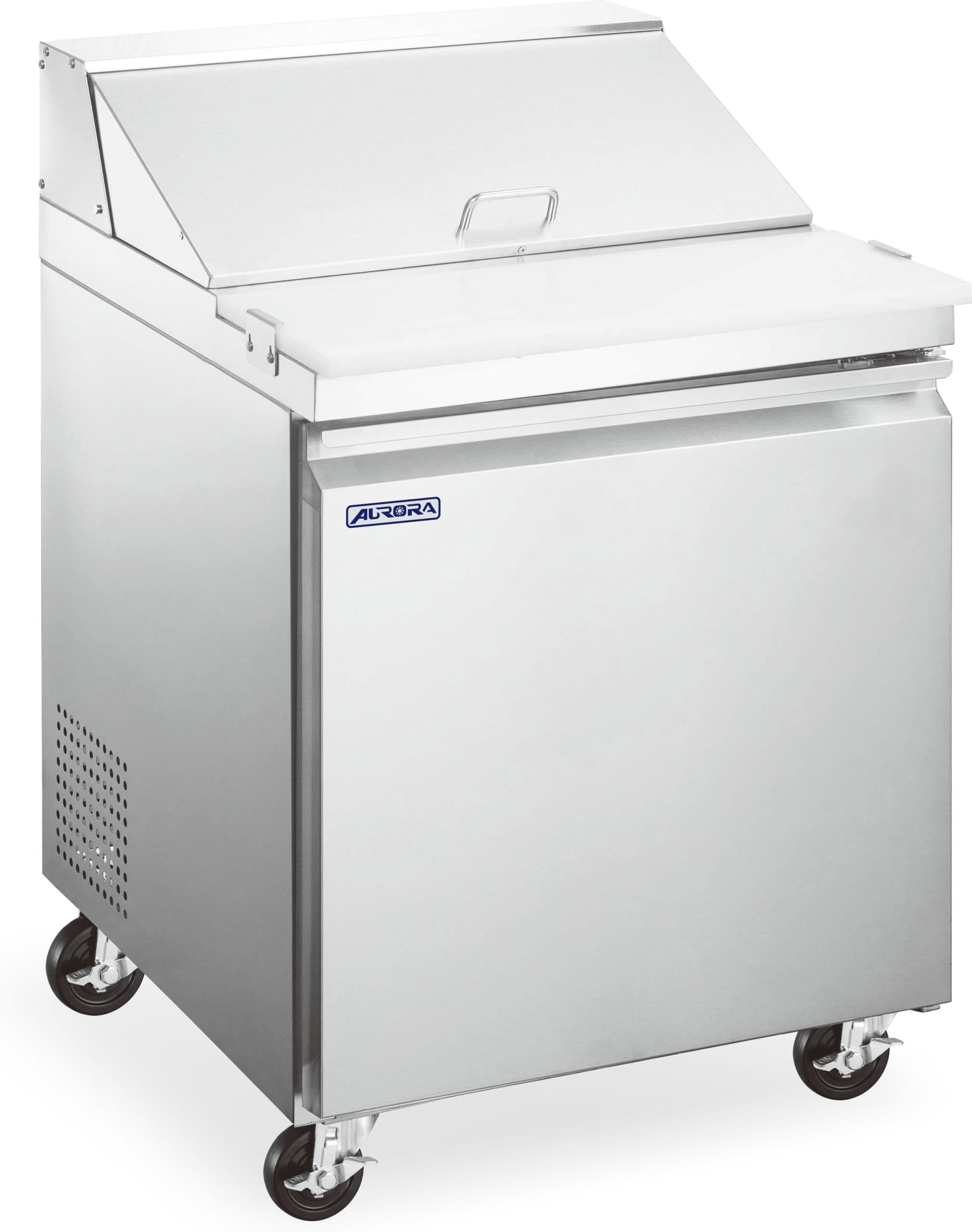
This guide covers the proper use and care of Aurora reach-in refrigerators and freezers, prep tables, and undercounter units. Follow these steps to ensure reliable performance and food safety.
Key takeaways
- Let the unit stand upright for 24 hours after transport before plugging it in.
- Maintain the specified rear clearance: 4 inches for reach-ins and undercounters, 6 inches for prep tables.
- Clean the condenser coil monthly with a commercial cleaner, brushing from top to bottom.
- Use only mild soap and warm water on interior surfaces; never use abrasive cleaners or bleach.
- For any service beyond routine cleaning, contact the manufacturer's authorized service network.
Models covered and manuals
Aurora's refrigeration lineup includes reach-in refrigerators and freezers, glass door display units, prep tables (pizza, sandwich/salad, and mega top), undercounter refrigerators and freezers, and a back bar cooler. The instruction manuals provided by the manufacturer cover specific model groups. One manual covers items 59023, 59024 and 59025 (the 29-inch one-door reach-in freezer and refrigerator and the 54-inch two-door reach-in freezer). A second covers reach-in and glass door display refrigerators, including items 59026, 59032 and 59033. The prep table manual covers the sandwich/salad and mega top tables, including items 59045, 59048, 59049 and 59050, and the undercounter manual covers items 59055 and 59056.
The other Aurora units in our list, such as the pizza prep tables, the 27-inch undercounters and the back bar cooler, come with their own manuals.
Installation
Before plugging in any Aurora unit, let it stand upright for at least 24 hours if it has been transported. This allows the compressor oil to settle. Install the unit on a strong, level surface indoors in a well-ventilated area. The reach-in and undercounter manuals specify a minimum clearance of 4 inches from the back of the unit; the prep table manual requires 6 inches. Avoid locations with high humidity, dust, or heat-generating equipment, as these can reduce efficiency and cause rust or malfunction. The specification tables give a maximum ambient temperature rating of 24°C (75°F). Outdoor use is not permitted.
All electrical work must be performed by a qualified, licensed installer according to local code. Each unit requires a dedicated, grounded 110–120V / 60Hz single-phase outlet with appropriate overcurrent protection. Do not use an extension cord. The rating plate on the unit lists the exact electrical requirements. Ensure the unit reaches its operating temperature before loading it with product. Make sure all accessories (shelves, casters, etc.) are installed before plugging in.
Daily operation and temperature controls
Aurora refrigeration units are equipped with a digital temperature controller. On prep table models, the controller is factory-set to maintain an average temperature of 38°F (approximately 3.3°C). Reach-in refrigerators operate in the range of 0.5 to 4.4°C (33 to 40°F), while freezers maintain -22.2 to -17.8°C (-8 to 0°F). Undercounter refrigerators run at 0.6 to 4.4°C (33 to 40°F) and undercounter freezers at -22.2 to -17.8°C. To adjust the set point, press the SET button for one second until the value flashes, use the UP or DOWN arrows to change it, and press SET again to confirm. The prep table manual warns that setting the control to the coldest setting may cause the evaporator coil to ice up, eventually leading to a warmer cabinet.
When loading product, leave 2 to 4 inches of space between the back wall and stored items to allow proper airflow. Blocking the evaporator fans can result in warmer temperatures and compressor failure. For prep tables, keep all food pans in place—even empty ones—to maintain correct air circulation, and close the insulated lid cover when the unit is not in use. The defrost system is automatic: refrigerators use off-cycle defrost, while freezers use electric defrost. Avoid excessive door opening to prevent coil freeze-up.
Cleaning and routine care
Always disconnect the power cord before cleaning any part of the unit. Clean the condenser coil at least once per month. Use a commercial condenser coil cleaner and brush the fins from top to bottom, never side to side. After cleaning, straighten any bent fins with a fin comb. If the fan blades or motor need cleaning, use a soft cloth; if the blades must be washed, cover the fan motor to prevent moisture damage.
For the interior, use a solvent of warm water and mild soap. Do not use steel wool, caustic soap, abrasive cleaners, or bleach, as these can damage the stainless steel surface. If a door gasket is not sealing, make sure it is snapped in completely; if it still leaks, remove it, wash it with soap and water, and replace it if it is worn. Periodically remove the shelves and pilasters; clean them with mild soap and warm water. To remove the pilasters, first take out the shelves and shelf brackets, then lift the pilaster up and out.
Troubleshooting
If the compressor is not running, check for a blown fuse or tripped circuit breaker, ensure the power cord is plugged in, verify the thermostat is not set too high, and wait for the defrost cycle to finish if the unit is in defrost. If the condensing unit runs for long periods, the cabinet may have been loaded with too much warm product; allow time for cooling. Also check for prolonged door openings, a door gasket that is not sealing properly (clean or replace it), a dirty condenser coil, or an iced evaporator coil. An iced evaporator may indicate the thermostat is set too cold or the door gasket is leaking.
When the cabinet temperature is too warm, first lower the thermostat setting. Re-arrange product so it does not block the air flow. Check for a blown fuse, dirty condenser, or door left ajar. If the evaporator coil is iced over, unplug the unit and allow it to defrost, then address the root cause. A noisy cabinet usually points to loose parts—locate and tighten them—or tubing vibration; ensure tubing is not touching other components.
Service and support
For any problem that cannot be resolved with the steps above, contact the manufacturer's authorized service network. Do not attempt to repair the refrigeration system yourself. These units use R290 flammable refrigerant; only trained service technicians should perform repairs.
Common questions
How often should I clean the condenser coil?
- The Aurora manuals recommend cleaning the condenser coil and fins at least once a month, with a commercial condenser coil cleaner, brushing the fins from top to bottom and never side to side.
What clearance is required behind the unit?
- For reach-in refrigerators, freezers, and undercounter units, maintain 4 inches. For prep tables, the manual specifies 6 inches.
Can I use an extension cord?
- No. Each unit must be plugged directly into a dedicated, grounded outlet to prevent shock and fire hazards.
Why is my unit icing up?
- The evaporator coil may ice over if the thermostat is set too cold, the door gasket is not sealing, or the door is opened too frequently. Defrost the unit and correct the underlying issue.
How do I reverse the door on a single-door prep table?
- The prep table manual gives a step-by-step procedure for single-door units only. Do it with another person present so the door cannot fall: remove the top panel screws and open it, take off the bottom louver, then unscrew the upper and lower hinges and refit the door on the opposite side.