
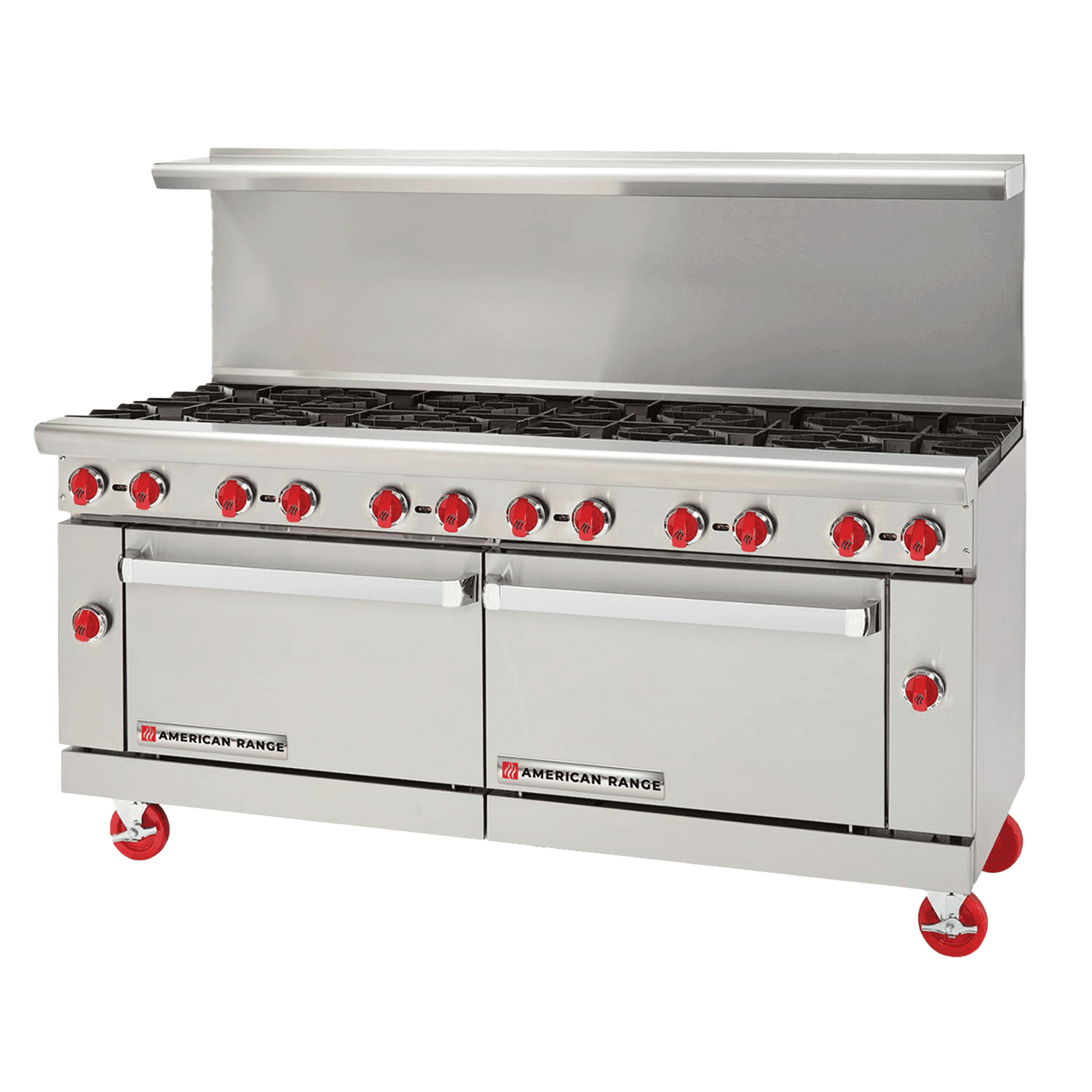
This guide covers proper installation, daily operation, cleaning, and troubleshooting for American Range commercial ranges, griddles, broilers, and fryers. All steps are drawn from the manufacturer's owner's manuals.
Key takeaways
- Installation must be performed by a qualified, licensed gas fitter in accordance with local codes and the manufacturer's instructions.
- Always check gas connections with a soapy water solution, never an open flame.
- Season griddle plates before first use and after cleaning to maintain a non-stick surface.
- Refer to the troubleshooting table in your model's manual before calling for service.
- Use only genuine American Range factory parts for repairs.
Model series and manuals
The American Range cooking line in our list includes AR restaurant ranges and hot plates, ARSMG and ARSTG countertop griddles, ARSRB char-rock broilers, and AF floor fryers. Each product series is covered by a specific owner's manual that provides installation, operation, and maintenance instructions.
The AR ranges and hot plates are documented in Owner's Manual AR-4. Countertop griddles, including ARSMG and ARSTG models, are covered by Owner's Manual ARSMG-12. Countertop radiant broilers, such as the ARSRB series, are detailed in Owner's Manual ARSRB-12. The AF fryer series is addressed in Owner's Manual AF-50HE, which also covers models like AF25, AF25/25, AF35/40, AF35/50, AF50/25, AF75, and AFDS.
Before using any equipment, locate the rating plate on your unit. For ranges, it is inside the toe kick panel and on the rear panel; for countertop models, it is on the right side rear corner or right side of the unit. The rating plate lists the model, serial number, gas type, and burner BTU ratings, which are essential for proper identification and support.
Installation requirements
Installation must be performed by a qualified, licensed installer familiar with local codes. In the absence of local codes, the installation must conform to the National Fuel Gas Code ANSI Z223.1/NFPA 54, or the Natural Gas and Propane Installation Code CSA B149.1, as applicable. The installer must leave the manual with the operator for future reference.
All appliances require a 3/4" NPT gas inlet. The gas supply line must be at least the same size and must not be reduced. A manual shut-off valve and the supplied gas pressure regulator must be installed ahead of the appliance. The regulator is factory set to 5" W.C. for natural gas and 10" W.C. for propane, and it can withstand a maximum inlet pressure of 14" W.C. (1/2 PSI). If the supply pressure is greater than that, a step-down regulator is required, and an LPG tank must never be connected to the unit without one. The regulator has a flow arrow that must point downstream to the appliance, and the blue vent cap must not be removed.
Clearances vary by model. The radiant broiler manual's clearance table gives 0" to non-combustible walls and, to combustible walls, 12" at the rear and 8" at the sides for its ARRB and AERB models (18" for the ARKB). The AF fryer manual lists clearances of 0" sides, 0" rear, and 0" floor to non-combustible surfaces, and 6" sides, 6" rear, and 6" floor to combustible surfaces. The range and griddle manuals do not provide specific clearance dimensions but state that adequate clearances for servicing and proper operation must be planned, and the area must be kept free of combustible materials.
The standard gas-operated ranges, hot plates, griddles, and broilers do not require an electrical connection. The fryer manual states that the appliance must be wired and electrically grounded in accordance with local codes. For any gas-fired 120 VAC unit, proper ground and correct polarity are required. A qualified electrician should handle all electrical connections.
After installation, check all gas joints for leaks using a soapy water solution (one part soap to three parts water). Never use an open flame. If bubbling occurs, turn off the gas supply and call a licensed technician.
- Radiant broiler clearances (ARRB, AERB): non-combustible 0" rear and sides; combustible 12" rear, 8" sides.
- AF fryer clearances: non-combustible 0" sides, 0" rear, 0" floor; combustible 6" sides, 6" rear, 6" floor.
- Gas regulator settings: 5" W.C. (natural gas), 10" W.C. (propane); maximum inlet pressure 14" W.C. (1/2 PSI).
Daily operation and controls
Lighting instructions vary by equipment type. For AR ranges with open burners, griddles, or raised griddle-broilers: turn the pilot adjustment screw counterclockwise, light the standing pilot, and adjust the flame to approximately 1/4" high. Then turn on the gas valves to light the main burners. For the oven, turn the thermostat to OFF, wait five minutes, lift the kickplate to access the safety valve, push and hold the safety valve button, and repeatedly press the piezo ignition button until the pilot stays lit. Then set the thermostat to the desired temperature.
For gas-fired convection ranges, the appliance uses automatic spark ignition. Turn the manual gas supply valve to ON, press the power switch to COOK, and set the thermostat. The direct spark ignitor will light the burner. If the burner does not light, repeat the process from turning off the gas valve.
Countertop griddles and radiant broilers follow a similar pilot-lighting procedure. Turn off the service gas shut-off valve and all burner knobs, then turn all pilot valve adjustment screws clockwise to OFF. Wait five minutes, turn on the service gas shut-off valve, and individually light each pilot by turning its adjustment screw counterclockwise, adjusting the flame to 1/4". To light a burner, push in and turn the corresponding knob counterclockwise. If ignition fails, turn the knob to OFF, wait five minutes, and try again.
For AF fryers, the owner's manual provides detailed lighting and temperature-setting steps. Always ensure the pilot is lit before attempting to operate the main burners. Never stand with your face close to the combustion chamber when lighting any appliance.
Cleaning and routine care
Proper cleaning extends equipment life and prevents food contamination. For countertop griddles (ARSMG, ARSTG, and similar models), the manual provides specific daily steps. First, season the griddle plate by pouring a small amount of cooking oil (about 1 oz. per square foot) over the surface, spreading it with a cloth to create a thin film, and wiping off excess. Turn the burner on very low and allow the oil to burn off; repeat this three times before regular use.
After cooking, remove and empty the grease pan, clean it thoroughly, and replace it. Clean the griddle plate with warm, soapy water or a mixture of half vinegar and half club soda. Rinse with warm water, then turn the griddle on and rinse again with warm water to boil out any soap residue at the edges. Finally, repeat the seasoning process.
Important precautions: never place ice or cold water on a hot griddle, as this can cause irreparable damage to the plate. Do not use chemicals or acidic cleansers on the griddle plate, because they may seep into the edges and contaminate food when reheated. Avoid overheating the griddle; turn it down or off during idle periods.
On the ranges, the AR manual's daily routine for open-top burners is to clean the cast iron grates with a mild soap and water solution, rinse and dry them, and apply cooking oil before putting them back; grates that are not seasoned after each cleaning will rust. Ovens are cooled, wiped out and their racks washed daily, with the rear flue way checked periodically. Stainless steel is wiped with hot soapy water during the day and a stainless steel liquid cleaner at the end of it, never with steel wool, abrasive cloths, cleansers or powders; soak encrusted material in hot water and lift it with a wood or nylon scraper.
The radiant broiler manual says to scrape the top grates with a wire brush during broiling, soak them overnight in commercial grill cleaner if needed, then rinse with hot water, dry and oil them; the cast iron radiants are washed with soap and water, dried and oiled, and the grease pan is emptied and cleaned. Never cover the broiler with pans to burn it off, which can warp its components, and never pressure wash any part of it. Preheat the broiler for 15 to 20 minutes before use.
For the AF fryers, the manual's boil-out uses boil-out solution only, never acidic cleaners: drain the cooled oil into a filter pan or steel container, flush out the sediment, fill the vessel with boil-out solution and water, then drain, scrub and rinse. Do not drain the solution into a filtration or disposal unit, remove all water before refilling with oil, never dry fire the fryer or rinse a hot tank with cold water, and liquefy solid shortening before it goes in the tank.
- Season griddle: apply thin oil film, heat on low until oil burns off; repeat three times.
- Daily griddle cleaning: empty grease pan, wash with warm soapy water or vinegar/club soda mix, rinse, boil out soap residue, re-season.
- Do not use ice, cold water, chemicals, or acidic cleansers on a hot griddle plate.
Troubleshooting
The broiler manual's troubleshooting guide pairs each symptom with its likely cause. Uneven heating or burning at the sides points to burner valves that need adjusting, fluctuating gas pressure or an improperly adjusted burner; too much top heat to valves set too high, faulty ventilation or overrated gas pressure; uneven heat front to back to an appliance that is not level front to back.
Pilot outage comes from a pilot flame set too low, an obstruction in the pilot orifice or low gas pressure. Yellow burner flames call for opening the burner shutters until the flames are blue, lifting flames for closing them until the flames touch the burner, and fluctuating gas pressure for checking the regulator vent for a clog. Valve and burner adjustments and anything inside the controls belong to a qualified service technician; turn off the gas supply and call one if these checks do not settle it.
Service and support
Service must be performed by qualified personnel who are knowledgeable with American Range products. Using any part other than genuine American Range factory supplied parts relieves the manufacturer of all liability.
For service, contact American Range's authorized service network. Do not attempt to repair gas valves, thermostats, or electrical components yourself. If you have questions about a specific model, ask Norpex for assistance in locating the correct manual or identifying the appropriate service contact.
Keep the owner's manual and rating plate information accessible for any service calls. The rating plate provides the model and serial number, which are required when requesting support.
Common questions
What type of gas does my American Range appliance use?
- Check the rating plate on your unit. It specifies natural gas or liquid propane. The appliance must be connected only to the gas type indicated on the plate.
How do I season a new griddle?
- Pour a small amount of cooking oil (about 1 oz. per square foot) over the surface, spread it into a thin film with a cloth, and wipe off excess. Turn the burner on very low and let the oil burn off. Repeat this process three times before first use.
What should I do if I smell gas?
- Do not try to light any appliance, touch electrical switches, or use a phone in the building. Immediately call your gas company from a neighbour's phone and follow their instructions. If you cannot reach them, call the fire department.
Can I install the equipment myself?
- No. Installation must be performed by a qualified, licensed installer in accordance with local codes and the manufacturer's instructions. Improper installation can cause property damage, injury, or death.
How do I clean the radiant broiler?
- Scrape the top grates with a wire brush while broiling; the grates can soak overnight in commercial grill cleaner and are then rinsed, dried and oiled. Wash the cast iron radiants with soap and water, dry and oil them, and empty the grease pan. Never cover the broiler to burn it off or pressure wash it.